
Notice who, in most groups of friends, family, or coworkers, ends up deciding where everyone eats. It’s rarely the person with the strongest opinion about food. It’s usually whoever is most willing to simply say something, while everyone else who actually had a preference quietly let it go rather than risk being the one who complicated things. Multiply that small moment by every decision in a life — which project to take on, what time to leave a gathering, whether a comment landed wrong — and a pattern starts to surface: the people who end up shaping outcomes are not necessarily the ones who want something most. They’re the ones willing to say it out loud.
That gap between wanting and saying is where most assertiveness work actually happens. It’s tempting to think the goal is wanting more, or wanting more confidently. Usually the want was already there, fully formed, well before the moment it needed to be spoken — and the actual obstacle was never the wanting at all. Most advice on how to be assertive treats it as a script to memorize, when the harder, more durable shift happens somewhere upstream of any specific sentence.
Assertiveness Is Not the Same as Confidence
It’s easy to assume that assertive people are simply more confident, and that confidence is either present or absent, fixed early, mostly out of reach. That framing makes the gap between where someone is and where they want to be feel much wider than it actually is.
Assertiveness is closer to a skill than a trait — a set of behaviors that can be learned independent of how confident someone feels in the moment. A person can feel uncertain internally and still state a boundary clearly. The feeling and the behavior are more separable than they appear from the inside, which matters, because most people wait to feel confident before they act, and the feeling often arrives only after enough acting.
Why Saying What You Want Can Feel Disproportionately Hard
Brittany Speed and colleagues, in a 2018 review for Clinical Psychology: Science and Practice, describe assertiveness as a skill that touches far more than any single conversation — treatment research has found that building assertiveness improves general self-esteem, self-concept, and a person’s sense of control over their own circumstances. That connection runs both directions. Difficulty being direct rarely sits in isolation; it tends to travel alongside a quieter belief that one’s own preferences are slightly less valid than everyone else’s, or slightly more likely to cause harm if stated plainly.
That belief usually has a history. Somewhere along the way, directness got coded as risky — as something that strained a relationship, disappointed someone whose approval mattered, or simply wasn’t who a person was supposed to be. The avoidance that followed was not a character flaw. It was a reasonable adaptation to whatever the actual cost of speaking up used to be. The trouble is that adaptations outlive the conditions that created them, and a strategy that once kept things safe can quietly start keeping a person small.
What Assertive Communication Is Actually Doing
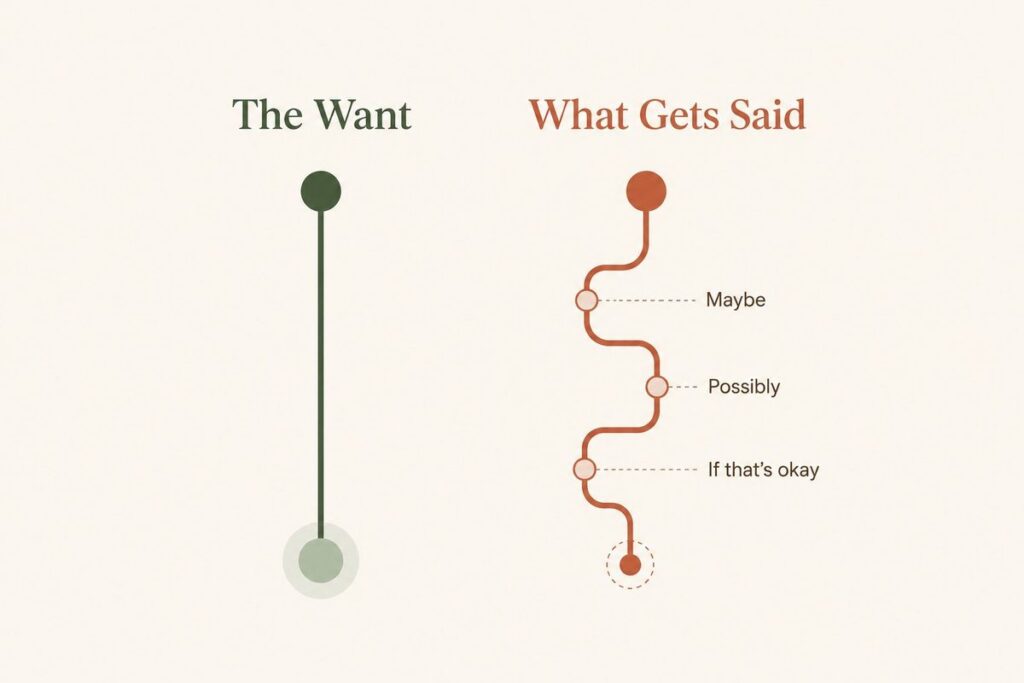
Assertive communication is often described by what it isn’t — not aggressive, not passive, not passive-aggressive — which is accurate but not especially useful on its own. What it’s actually doing is locating a specific, narrow target: stating a want, a limit, or a piece of information clearly enough that the other person can respond to it, without either inflating it into a demand or shrinking it into a suggestion.
That target is narrower than it sounds. Most unassertive language isn’t unclear because the person doesn’t know what they want — it’s unclear because the sentence has been pre-negotiated down before it ever left the room. “Maybe we could possibly look at, I don’t know, doing it a little differently sometime?” carries an entire want, but it’s been wrapped in so much cushioning that the listener has to do the work of unpacking it. Assertive language removes the cushioning without removing the care.
Building the Skill Without Becoming Someone Else
One of the more common fears about learning to be more assertive is that it requires becoming a different, harder version of oneself — trading warmth for bluntness. That trade isn’t actually necessary, and most lasting change in this area doesn’t look like a personality transplant. It looks like smaller, specific moves practiced enough times that they stop requiring a run-up.
A few of those moves tend to matter more than people expect. Naming the want plainly, before the qualifiers — “I’d like to handle it this way” rather than burying the want in the fourth clause of a sentence. Letting a request stand without immediately overexplaining or apologizing for it, since the apology often undercuts the request more than any pushback would. And treating the other person’s reaction, whatever it is, as their material to process rather than a verdict that needs to be managed in advance. Each of these is learnable in isolation, which is part of why assertiveness training has held up as well as it has — it doesn’t require an overhaul, just repeated practice with a narrower set of moves than most people assume.
Why the First Few Attempts Often Feel Worse, Not Better
Something predictable happens when someone who has been quietly accommodating for years starts being more direct: the people around them notice, and not always warmly. A request that used to come wrapped in three apologies now arrives plainly, and the absence of all that softening can read, briefly, as coldness — even though nothing about the underlying relationship has actually changed.
This is often where the work intersects with everyday stress and pressure at work, since workplaces are frequently where unassertive patterns get rewarded the most — the person who never pushes back tends to get handed more, not less. And for people whose unassertiveness is entangled with anxiety more broadly, the discomfort of that initial pushback can resemble the same physiological signals worth recognizing in anxiety recovery — a racing heart before a hard conversation isn’t evidence that the conversation was a mistake, it’s evidence that the nervous system is responding to something unfamiliar.
The discomfort tends to be front-loaded. It is usually most intense in the first several attempts and noticeably quieter by the tenth, not because the stakes have changed, but because the body has started to register that directness doesn’t reliably produce the catastrophe it was bracing for.
What This Looks Like in Therapy
Assertiveness rarely arrives in individual therapy as the presenting concern. It tends to surface underneath something else — a pattern of resentment in a relationship, a sense of being overlooked at work, a vague exhaustion that doesn’t have an obvious cause. Sean Orpen, MS, LMFT-S, CST-S, works with individuals in Seattle and the Eastside on exactly this kind of pattern: not the single difficult conversation, but the underlying belief system that made the conversation feel so much larger than it needed to be.
The work itself tends to be less about scripts and more about noticing — catching the moment a want gets edited down before it’s spoken, and getting curious about what that edit was protecting against. Scripts can help in the short term. The more durable shift comes from understanding the specific shape of what made directness feel unsafe in the first place, and finding out, often to some surprise, how much of that old calculation no longer applies.
Frequently Asked Questions
Is learning how to be assertive something you’re born with, or can it be taught?
It can be learned, and the evidence for this is fairly substantial. Decades of treatment outcome research have found that structured assertiveness training increases assertive behavior across very different populations, which suggests it functions more like a skill set than a fixed trait. The starting point varies by person, but the capacity to build the skill doesn’t appear to be reserved for people who were naturally outspoken to begin with.
How is assertive communication different from just being blunt?
Bluntness usually centers the speaker’s convenience — saying whatever is true without much attention to how it lands. Assertive communication centers clarity without sacrificing care: the want or limit is stated plainly, but the delivery still accounts for the fact that another person is receiving it. The difference often comes down to whether the other person’s response was considered at all, not whether the statement itself was direct.
Why does being assertive sometimes feel more exhausting than just going along with things?
In the short term, accommodation is almost always less effortful — it requires no negotiation, no risk of friction, no tolerance for an uncertain reaction. Assertiveness asks for more upfront energy because it involves actually metabolizing the possibility that someone won’t like the answer. The trade is that accommodation’s cost compounds quietly over time, while assertiveness’s cost is mostly concentrated in the moment itself.
What if being assertive damages a relationship that depends on you being easy to get along with?
This concern is common and usually overestimates the actual risk. Relationships that depend entirely on one person’s constant accommodation tend to be more fragile than they appear, since they’re built on a version of that person rather than the person themselves. A relationship that can’t tolerate a clearly stated want is offering information worth having, even if that information is uncomfortable. Most relationships, including the ones that matter most, can absorb far more directness than the anxious anticipation suggests.
How long does it typically take to feel less anxious about being direct?
There’s no fixed timeline, but the pattern tends to be front-loaded discomfort that eases with repetition rather than a single threshold that gets crossed. Most people notice the sharpest anxiety in the earliest attempts, with each subsequent instance requiring less internal preparation. The nervous system is, in effect, collecting evidence that directness doesn’t produce the outcome it was bracing for, and that evidence accumulates faster than most people expect.
References
American Psychological Association. (2023). Assertiveness. APA Dictionary of Psychology. https://dictionary.apa.org/assertiveness
Speed, B. C., Goldstein, B. L., & Goldfried, M. R. (2018). Assertiveness training: A forgotten evidence-based treatment. Clinical Psychology: Science and Practice, 25(1), 1–20. https://www.stonybrook.edu/commcms/psychology/_pdfs/faculty/Speed_et_al-2017-Clinical_Psychology__Science_and_Practice.pdf
Sean Orpen, MS, LMFT-S, CST-S, works with individuals in Seattle and the Eastside on the patterns underneath unassertiveness — not the single hard conversation, but the belief system that made it feel so much larger than it needed to be.