
How do you handle stress and work under pressure? Most people answer that question with a list of things they’re supposed to do — breathe deeper, sleep more, meditate. Fewer people stop to ask what’s actually happening in the body when work pressure builds, or why those familiar tips so often fail to stick. Stress isn’t a character flaw or a productivity problem. It’s a nervous system doing exactly what it was built to do, often with too little rest between rounds.
This isn’t a list of hacks. It’s a way of understanding what’s happening under pressure, and a handful of moves that hold up in a real week, not just a calm one.
What the Body Is Actually Doing
A tight chest before a meeting. A clenched jaw during a long commute. Racing thoughts at 11pm replaying a conversation that’s already over. None of that is weakness — it’s protection. The nervous system is reading signals (deadlines, expectations, an overloaded calendar) and responding the way it’s wired to respond. Stress shows up physically, mentally, and behaviorally: snapping at the people closest to you, scrolling instead of starting, saying yes when every part of you wants to say no.
The body isn’t betraying anyone here. It’s working with incomplete information. Learning how to handle pressure at work often starts with offering the body different information — safety, rhythm, and small moments of real choice — rather than trying to override the signal altogether.
Three Loads, One Nervous System
Picture three overlapping circles. Life-load: finances, health, the errands that pile up quietly. Work-load: deadlines, expectations, the blurred edges of a schedule that never fully turns off. Relationship-load: the emotional labor of staying connected to the people who matter, even when there’s nothing left to give. When all three climb at once, margin disappears — and a person without margin reacts instead of responds.
The goal isn’t to eliminate stress. Stress is information, and some of it is useful. The actual work is restoring small pockets of margin so there’s room to think before reacting.

Calm First, Then Solve
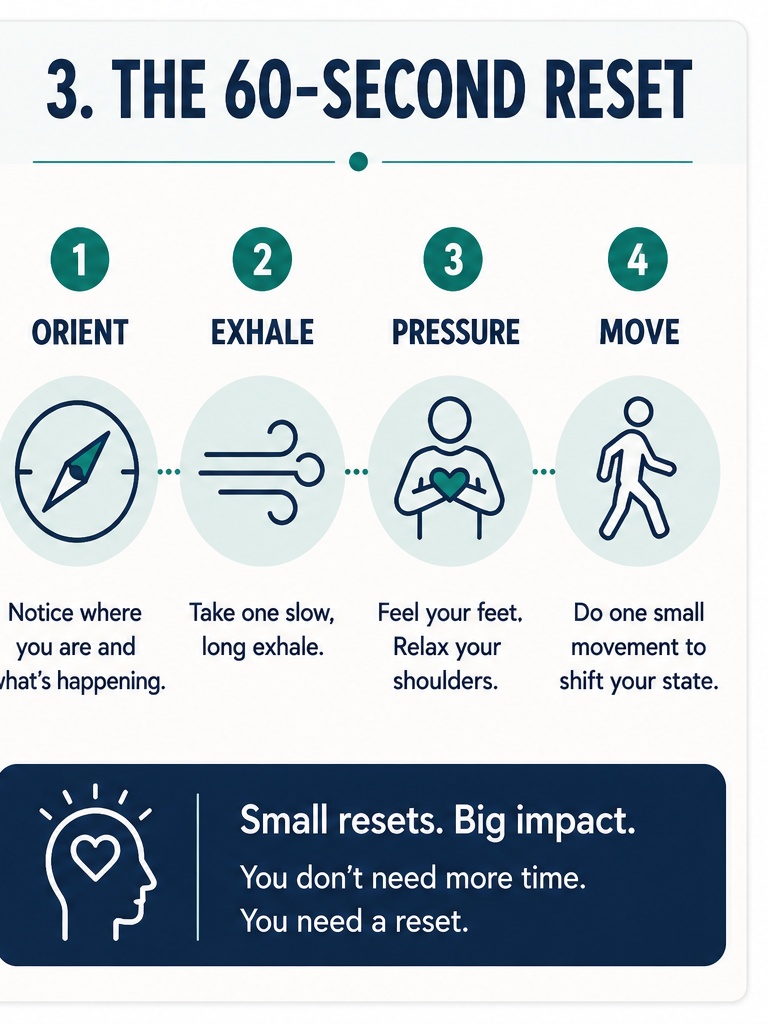
Decisions made from a flooded body are rarely good decisions. Before a hard conversation, between back-to-back meetings, or right after a tense exchange, a 60 to 90 second reset changes what’s available mentally.
A few that hold up under real pressure: orienting (naming five things in the room, four sounds, three physical sensations — telling the body this moment is survivable), a longer exhale (in for four, out for six to eight, shoulders dropping on the way down), or simple micro-movement (rolling the shoulders, unclenching the jaw, a few seconds of stretching). None of these solve the problem on the table. They make it possible to think clearly enough to solve it.
Boundaries Are the Quiet Fix for Workplace Pressure
A lot of work stress isn’t really about the workload. It’s about unspoken agreements nobody actually chose — the assumption that every request gets answered immediately, that saying no requires an essay-length justification, that being available constantly is the same as being good at the job.
Explicit boundaries return energy to where it’s actually needed. At work, a useful script: “I can give this ten minutes now, or thirty tomorrow at two — which is more useful?” Triage incoming requests into now, later, and not mine. When the calendar is full, it’s full; offering an alternative is not the same as failing to help.
This is one of the places stress management for working professionals quietly overlaps with executive coaching and therapy — the people most likely to absorb every incoming request are often the ones with the least permission, internally, to say no.
Lowering the Heat in Hard Conversations
Pressure makes language fast and absolute. Slowing down and getting specific does more for a tense exchange than almost anything else. Naming impact instead of accusation — “When this lands at 5pm on a Friday, I don’t have room to do it well” — moves a conversation forward instead of putting someone on the defensive. A mid-conversation flag like “I’m getting flooded, can we pause for a breath?” gives both people permission to slow down without anyone losing face.
Workdays With Less Friction
A lot of ambient stress isn’t about any one hard task — it’s about a hundred small frictions stacking up. Declining meetings without an agenda. Defaulting to shorter blocks so natural breaks exist. Sorting an inbox into action, waiting, and read-later so the brain sees a container instead of chaos. Ending a task out loud — even just internally — “parking this until tomorrow morning” — and actually closing the laptop. Transitions matter more than most people give them credit for.
A Quick Stress Triage
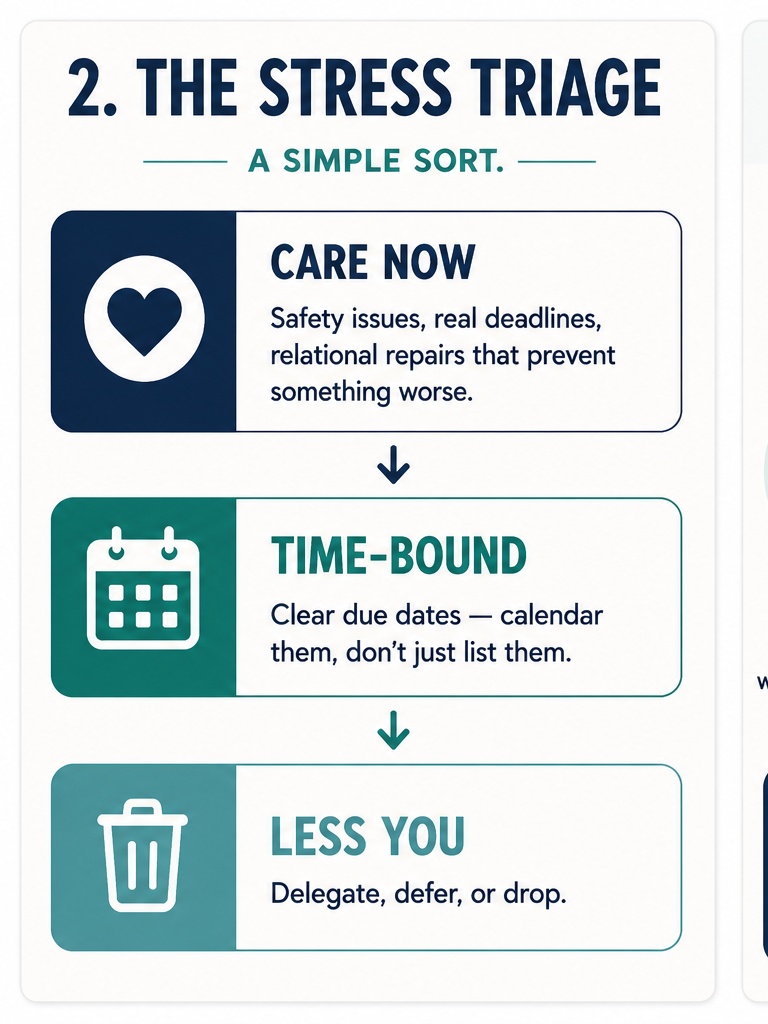
When everything feels urgent, not everything actually is. A simple sort: care now (safety issues, real deadlines, relational repairs that prevent something worse), time-bound (clear due dates — calendar them, don’t just list them), and less-you (delegate, defer, or drop). If something has sat on a list for three weeks and no one’s been harmed by its absence, it’s probably safe to let go.
It’s worth pausing here on what counts as a signal worth listening to. The signs work is too stressful aren’t always dramatic — they’re often quieter than that: dreading the inbox before it’s even open, a weekend that never quite feels like a break, irritability that shows up before the workday does. None of these mean something is broken. They mean the load has outpaced the recovery, and the triage above is one way to start closing that gap.
This isn’t avoidance. It’s choosing impact deliberately instead of reacting to whatever feels loudest in the moment.
The Basics That Actually Move the Needle
Sleep, food, connection, and meaning outperform most stress hacks combined. The thirty minutes before bed set tomorrow’s baseline more than almost anything else in the day. Two minutes of real, undistracted connection with someone who matters often does more than thirty minutes of half-present time in the same room. And naming one thing each day that mattered — however small — gives pressure a context the nervous system can actually hold.
Stress under pressure isn’t something to eliminate. It’s something to work with — understood, not overridden. If the pressure has been building for a while and the usual advice isn’t landing, that’s often a sign the pattern underneath deserves a closer look, not more willpower. Individual therapy is where that closer look happens — at a pace that fits an already full life, not one more thing to squeeze in. For pressure that’s tied specifically to leadership, ownership, or the weight of being the one everyone else looks to, executive-focused work is built around that particular kind of load. The grief work involved in family estrangement often requires the same kind of deliberate attention – if that’s part of what you’re navigating, this piece on coping with family estrangement is a useful place to start.
FAQ
How do you handle stress and work under pressure when there’s no time to slow down?
Even fifteen to ninety seconds of body-based regulation — a longer exhale, naming what’s in the room — changes what’s available mentally before a decision gets made. The goal isn’t a long pause; it’s a short, repeatable one.
What’s the difference between normal work stress and burnout?
Stress tends to come and go with the workload. Burnout is what happens when the stress never fully resolves — exhaustion becomes the baseline rather than a temporary state, and even rest stops feeling restorative.
How do you set boundaries at work without seeming difficult?
Specificity helps. Offering an alternative (“I can do this Thursday instead of today”) reads as collaborative, while a flat no without context often reads as resistance — even when the underlying answer is the same.
Is stress management something therapy actually helps with, or is it just willpower?
Chronic work pressure is rarely a willpower problem. It’s often a pattern — in how requests get absorbed, how boundaries get avoided, how the nervous system has learned to stay on alert. Therapy works with that pattern directly, which willpower alone usually can’t touch.
Sean Orpen, MS, LMFT-S, CST-S, works with individuals and couples in Seattle and the Eastside on stress, burnout, and the patterns that keep both running longer than they should.
References
American Psychological Association. (2023, March 8). Stress effects on the body. https://www.apa.org/topics/stress/body