
AA little nervous laughter. A question you have practiced in your head a dozen times. The hope that they will meet you with curiosity instead of a raised eyebrow. That is usually what it looks like when someone starts thinking seriously about introducing your partner to kink, quieter and gentler than the word itself sounds.
If part of what brought you here is a broader search for how to spice up a relationship, kink is one path among several, and a good one, as long as it is built on consent and care rather than pressure. It is a conversation that comes up often in my sex therapy practice in Seattle, and this guide offers a grounded, warm way to start it and explore together, at whatever pace feels right for both of you.
Start With Your Why
Before you bring your partner into anything new, spend a little time with yourself first.
- What draws you to this? Sensation, play, power exchange, novelty, closeness, stress relief.
- What feelings are you hoping for? Safety, surrender, being chosen, being in charge, laughter, intensity.
- What are your non-negotiables? Hard limits, words that do not work for you, areas that stay off-limits.
- What are your fears? Rejection, being judged, doing it wrong, losing control.
Once you know the meaning underneath the behavior, you can share it in a way that feels human, not like a list of demands.
Build Safety in Your Body First
Calm is not something you can think your way into. You have to show your nervous system, not just tell it.
- Orienting: Slowly scan the room. Name five things you see, four you hear, three you feel. Let your body register: we are okay right now.
- Breath with weight: One hand on your chest, one on your belly, a pillow across your lap for gentle pressure. Lengthen your exhales.
- Sixty-second pleasure check-ins: A warm mug, soft fabric, sunlight on your face. Notice the temperature and texture. Remind yourself: this is allowed.
The more your body links exploration with safety, the easier the conversation gets, and eventually, the easier trying it becomes too. If performance pressure is part of what keeps your body on alert, my post on sexual anxiety and erectile dysfunction goes deeper into getting out of your head and back into sensation.
Choose the Moment, Keep It Low Stakes
Pick a time when neither of you is rushed or on edge, not right after an argument and not mid-sex. A short, clothed, pressure-free chat of ten to fifteen minutes is plenty. You can always come back to it.
Something like this works well as an opener: “I have been curious about adding a little structure and play to our sex life. Nothing urgent. I would love to share a bit, hear your thoughts, and see if anything sparks curiosity for you too.”
The tone you are setting matters more than the words: curious, collaborative, kind.
Lead With Meaning, Then Name a Behavior
Lead with implements or labels and your partner might picture something that has nothing to do with you. Start with feeling and meaning instead, then offer one small, specific example.
Feeling: “I am craving moments where I do not have to make decisions, just to let go and be guided.” Behavior: “Maybe you set the pace and gently hold my wrists for a minute, or give simple, warm directions.”
Or feeling: “I want moments where I feel unmistakably chosen and in charge.” Behavior: “Maybe I pick the music, give clear instructions, and you focus on receiving for five minutes.”
Small and specific beats big and vague every time.
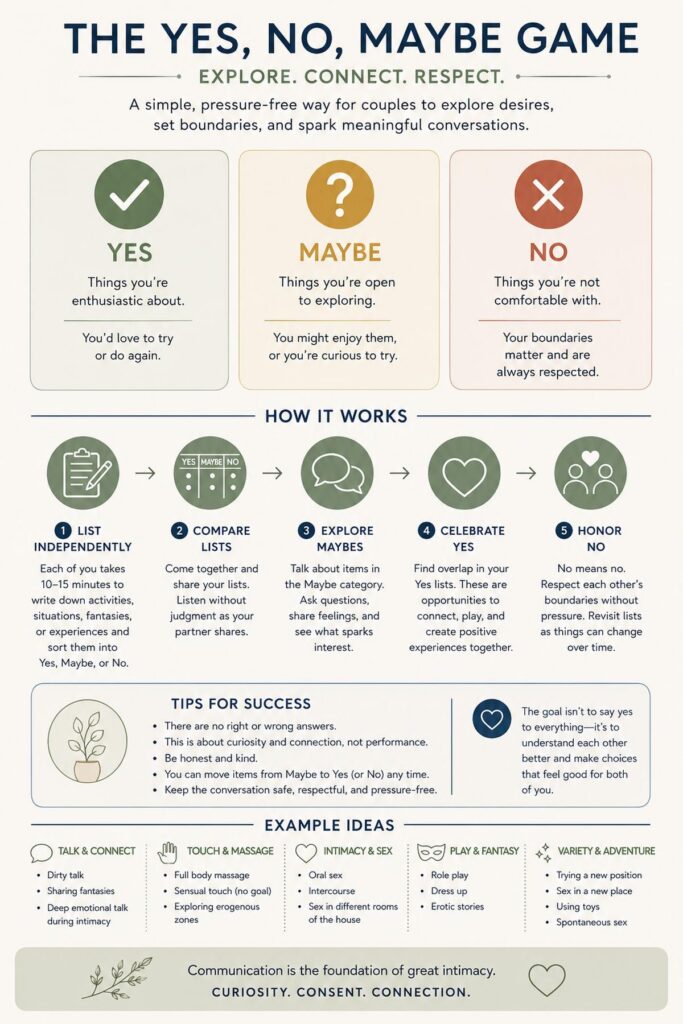
A Shared Map: Yes, No, and Maybe for Right Now
Build a living list together, in three columns: yes for right now, no with no explanation required, and maybe for right now for anything that needs more information or a smaller first step. A yes/no/maybe checklist gives you a running start if you would rather react to a list than build one from scratch, and the Yes No Maybe app works well if you would rather do this on your phones, answering privately and only revealing where you overlap. Revisit it monthly. Desire shifts over time, and consent stays alive when you both keep checking in.
If one of you feels more hesitant, let the slower partner set the pace and the eager partner set the tone: patient, playful, zero pressure. Both nervous systems get respected that way.
Negotiate Like a Team
A simple structure helps carry the conversation: intentions (“I am hoping for more play and closeness, not a performance”), boundaries (“no surprises, if I freeze we stop”), and signals. Agree on a safe word and a nonverbal signal, like a double tap, and use them before things get overwhelming, not after the fact.
Researchers who study consent within kink and non-monogamous communities point to clear, ongoing, and revocable agreement, spoken out loud rather than assumed, as the line between healthy exploration and harm. That is the whole spirit of it, not because kink is inherently risky, but because intensity deserves care and choice.
Keep the First Round of Kink Play Very Small
Pick one:
- Sensory play, eyes closed. One partner closes their eyes for two minutes while the other offers slow touch to the forearms or shoulders, non-sexual areas only. Notice the breath. Check in.
- A power cue, no props. For three minutes, one partner gives simple directions, like “turn around” or “breathe slow.” Then switch or debrief.
- Constraint without restraint. The receptive partner loosely holds their own wrists while the other kisses their neck or shoulder for a minute or two, the symbolism of being held, no actual tying.
This is about building a shared language of safety and kink play together, not proving anything to each other.
Aftercare Is Part of the Plan
Aftercare matters even for gentle, low-key experiences, not only intense ones. It is how you land together afterward: water and a blanket, a few quiet minutes of cuddling, naming one moment you appreciated, a warm shower, or checking in again later that night. Work looking at consensual power exchange has found that these small moments of care, woven through before, during, and after, are part of why couples so often describe feeling closer afterward rather than more distant.
Common Worries, Gentle Responses
Will you think less of me if I say no? No is healthy. A thriving erotic life needs a trusted no as much as it needs a clear yes.
What if I freeze or get triggered? That is information, not failure. Pause, breathe, reconnect. If touch feels complicated for either of you, trauma-informed approaches to touch-based exercises that slow the pace and track the nervous system can widen what feels possible over time.
Am I kinky enough? There is no leaderboard here. Recent research on BDSM interest describes these preferences as part of the ordinary range of human sexuality, not evidence that something is wrong. Eye contact can feel as vulnerable to one person as rope does to another.
What if we do not like the same things? Picture a Venn diagram: find the overlap, respect the edges, get creative in the shared slice.
Language That Helps
“I am curious about” opens a door that “I want you to” tends to close. “For two minutes” keeps the window small and bodies calm. “Right now” reminds you both that a no or a maybe can shift later. “I felt ___ when ___” shares your own experience instead of assigning blame.
When It Helps to Bring in Support
Plenty of couples work through all of this on their own. Others find it easier alongside a guide, especially when past experiences make trust or vulnerability harder to access. BDSM therapy with a kink-aware clinician can help build the specific communication skills this kind of exploration asks for, without judgment about what you are curious about. For couples in Seattle or on the Eastside, that support is available through my sex therapy practice, where sessions are shaped around consent, curiosity, and your actual relationship rather than a borrowed script.
Sean Orpen, MS, LMFT-S, CST-S, is a certified sex therapist based in Seattle who works with couples navigating exactly these conversations.
A Gentle Close
Introducing your partner to kink is not about becoming different people. It is about inviting more of who you already are, your playfulness, your longing to be chosen, your desire to guide or let go, into the relationship you already have. If you are still weighing other ideas for how to spice up a relationship beyond kink specifically, my post on rediscovering playfulness in intimacy offers a gentler starting point.
Start tiny. Keep talking. Celebrate the small wins. Let your pace be the proof that you care for each other as much as you crave each other.
If you try any of this and want help shaping the next step, you are welcome to reach out through my sex therapy practice. I will go slowly, with consent at the center, and build something that feels like the two of you.
Frequently Asked Questions
How do I bring up kink with my partner for the first time?
Choose a calm, low-pressure moment away from the bedroom. Lead with what the interest means to you emotionally before naming a specific activity, and frame it as curiosity rather than a request.
Is it normal to be curious about kink?
Yes. Curiosity about power exchange, sensation, or structure in a sex life is a normal and common part of human sexuality, not a sign that something is wrong with you or your relationship.
What if my partner does not share my interest in kink play?
Look for the overlap between what excites you and what feels comfortable for them, and treat anything outside that overlap as a hard no rather than something to push past.
Do we need a therapist to explore kink safely?
No, many couples work through this on their own with open communication. A kink-aware therapist can help if past experiences, trust issues, or communication patterns make these conversations harder to have alone.
References
Larva, M. A., & Rantala, M. J. (2024). An evolutionary psychological approach toward BDSM interest and behavior. *Archives of Sexual Behavior, 53*(6), 2253-2267. https://link.springer.com/article/10.1007/s10508-024-02881-x
De Neef, N., Coppens, V., Huys, W., & Morrens, M. (2019). Bondage-discipline, dominance-submission and sadomasochism (BDSM) from an integrative biopsychosocial perspective: A systematic review. *Sexual Medicine, 7*(2), 129-144. https://www.sciencedirect.com/science/article/pii/S2050116119300285
Sheff, E. (2021, August 25). Defining consent in BDSM and multiple-partner relationships. *Psychology Today*. https://www.psychologytoday.com/us/blog/the-polyamorists-next-door/202108/defining-consent-in-bdsm-and-multiple-partner-relationships
Gewirtz-Meydan, A. (2025). Adapting sensate focus for sexual abuse survivors: A trauma-informed approach to reclaiming body and intimacy. *Sexual and Relationship Therapy*. https://www.tandfonline.com/doi/full/10.1080/26929953.2025.2479548
Tools Mentioned in This Post
Sex With Emily. Yes, no, maybe checklist. https://sexwithemily.com/swe-guides/SWE_YesNoMaybeChecklist.pdf
Yes No Maybe. Explore your desires, together. https://www.yes-no-maybe.app/en