
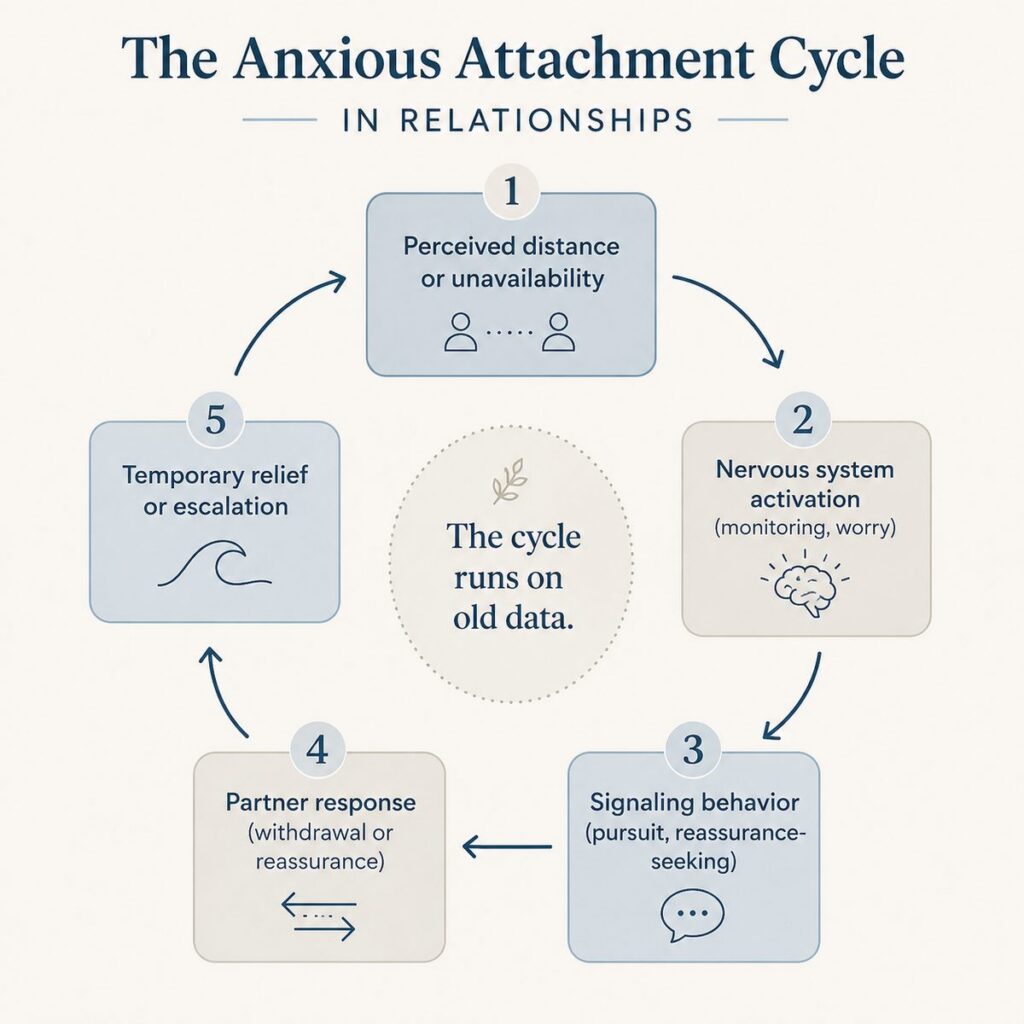
The text goes unanswered for forty-five minutes, and something in the body shifts before the mind has named what is happening. There is a tightening, a rehearsal of possible explanations, a monitoring of the phone that is hard to stop even when you know, rationally, that there is nothing to be concerned about. By the time the reply comes — apologetic, ordinary, fine — the relief is real, but so is the faint embarrassment about what just happened internally. This is what anxious attachment style in relationships often feels like from the inside: a sensitivity calibrated for a threat that is not currently present, running on a nervous system that learned its lesson somewhere else, at an earlier time.
What Anxious Attachment Actually Is
Attachment theory, developed by John Bowlby and expanded through the empirical research of Mary Ainsworth, proposes that human beings develop internal working models of relationships — templates formed through early caregiving experiences that shape how closeness, dependency, and separation are experienced in adult life. Anxious attachment — Ainsworth’s original term was “ambivalent” — emerges from caregiving environments that were inconsistent: close and attuned at some moments, unavailable or overwhelming at others. The infant’s response to this inconsistency is to amplify attachment behavior — to signal more insistently, to monitor the caregiver more closely, to resist separation more intensely. This strategy makes developmental sense. In adult relationships, it tends to create the very disconnection it is designed to prevent.
Research by Mikulincer and Shaver, synthesized in their foundational text Attachment in Adulthood, maps what they call “hyperactivating strategies” — the adult expression of the anxious infant’s amplified signaling. These include heightened vigilance to signs of partner unavailability, exaggerated emotional responses to perceived slights or distance, difficulty self-regulating in the absence of partner reassurance, and a tendency to interpret ambiguous signals as evidence of threat. None of these are character defects. They are the adult nervous system running an old attachment program in a new relational context.
What Anxious Attachment Style Looks Like in Relationships
In practice, anxious attachment style in relationships shows up differently depending on the person and the partnership. Some of the most common patterns include seeking reassurance more frequently than the reassurance helps, because the relief it provides is real but short-lived; difficulty tolerating periods of reduced contact without interpreting them as signs of diminishing interest; a tendency to read a partner’s emotional state as a signal about the relationship rather than about the partner’s separate internal life; and an escalation toward connection at the same moments the partner is most likely to need space, which can produce the classic anxious-avoidant dynamic.
There is also a quieter version that does not always get recognized as anxious attachment: the person who suppresses the monitoring and reassurance-seeking, presents as low-maintenance, and carries the activation internally. The anxiety is present; it has simply been trained not to be visible. This pattern tends to surface in particular moments — during periods of stress, when the relationship is under pressure, or when closeness begins to deepen and the old threat assessment activates.
For couples where one or both partners carry anxious attachment, couples therapy provides a structured way to understand the pattern without it becoming a recurring crisis. The goal is not to eliminate the attachment system’s sensitivity but to develop a different relationship with it — one where the activation can be named and communicated rather than enacted.
How to Deal With an Anxious Attachment Partner
Partners of people with anxious attachment often find themselves in a bind that tightens the more they try to resolve it: the more reassurance they provide, the more is needed; the more they pursue their own space, the more the anxious partner pursues connection. What gets called a “reassurance addiction” is actually a regulatory pattern — the anxious partner is using the other person’s presence and response to manage emotional states that they cannot yet manage independently.
The most useful thing a partner can do is not more reassurance, but a different quality of presence. Research by Johnson on emotionally focused therapy — specifically her concept of “A.R.E.” (Accessibility, Responsiveness, Engagement) — finds that what anxiously attached partners are most fundamentally seeking is not constant contact but the reliable experience of a partner who is genuinely reachable when it matters. A partner who is accessible and responsive in meaningful moments does more for the anxiously attached person’s nervous system than one who is in constant contact but emotionally unavailable within that contact.
This is difficult to calibrate without support, which is one reason that couples therapy is often productive even when the anxious attachment does not originate in the current relationship. The therapist helps both partners understand the cycle they are in, so the less anxiously attached partner stops experiencing the pursuit as irrational and the more anxiously attached partner stops experiencing the space-seeking as abandonment.
Anxious Attachment in Marriage: A Particular Pressure
Anxious attachment in marriage tends to intensify around three specific conditions: transitions (a new job, a move, a pregnancy, any change that reorganizes the relationship’s structure), periods of extended stress in either partner, and moments of genuine relational conflict that raise the specter of disconnection or departure. These are exactly the moments when both partners most need access to their own resources and each other’s — and when anxious attachment most reliably depletes both.
What makes anxious attachment in marriage particularly complex is the stakes. The internal cost of disconnection is higher in a long-term committed relationship than in earlier or less committed partnerships. The anxious attachment system is responding proportionally to what is genuinely at risk. This does not make the behavioral expressions of that anxiety functional — they often are not — but it does mean that treating the anxiety as irrational tends to increase rather than decrease it.
Individual therapy alongside couples work is often particularly valuable for people navigating anxious attachment in marriage. Individual therapy provides the space to develop internal regulation skills — the capacity to manage the activation without requiring the partner’s response — which reduces the burden on the relationship and makes couples work more productive. The two tracks reinforce each other rather than competing.
What Actually Shifts Anxious Attachment
Anxious attachment style is not fixed. This is one of the most important and underappreciated findings in attachment research. A landmark longitudinal study by Davila, Burge, and Hammen, published in the Journal of Personality and Social Psychology, tracked attachment security over time and found meaningful movement toward more secure functioning, particularly in the context of consistently safe relational experiences. Bowlby himself described the internal working model as “opa-flexible” — open to revision given sufficient evidence that the old model is no longer accurate.
What revises the model is not argument or insight alone. It is experience. A repeated, accumulated set of interactions in which the anticipated threat does not materialize — where reaching for connection produces genuine responsiveness rather than withdrawal or overwhelm, where expressing a need does not result in punishment or abandonment. These experiences gradually update the threat assessment the nervous system has been running, replacing the old template with something built from current data.
Therapy provides one context for this experience, particularly emotionally focused therapy, which creates explicit conditions for the kinds of responsiveness and accessibility that support the movement toward more secure functioning. A secure and attuned partnership provides another. Some people find that the combination of both — individual work to develop regulation skills and couples work to change the relational dynamic — produces the most durable shift.
Frequently Asked Questions About Anxious Attachment in Relationships
Is anxious attachment the same as being needy?
No, though they can look similar from the outside. Anxious attachment is a structural feature of how the attachment system is calibrated — the result of early relational experience, not a personality weakness. What gets called “neediness” is often the behavioral expression of an activated attachment system that has learned it needs to signal loudly to be heard. The underlying need — for genuine connection, for a partner who is reliably present — is not excessive. The strategy for meeting it often is.
Can someone with anxious attachment be in a healthy relationship?
Yes. Anxious attachment creates patterns that require attention and, usually, some deliberate work — but it does not preclude genuine intimacy or a satisfying partnership. Many people with anxious attachment are in healthy, committed relationships. What tends to make the difference is a combination of self-awareness about the pattern, a partner who responds with genuine availability rather than withdrawal or frustration, and often some therapeutic support. Couples therapy is particularly useful for creating the shared understanding that allows both partners to work with the pattern rather than against each other.
What if both partners have anxious attachment?
Two anxiously attached partners typically create a relationship that oscillates between intense closeness and mutual overwhelm. The reassurance that one partner needs is hard for the other to provide sustainably, because they need it too. This does not make the relationship impossible, but it does mean the work is more complex. Individual therapy for both partners, alongside couples work, tends to be the most productive configuration.
How does anxious attachment interact with avoidant attachment?
The anxious-avoidant pairing is extremely common — research suggests the two styles are drawn together partly because they confirm each other’s core beliefs about relationships. The anxiously attached partner’s pursuit activates the avoidantly attached partner’s withdrawal, which activates the anxious partner’s escalation, which intensifies the withdrawal. Understanding this cycle is one of the primary focuses of couples work in these pairings. The companion post on how to fix avoidant attachment covers the avoidant side of this dynamic.
When should someone with anxious attachment seek therapy in Seattle?
When the pattern is creating significant distress in the current relationship or has been a recurring feature across multiple relationships, therapy is worth considering. The same is true when the anxiety is affecting daily functioning: intrusive thoughts about the relationship, difficulty being present in other areas of life, or a sense that the monitoring and reassurance-seeking have become exhausting to manage. Reaching out is a reasonable first step for couples in Seattle and the Eastside navigating this together.
References
Ainsworth, M. D. S., Blehar, M. C., Waters, E., & Wall, S. (1978). Patterns of attachment: A psychological study of the strange situation. Erlbaum.
Johnson, S. M. (2008). Hold me tight: Seven conversations for a lifetime of love. Little, Brown.
Mikulincer, M., & Shaver, P. R. (2016). Attachment in adulthood: Structure, dynamics, and change (2nd ed.). Guilford Press.
Sean Orpen, MS, LMFT-S, CST-S, works with individuals and couples in Seattle and the Eastside on attachment patterns, relational dynamics, and the work of building something more secure. Reaching out is a reasonable next step.