
The person who pulls away when things get close is not, usually, someone who does not want closeness. That is the part that tends to be misread — by partners, and often by the avoidantly attached person themselves. What drives the withdrawal is not indifference but a particular kind of self-protection: a nervous system that learned, early, that depending on others was unreliable, costly, or both. The strategy that emerged — become self-sufficient, keep a degree of distance, manage internally rather than externally — was adaptive at the time. In an adult relationship that requires genuine emotional presence, it creates the disconnection the avoidant person is often quietly hoping to avoid.
What Avoidant Attachment Actually Is
In Ainsworth’s original classification of infant attachment patterns, the “avoidant” infant was notable for apparently calm behavior during parental separation and minimal emotional display upon reunion. Subsequent research showed that this apparent calm was physiologically expensive: these infants’ cortisol levels were elevated, suggesting significant stress that was simply not being expressed. The behavior was a suppression strategy, not an absence of need. Cassidy and Kobak’s research on what they termed “deactivating strategies” — published in what became the foundational Handbook of Attachment — mapped how this early suppression becomes an adult attachment style organized around minimizing attachment needs, downplaying the importance of relationships, and maintaining self-reliance as a core identity.
In adult relationships, dismissive avoidant attachment tends to look like: emotional unavailability during moments of partner distress, discomfort with expressed vulnerability in either direction, a tendency to intellectualize rather than feel, difficulty remaining present in conflict without withdrawing, and a sense that closeness begins to feel suffocating at a certain threshold. These are not character failures. They are the adult form of a strategy that once worked.
The Avoidant Partner: What the Withdrawal Is Really About
Partners of avoidantly attached people often describe a particular confusion: someone who is warm, capable, and even tender in ordinary life, but who becomes suddenly and completely unavailable the moment emotional demand increases. The withdrawal feels personal, and it is — but not in the way the partner typically assumes. It is not a statement about the partner’s worth or importance. It is an automatic response to a threat that the avoidant person’s nervous system registers when closeness crosses a certain threshold. Couples therapy helps both people understand this distinction clearly, which changes the dynamic significantly.
Mikulincer and Shaver’s research on the “threats to the attachment system” in avoidant adults identifies a specific trigger: situations that require vulnerability, dependency, or emotional exposure. Their work, summarized in Attachment in Adulthood, shows that avoidantly attached adults do not lack emotional responsiveness — they have developed a system for suppressing it. Under conditions of low stress, that suppression is relatively easy. Under conditions of high relational demand, it requires significantly more effort and eventually fails, often producing what looks to the partner like unexpected coldness or shutdown.
What Dismissive Avoidant Relationship Advice Usually Gets Wrong
The standard advice to avoidant partners — “just open up more,” “try to be more present,” “learn to express your feelings” — misses the structural nature of the pattern. This is not a behavioral deficit that can be corrected through intention alone. The deactivating strategies that produce withdrawal are not conscious choices; they are automatic responses running below the level of deliberate decision-making. Telling someone to simply “open up more” is roughly equivalent to telling someone to simply stop being startled by loud noises. The instruction makes sense in the abstract and is functionally unhelpful.
What does help is a combination of: understanding the historical origins of the pattern clearly enough to separate past from present, developing the capacity to tolerate emotional activation without immediately suppressing it, and accumulating relational experiences in which emotional exposure does not produce the outcomes the avoidant system anticipates. The last of these cannot be willed into existence; it depends on a relational context that provides genuine safety for vulnerability.
This is where couples therapy becomes structurally valuable. The therapist creates the conditions for moments of genuine emotional exposure in a context safe enough that the avoidant partner can remain present rather than withdraw. These in-session experiences — what emotionally focused therapy calls “enactments” — provide the corrective relational experience that updates the internal working model in a way that intellectual insight alone cannot.
How to Fix Avoidant Attachment: What the Process Looks Like
Fixing avoidant attachment is not an accurate frame, because it implies a final state of resolution that the work does not typically produce. What actually happens is more gradual: the deactivating strategies become less automatic, the threshold at which they activate shifts upward, and the avoidant person develops a growing capacity to tolerate closeness without the same degree of internal cost.
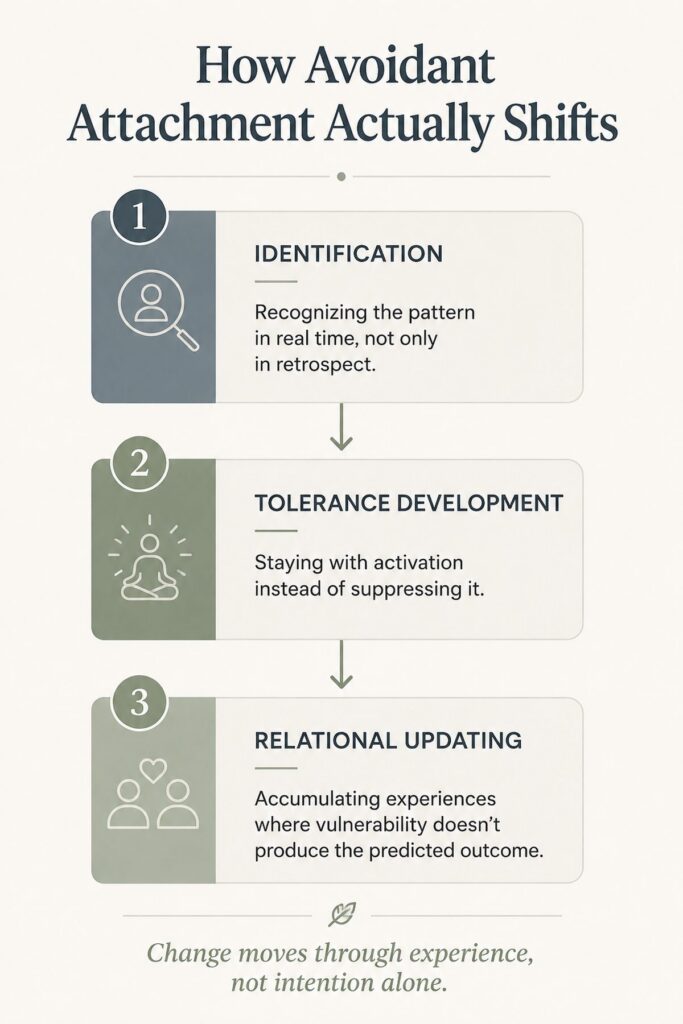
The work typically moves through several recognizable stages. The first is identification: understanding the pattern clearly enough to recognize it in real time, rather than only in retrospect. Many avoidantly attached people describe a significant gap between what is happening internally and what they are aware of in the moment. Therapy helps close that gap.
The second stage is tolerance development: building the capacity to remain with emotional activation — their own or a partner’s — without immediately suppressing it. This is often where individual therapy is particularly useful, because it provides a lower-stakes context for practicing emotional presence than the couples room can offer in the early stages.
The third stage is relational updating: the accumulation of experiences in which vulnerability does not produce the outcomes the old model predicted. This is where the couples work becomes central. A partner who responds to the avoidant person’s tentative emotional exposure with genuine attunement — rather than escalating demand or disappointed withdrawal — provides the evidence that the nervous system needs to begin revising its threat assessment.
For couples in Seattle navigating this pattern, couples therapy with someone who understands attachment dynamics is usually the most direct route. Individual therapy alongside the couples work tends to produce the most durable change.
The Anxious-Avoidant Dynamic: Why It Persists
Avoidant attachment and anxious attachment are drawn to each other with a regularity that researchers have noted across multiple studies. The pairing makes psychological sense: the avoidant person’s self-sufficiency and emotional containment feels like security to the anxiously attached partner; the anxiously attached partner’s expressiveness and pursuit of closeness feels initially like desirable warmth to the avoidant person. The dynamic that emerges from this combination — pursuit triggering withdrawal, withdrawal triggering escalated pursuit — is one of the most common and most painful patterns in couples therapy. The companion post on anxious attachment style in relationships covers the anxious side of this dynamic in depth.
What breaks the cycle is not one partner changing unilaterally, but both understanding the cycle they are in clearly enough to interrupt it. The pursuer learns to approach with less activation; the withdrawer learns to remain present long enough to signal availability before the pursuit escalates. Small changes in both directions can destabilize a cycle that has felt completely entrenched.
Frequently Asked Questions About Avoidant Attachment
Can avoidant attachment be fixed?
Avoidant attachment can be meaningfully shifted — the deactivating strategies become less automatic, the threshold at which they activate changes, and the capacity for genuine emotional presence in relationships increases. “Fixed” implies a finality that does not typically apply; this is more about developing new patterns than erasing old ones. The research on earned security — people who show secure attachment functioning despite insecure early histories — demonstrates clearly that significant change is possible.
What does an avoidant partner actually need in a relationship?
Paradoxically, avoidant partners need a degree of consistency and genuine availability that their behavior tends to push away. What they most need is a partner who can remain warm and present without escalating demand when the avoidant person withdraws — someone who communicates “I’m here, and I’m not going anywhere, and I’m not going to punish you for needing space.” This is difficult to sustain without understanding the pattern, which is partly why couples therapy is so useful for these pairings.
How is dismissive avoidant different from fearful avoidant?
Dismissive avoidant attachment is organized around self-sufficiency: the person genuinely believes they do not need close relationships, or minimizes how much they do. Fearful avoidant attachment — also called disorganized — is characterized by wanting closeness and fearing it simultaneously, often stemming from caregiving experiences that were frightening rather than simply inconsistent. The behavioral presentations can look similar from the outside, but the internal experience is different, and the therapeutic approach differs accordingly.
Is it worth staying with an avoidant partner?
This depends less on the attachment style itself than on the avoidant partner’s willingness to understand and work with the pattern. An avoidant partner who is genuinely engaged with understanding their own dynamics and willing to do the work — individually and in the relationship — can be a deeply committed and caring partner. An avoidant partner who is not willing to engage with the pattern creates a different situation. Couples therapy can be a useful context for both understanding which situation you are in and for creating the conditions where meaningful engagement becomes possible.
How does avoidant attachment affect trust in the relationship?
Avoidant attachment creates a specific trust pattern: the avoidant person tends to trust behavioral reliability — whether someone does what they say — more than emotional attunement. They may be deeply loyal and consistent in practical terms while remaining emotionally unavailable in ways that erode their partner’s sense of being known and cared for. Addressing this dimension — the gap between behavioral reliability and emotional presence — is often central to therapy for trust issues in couples where one partner is avoidantly attached.
References
Cassidy, J., & Kobak, R. R. (1988). Avoidance and its relationship with other defensive processes. In J. Belsky & T. Nezworski (Eds.), Clinical implications of attachment (pp. 300–323). Erlbaum.
Main, M., & Goldwyn, R. (1994). Adult attachment scoring and classification system. Unpublished manuscript, University of California, Berkeley.
Mikulincer, M., & Shaver, P. R. (2016). Attachment in adulthood: Structure, dynamics, and change (2nd ed.). Guilford Press.
Simpson, J. A., & Rholes, W. S. (Eds.). (2015). Attachment theory and research: New directions and emerging themes. Guilford Press.
Sean Orpen, MS, LMFT-S, CST-S, works with individuals and couples in Seattle and the Eastside on avoidant attachment, the anxious-avoidant dynamic, and the longer work of building a relationship that both people can actually be present in. Reaching out is a reasonable next step.