
Most people who struggle to trust their partner are not struggling with their partner. They are struggling with something older — a nervous system that learned, at some point, that being open was the faster route to being hurt. What looks like a relationship problem is often a learned protection, running on information that may no longer be accurate. Therapy for trust issues does not ask you to simply decide to trust more. It works with what the distrust is actually about — and that is a different kind of project entirely.
What Trust Issues in a Relationship Actually Look Like
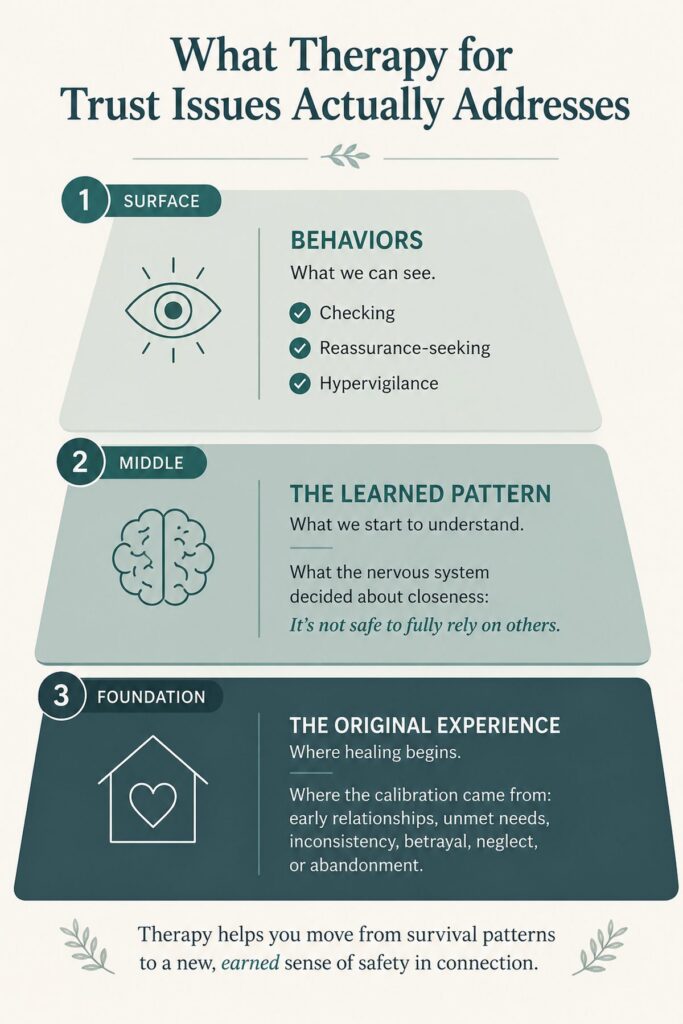
Trust issues in a relationship rarely arrive with a clear label. They tend to surface through behavior: checking a partner’s phone, replaying a conversation for evidence of what was really meant, bracing before closeness rather than relaxing into it. Sometimes they follow a specific rupture — infidelity, a significant lie, a repeated pattern of broken promises. Often they precede the current relationship entirely, imported from family systems or earlier partnerships where trust was a reasonable thing to withhold.
What unites these patterns is not a character flaw but a calibration. The nervous system that monitors for threat in a relationship is doing exactly what it was designed to do. The problem is when that calibration is no longer accurate to the current situation — when it reads a neutral moment as dangerous, or a vulnerable partner as unsafe, based on data that belongs to a different time.
Research published in the Journal of Personality and Social Psychology identifies trust as a multidimensional construct — not a single switch but a layered set of beliefs about a partner’s honesty, benevolence, and reliability. Understanding which dimension has been damaged is often the first clinical task in couples therapy for trust issues.
Why Trust Is Hard to Rebuild Without Support
The difficulty with rebuilding trust is that the tools most people reach for — time, good intentions, repeated reassurances — address the surface without touching the structure underneath. A partner can offer consistent behavior for months and still find that the other person cannot receive it. Not because they are unwilling, but because the part of them that learned to distrust is not persuaded by evidence in the way the rational mind is.
John Gottman’s research on what he calls the Sound Relationship House frames trust not as a feeling but as a set of small behavioral moments — what he terms ATTUNE: Awareness, Turning toward, Tolerance, Understanding, Non-defensive responding, and Empathy. His finding is that trust is built or eroded in these micro-interactions far more than in grand gestures or explicit conversations about the relationship. This is partly why unstructured attempts to rebuild trust so often plateau.
Therapy creates the conditions for something different: a structured environment where the patterns that undermine trust can be named, examined, and interrupted with enough support to actually change them.
What Therapy for Trust Issues Actually Does
The first stage of therapy for trust issues is not reassurance — it is clarity. Before two people can rebuild something, they need to understand what they are actually dealing with. This means separating the current relationship from the emotional history each person brings to it, identifying the specific moments where trust breaks down and what each person’s internal experience is in those moments, and developing a shared language for the patterns they keep running into.
Emotionally focused therapy, developed by Sue Johnson and grounded in attachment theory, is particularly well-suited to this work. EFT maps the negative interaction cycle — the sequence of moves each partner makes when threat is activated — and creates conditions for reaching beneath those moves to the underlying attachment needs. Research published in Psychotherapy: Theory, Research, Practice, Training demonstrates that EFT produces significant and durable improvements in relationship satisfaction, with effect sizes among the strongest of any couples intervention studied.
The second stage involves what Johnson describes as “enactments” — moments in session where partners are guided to express their deeper emotional experience directly to each other, often for the first time. For couples working on trust, this typically means one person being able to articulate the fear or grief underneath their distrust, and the other being able to receive that without defending against it. These moments reorganize the relational dynamic at the level where trust actually lives.
The third stage is consolidation — building new patterns of interaction that can hold the relationship outside of the therapy room. This is where the behavioral work of trust becomes more explicit: what accountability looks like, what transparency means for this particular couple, what each person needs to feel genuinely secure.
Individual vs. Couples Therapy for Trust Issues
Whether individual or couples therapy is the right starting point depends on where the trust issues are rooted. If the distrust is primarily relational — tied to something that happened between these two people — couples therapy is usually the more direct route. If the trust issues predate the relationship or run significantly deeper than any single partnership, individual therapy may be the better first step, with couples work added when the individual has more internal stability to bring to the joint work.
For many people, both are useful at different stages. Individual therapy can help someone understand their own attachment patterns, develop regulation skills, and process earlier experiences that are being activated in the current relationship. Couples therapy then has more to work with when both partners arrive with some capacity to tolerate difficult emotional material without immediately going to defense.
Sean Orpen, MS, LMFT-S, CST-S, works with both individuals and couples navigating trust — whether the work starts in the couples room, individually, or moves between both over time.
What Makes Therapy for Trust Issues Effective
The research on what predicts successful trust repair is fairly consistent. Willingness to engage — particularly the willingness of the person who broke trust to remain present with the impact without minimizing it — is the strongest predictor of outcome. Couples who recover from trust ruptures are not distinguished by the absence of conflict in that process; they are distinguished by the capacity to keep talking through it.
Research published in the Journal of Consulting and Clinical Psychology found that forgiveness in the context of relationship injury is significantly predicted by the offending partner’s empathic responsiveness — not by time, not by explicit apology, but by the quality of attunement in subsequent interactions. This finding has direct implications for what therapy is trying to build: not a verdict on the past, but a different quality of contact in the present.
The couples who make meaningful progress in therapy for trust issues are not always the ones with the smallest ruptures. They are the ones who can tolerate the discomfort of the work long enough to let it do something.
For couples ready to put this into practice, the post on trust building exercises for couples covers the specific behavioral tools that support this work between sessions.
Frequently Asked Questions About Therapy for Trust Issues
How long does therapy for trust issues typically take?
There is no single timeline. Trust repair after a significant rupture — infidelity, betrayal, a pattern of dishonesty — often takes longer than couples expect, with meaningful shifts typically emerging somewhere between 12 and 25 sessions. Trust issues rooted in individual attachment history may require longer individual work before couples work becomes productive. The more useful question is usually not “how long” but “what would meaningful progress look like” — and answering that is part of early therapeutic work.
Can therapy help if only one partner has trust issues?
Yes, though the shape of the work differs. When trust issues are more asymmetrical — one partner guarded, the other frustrated by the guardedness — therapy helps both people understand what is being activated and why, and finds ways for the less guarded partner to be genuinely helpful rather than inadvertently reinforcing the dynamic. Couples therapy for trust issues is not a referendum on whose experience is ‘valid.’ It takes both people’s realities seriously as starting points.
What if my trust issues come from a previous relationship?
This is extremely common, and it matters to name clearly. Trust issues that originate outside the current relationship are not automatically the current partner’s problem to solve — though they do affect the current relationship, and the current partner is inevitably involved in what it feels like to carry them. Individual therapy is often the right primary container for this work, with couples therapy as a useful addition when the relational impact is significant.
Is it possible to fully trust again after betrayal?
For many people, yes — though the trust that emerges after a significant rupture is different from the trust that preceded it. It tends to be more explicit, more negotiated, and less naive. Some people find it more durable for exactly that reason. Others find the gap too wide and the relationship ends. Therapy is not a guarantee of outcome; it is a structured way of understanding what is possible and making a more informed decision about what to do with that information.
When should someone in Seattle seek therapy for trust issues?
If trust issues are affecting the quality of daily life — intrusive thoughts, difficulty being present in the relationship, chronic anxiety about a partner’s fidelity or honesty — that is a reasonable signal that the pattern has moved beyond what self-management alone can shift. Reaching out is not a sign that something is broken beyond repair. It is often the opposite — evidence that what is carrying is worth taking seriously.
How does therapy for trust issues connect to the work I’ve been doing on communication?
Trust and communication are not separate tracks. Much of what gets called a communication problem — shutdown, avoidance, chronic misattunement — is a trust problem in disguise. When people do not feel safe, they do not communicate fully. This is one reason that the boundaries post on this site frames clear limits as a form of trust-building rather than barrier-building: trust and honest communication tend to move together, and working on one tends to support the other.
References
Gottman, J. M. (2011). The science of trust: Emotional attunement for couples. W. W. Norton & Company.
Makinen, J. A., & Johnson, S. M. (2006). Resolving attachment injuries in couples using emotionally focused therapy: Steps toward forgiveness and reconciliation. Journal of Consulting and Clinical Psychology, 74(6), 1055–1064.
Sean Orpen, MS, LMFT-S, CST-S, works with individuals and couples in Seattle and the Eastside navigating trust, attachment, and the relational patterns that make both harder to move through. If this is where you are, reaching out is a reasonable next step.