
The discovery tends to reorganize everything. Not just the relationship — the past, the sense of what was real, the understanding of who you are to someone else. People who have been through infidelity often describe something more disorienting than heartbreak: a sense that the map they were using to navigate their own life has turned out to be wrong. The question of how to get over being cheated on is real, but it misses something. The more accurate question is usually: how do I understand what just happened, and how do I find my footing when the ground I thought I was standing on wasn’t solid?
This piece is about what healing from infidelity actually involves — psychologically, relationally, and practically. Not what it should look like on a timeline, but what tends to be true about the process for people who move through it rather than staying caught in it.
What’s Actually Happening After Infidelity
The psychological experience of discovering a partner’s infidelity shares significant features with trauma response. Research by Snyder, Baucom, and Gordon, published in Getting Past the Affair, frames infidelity as a relationship trauma with recognizable features: intrusive thoughts and images, hypervigilance toward the partner, emotional numbing alternating with flooding, and a disrupted sense of reality. The betrayed partner often describes not knowing what is real anymore — questioning memories, reinterpreting moments that previously seemed ordinary, and losing access to the felt sense that the relationship is what they thought it was.
This matters because it explains why the standard advice — take time, talk it through, decide what you want — can be impossible to follow in the early aftermath. The nervous system is not in a state that supports clear-headed decision-making. It is in a state of threat response, doing exactly what it was designed to do when safety has been violated.
What helps in this stage is not resolution but stabilization: reducing the intensity of the intrusive symptoms enough that some degree of normal functioning is possible. This may involve individual therapy for the betrayed partner, separate from any couples work, to create a space where the experience can be processed without the complexity of the partner’s presence.
The Two Things Healing Actually Requires
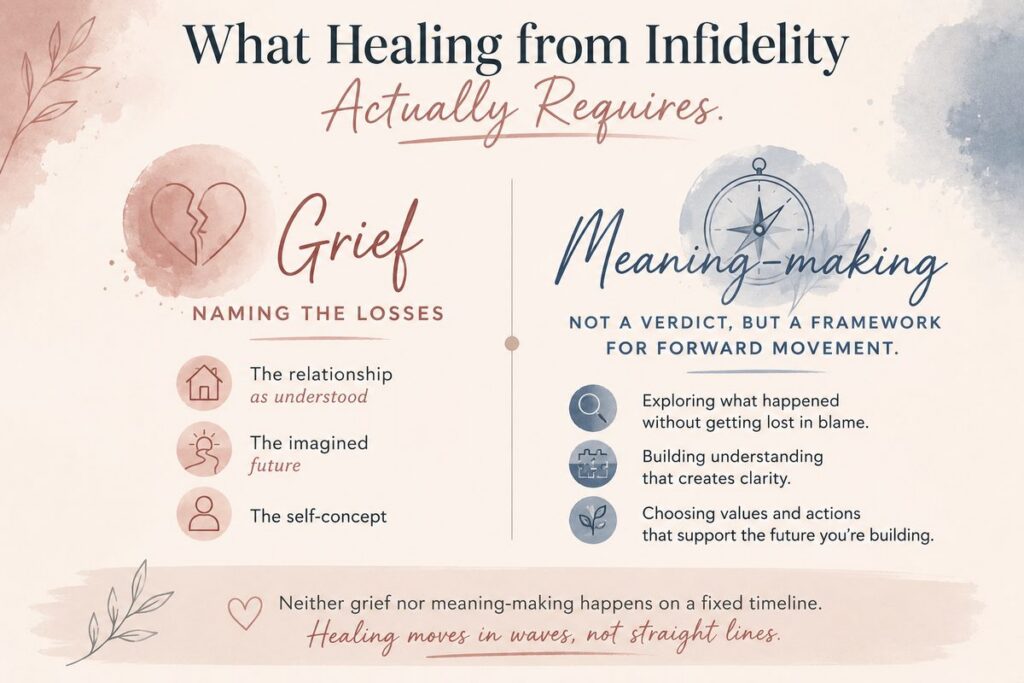
Beneath the practical questions — whether to stay, what to tell people, how to handle shared finances and children and social circles — there are two things that healing from infidelity genuinely requires, and they are often in tension with each other.
The first is grief. Infidelity involves multiple losses simultaneously: the relationship as it was understood, the future that was imagined, sometimes a particular self-concept that depended on the partnership. Many people try to bypass this by moving immediately to problem-solving mode — either working intensively on the relationship or extracting themselves from it as quickly as possible. Both can be ways of avoiding the grief, and both tend to extend the overall difficulty of the healing process.
The second is meaning-making. At some point in the recovery process, the question shifts from “what happened” to “what does this mean.” Not a verdict on the partner or the relationship, but an attempt to understand the event in a way that allows for forward movement. Research on post-traumatic growth — including work by Tedeschi and Calhoun, foundational in the field — consistently finds that the people who recover most fully from significant adversity are not those who found the experience trivial, but those who were eventually able to integrate it into a larger understanding of their own life. That integration takes time and usually requires support.
What Getting Over Being Cheated On Does and Doesn’t Mean
The phrase “getting over” infidelity creates a misleading picture. It implies a threshold crossed, a return to a previous state, a point at which the experience stops mattering. That is not typically what happens.
What healing actually looks like is more gradual and less linear: the intrusive thoughts becoming less frequent and less consuming, the ability to be present in ordinary life returning, the capacity to think about the future without the future feeling foreclosed. Many people describe a sense not of returning to who they were before but of becoming a different version of themselves — one who knows something harder and has found a way to carry it.
Whether healing happens within the relationship or outside of it is a separate question. Some couples recover from infidelity and report that the relationship is stronger afterward — not because the infidelity was acceptable, but because the crisis forced a depth of conversation and honesty that the relationship had not previously had. Others find that the rupture is too significant and the relationship ends. Couples therapy after infidelity does not predetermine which outcome is right; it creates the conditions for that determination to be made more clearly.
Betrayal Trauma Therapy: What It Is and Why It Helps
The framing of infidelity as a trauma — rather than simply a relational event — has important clinical implications. Betrayal trauma therapy draws on trauma-informed approaches that recognize the betrayed partner’s symptoms as reasonable responses to genuine threat, rather than overreactions to be managed.
In practice, this means therapy that validates the disorientation without rushing toward resolution, that helps the betrayed partner regulate the nervous system enough to think clearly, and that creates enough safety for the deeper questions — about the relationship, the partner, and the self — to be examined honestly.
For couples working together, emotionally focused therapy provides a structured approach to what researchers Makinen and Johnson call “injury resolution” — a specific therapeutic process for working through attachment injuries, of which infidelity is one of the most significant. Their research, published in the Journal of Consulting and Clinical Psychology, demonstrates that couples who complete this process show meaningful reductions in distress and improvements in relationship quality, with gains maintained at two-year follow-up.
The key moves in injury resolution are: the injured partner articulating the impact in their full emotional depth; the offending partner remaining present with that impact without minimizing or deflecting; a moment of genuine empathic responsiveness from the offending partner; and a gradual shift from the event itself toward what it means for the future of the relationship. This process cannot be rushed, and it rarely happens without a skilled third party.
When Healing Is Happening — and When It’s Stuck
Healing from infidelity is not always linear, and setbacks do not mean failure. A difficult anniversary, an unexpected reminder, a moment of seeing something that reactivates the original discovery — these can bring the material back with an intensity that feels like going backward. Usually it is not. The setback is typically shorter in duration and less consuming than the original injury, which is itself a sign of progress.
Signs that healing is genuinely stuck include: the intrusive symptoms not diminishing over months, increasing rather than decreasing difficulty with ordinary functioning, a growing constriction of what feels possible in life, or the development of significant depression or anxiety that is affecting sleep, work, and other relationships. These are signals worth taking seriously — not as evidence that recovery is impossible, but as indicators that the level of support currently available is not sufficient for what is being carried.
Sean Orpen, MS, LMFT-S, CST-S, works with individuals and couples navigating infidelity in Seattle and the Eastside. For the individual experience of betrayal, individual therapy creates the space to process what has happened and find a clearer path forward. For couples working on recovery together, reaching out is a reasonable next step.
Frequently Asked Questions About Healing After Infidelity
How long does it take to heal from being cheated on?
There is no universal timeline, and the advice to “give it time” is only partially useful. Time without adequate processing tends to extend difficulty rather than resolve it. Research suggests that meaningful recovery — a reduction in intrusive symptoms and a restoration of functional life — typically takes one to two years when the relationship is being worked on actively, longer when it is not. Individual variation is significant, and the severity of the initial rupture, the quality of support, and the responsiveness of the offending partner all affect the timeline.
Is it normal to still think about the infidelity constantly?
Yes, particularly in the early months. Intrusive thoughts and images are a standard feature of betrayal trauma, not a sign that something is wrong with you or that you will never recover. The relevant question is whether the intrusion is gradually decreasing in frequency and intensity over time. If it is not — if months have passed and the thoughts are as consuming as they were initially — that is worth addressing in therapy.
Can I heal if my partner isn’t doing the work?
Yes, though the shape of the healing is different. If the relationship is ending, healing primarily involves processing the grief and loss on your own terms, separate from the dynamics of the partnership. If the relationship is continuing but your partner is not engaging meaningfully with the repair, that is itself a significant piece of information about what the relationship offers — and individual therapy can help you think clearly about what you want to do with it. Therapy for trust issues often addresses exactly this terrain.
How do I know if I should stay or leave after infidelity?
This is one of the most common questions, and it is almost always asked before there is enough information to answer it well. The early aftermath of discovery is a particularly poor time for major decisions, because the nervous system is in threat response and the full picture of both the relationship and the infidelity is not yet clear. Most therapists who work in this area recommend giving the immediate crisis some time to settle before making irreversible decisions. That is not the same as staying indefinitely in something that is not working — it is recognizing that clarity usually comes after the acute phase, not during it.
What’s the difference between healing as an individual and healing as a couple?
Individual healing focuses on the betrayed partner’s internal experience: processing the grief, stabilizing the nervous system, working through what the infidelity means about the self and the relationship. Couples healing focuses on the relational dynamic: what happened, what it means for the partnership, whether trust can be rebuilt and what that would require. Both are real work, and they are not mutually exclusive. The post on couples therapy after infidelity covers the couples dimension in more depth.
References
Sean Orpen, MS, LMFT-S, CST-S, works with individuals and couples in Seattle and the Eastside navigating infidelity, betrayal, and the longer work of rebuilding — with yourself or with your partner. Reaching out is a reasonable next step.