
There is a particular strangeness to relearning trust with someone you have loved. The exercises feel too small for the weight of what you are carrying. A journaling prompt or a conversation ritual seems almost beside the point when what you are actually trying to rebuild is the baseline sense that this person is safe — that the ground beneath the relationship holds. And yet the research is clear: trust does not return through declaration or through time alone. It returns through accumulated behavioral moments, repeated with enough consistency that the nervous system gradually updates its threat assessment. The exercises matter because the moments matter.
Why Trust Exercises Work — and When They Don’t
John Gottman’s research on what he calls “sliding door moments” — small daily opportunities to turn toward or away from a partner — finds that trust is built or eroded in these micro-interactions far more than in formal conversations about the relationship. His longitudinal work, summarized in The Science of Trust, shows that couples who maintain trust over time are distinguished not by the absence of conflict but by their habitual responsiveness in ordinary moments: noticing a bid, meeting it with attention, staying present when the easier option is to withdraw. In his longitudinal observations, couples who remained together responded to each other’s bids for connection 86% of the time — compared to 33% in couples who later divorced.
Trust exercises work when they create these micro-moments deliberately — when they build the behavioral infrastructure that trust depends on. They do not work when they are performed as gestures without the underlying intention, or when they bypass the emotional reality of what has happened between two people. An exercise that both partners resent doing does not build trust; it builds resentment that has been temporarily organized into a shared activity.
This is one reason couples therapy often accompanies trust repair work. A therapist provides the structure to ensure that exercises are calibrated to what the couple can actually tolerate at a given stage — and to help process what surfaces when they do.
Trust Building Exercises That Have Research Support
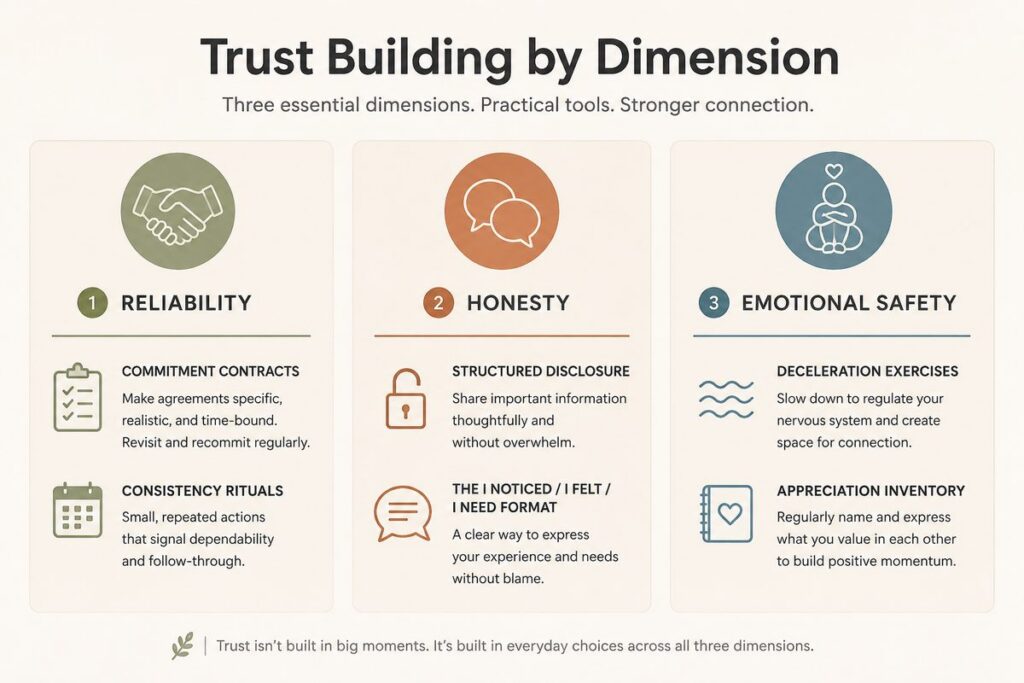
The following exercises draw from attachment research, emotionally focused therapy, and the Gottman method. They are organized by the dimension of trust they primarily address: reliability, honesty, and emotional safety.
Exercises for Rebuilding Reliability
Reliability — the sense that a partner does what they say they will do — is often the most practically damaged dimension after a trust rupture. Rebuilding it requires behavioral consistency over time, not promises about future behavior. Gottman’s research on turning toward bids provides the empirical foundation here: each small act of follow-through functions as a bid response, and the cumulative ratio of these responses is what the nervous system uses to update its assessment of whether the relationship is safe.
Commitment contracts are small, explicit agreements about specific behaviors: not grand vows, but concrete commitments for a defined time period. “This week I will text when I leave work” is more trust-building than “I will always be transparent.” The specificity allows follow-through to be verified and acknowledged, which is what the nervous system needs to update its threat assessment.
Reliability rituals are structured daily or weekly touchpoints that the couple commits to consistently — a brief check-in at the end of the day, a standing Sunday morning conversation, a shared routine that belongs to both people. Their trust-building function is not in the content but in the consistency: the repeated experience of “this person shows up when they said they would.”
Exercises for Rebuilding Honesty
Research by Brené Brown on vulnerability and connection finds that the capacity for genuine honesty in a relationship is closely linked to psychological safety — the belief that honesty will not result in punishment, withdrawal, or escalation. This is why honesty exercises that simply ask people to “be more open” tend to backfire: they increase exposure without first building the safety that makes exposure feel survivable. Her work is discussed extensively in Daring Greatly, which offers a useful frame for understanding why vulnerability and trust are not sequential but interdependent.
Structured disclosure exercises involve one partner sharing something true about their inner experience — something they have been holding back, not something inflammatory — while the other partner practices receiving it without fixing, defending, or redirecting. The exercise is not about the content disclosed; it is about the experience of saying something real and having it met with curiosity rather than threat. Brown’s research identifies this exchange — vulnerability offered and met with non-defensive attention — as the primary mechanism through which psychological safety is built rather than assumed. The “I noticed / I felt / I need” format gives honesty a structure that reduces the likelihood of it landing as an attack. Rather than “you never tell me what is really happening,” the format produces something like: “I noticed you went quiet after dinner. I felt uncertain about what you were carrying. I need to know if there is something between us that needs attention.” The same information, but organized in a way the other person can actually receive.
Exercises for Rebuilding Emotional Safety
Emotional safety — the experience of being with someone without bracing for impact — is the dimension of trust that is hardest to measure and most central to everything else. Sue Johnson’s emotionally focused therapy frames this as the fundamental goal of couples work: creating a relationship where both partners can be their actual selves without the protective performances that erode intimacy over time.
Deceleration exercises ask couples to practice slowing down in the moments when they would normally speed up. When a conversation starts to escalate, both partners pause, take three slow breaths, and each states — briefly — what they are actually feeling rather than what they are about to say. This interrupts the escalation cycle at the point where it typically takes over, and creates a small moment of mutual regulation rather than mutual threat.
The “appreciation inventory” is a low-pressure exercise that builds positive emotional texture without requiring vulnerability. Each partner writes down three specific things they noticed the other person doing in the past week that they appreciated — not general qualities but particular observations. They share these at a set time. The exercise works because specific, observed appreciation registers differently to the brain than generic compliments. It signals: I was paying attention. Research by Lambert and colleagues found that expressing gratitude to a partner predicted increases in the perceiver’s sense of the relationship’s communal strength over time — suggesting that the appreciation inventory does more than feel good in the moment. It gradually changes how each partner understands the nature of the relationship itself.
Activities to Rebuild Trust in a Relationship After a Rupture
When trust has been specifically broken — through infidelity, a significant lie, or a repeated pattern of breach — the activities listed above are still relevant, but they require a foundation that may need to be built first. Before behavioral exercises can do their work, two things typically need to happen.
First, the person who broke trust needs to demonstrate genuine understanding of the impact — not a perfunctory apology, but an accurate account of what the other person experienced and why it makes sense that they are struggling. Research on interpersonal forgiveness consistently finds that this empathic accuracy — the offending partner’s ability to name the injured partner’s experience precisely — is the strongest predictor of recovery. General remorse is much less effective than specific recognition.
For couples who want to understand the fuller therapeutic process behind trust repair, the post on therapy for trust issues covers what that work actually involves
Second, the injured partner needs space to grieve. Trust ruptures involve loss: the loss of the relationship as it was understood, sometimes the loss of a particular self-concept. Exercises that move too quickly to rebuilding can bypass the grief and create a shaky foundation. Therapy provides the structure for grief to coexist with the early stages of repair without either collapsing the process or cementing it into resentment.
For couples navigating this territory, the post on how to heal from being cheated on covers the psychological texture of that specific rupture in more depth. For the relational work that follows, couples therapy provides the environment where these activities land differently than they do without support.
Frequently Asked Questions About Trust Exercises for Couples
How often should couples do trust-building exercises?
Consistency matters more than frequency. A brief daily practice — five minutes of intentional check-in, a stated appreciation, a moment of physical closeness without agenda — is more trust-building than an intensive monthly exercise that creates positive feeling and then disappears. Trust is rebuilt in small, repeated moments. The exercises are most effective when they become ordinary rather than effortful.
What if my partner refuses to do the exercises?
This is worth taking seriously as information rather than dismissing as obstruction. Refusal often signals that something about the exercise — its framing, its timing, or its underlying premise — does not feel safe or meaningful to the reluctant partner. Exploring what they would need differently, or bringing the question into couples therapy, is more likely to be productive than pushing for compliance with the original format.
Can trust-building exercises work without therapy?
For couples where trust has been strained but not significantly ruptured — where the issue is more about accumulated disconnection than a specific betrayal — exercises done without professional support can be quite effective. For couples recovering from a significant breach, therapy is not strictly required, but it meaningfully improves the odds that the exercises are calibrated correctly and that what surfaces in the process gets worked through rather than around.
How do I know if trust-building is working?
The signs are usually quiet rather than dramatic: a reduced urge to check, an easier time receiving a partner’s reassurance, a growing willingness to be vulnerable without immediate regret. The nervous system’s threat response does not disappear, but it becomes less hair-trigger. Small setbacks stop feeling like confirmation that nothing will ever change. These are the real measures — not a moment of declaration, but a gradually different felt sense of what is possible.
How does this connect to the boundaries work we’ve been doing?
Trust and boundaries are closely related. The capacity to set a clear limit — to say what you need and what you are not available for — requires enough trust in the relationship to believe that honesty will not destroy it. And trust, in turn, is built partly through the experience of limits being respected. The post on boundaries in a relationship explores this in more depth, particularly the section on what happens when the boundary-setting reflex has been replaced by avoidance.
References
Brown, B. (2012). Daring greatly: How the courage to be vulnerable transforms the way we live, love, parent, and lead. Gotham Books.
Gottman, J. M. (2011). The science of trust: Emotional attunement for couples. W. W. Norton & Company.
Johnson, S. M. (2008). Hold me tight: Seven conversations for a lifetime of love. Little, Brown.
Sean Orpen, MS, LMFT-S, CST-S, works with couples in Seattle and the Eastside on trust repair, attachment, and the patterns that make genuine closeness difficult to sustain. Reaching out is a reasonable next step if this is where you are.