
In a meta-analysis of vacation research, de Bloom and colleagues (2009) found that time off improved people’s health and well-being, and that those gains faded soon after they went back to work. If you’ve ever come home from a week away and felt the old weight settle back onto your shoulders by Wednesday, that finding probably sounds familiar. Most of the leaders I talk with have tried the week away, sometimes more than once.
It’s also one of the most common reasons people start looking for a therapist for burnout. Rest helps, and the patterns that drained you are still waiting when you get back.
What a Therapist for Burnout Does
A therapist for burnout helps you understand what’s draining you, recover your energy and change the patterns that keep you running past empty. Sessions usually combine practical tools, such as cognitive behavioral therapy and body-based techniques, with a close look at how work, identity and relationships feed the exhaustion.
I think of therapy for burnout as working on two tracks at once. One is relief: sleep, energy, the short fuse, the fog. The other is understanding why you kept going long after your reserves ran low, because that part tends to repeat itself if no one looks at it.
Most people try to fix burnout on their own first. A long weekend. A new morning routine. A promise to stop checking email after nine. Those efforts make sense, and some of them help for a while. My honest view is that rest on its own is the most common burnout plan and one of the least reliable, because it leaves alone the part of you that keeps saying yes to more. If you’re still unsure whether what you’re feeling is burnout at all, my post on high-functioning burnout walks through the signs.
Time off still has a place. Some people need a real break, or a medical leave, before they can do much of anything else, and therapy can help you think that decision through alongside your doctor and the people you work with. Rest and therapy tend to work best together. The break gives you room to breathe, and therapy helps you use that room to understand what happened, so the next stretch of work doesn’t drain you in the same way.
The First Few Sessions: Getting the Full Picture
A first session for burnout is mostly listening and mapping. I’ll ask what a typical week looks like, how you’re sleeping, when you last felt rested, what’s happening at home and what you’ve already tried. I’ll often ask about your physical health too, since a few medical conditions can look a lot like burnout. And I’ll ask about safety. If you’re ever having thoughts of not wanting to be here, please call or text 988, the Suicide and Crisis Lifeline.
Many leaders arrive with a plan for therapy. They want the framework, the fix, the three things to do differently by next quarter. I understand the instinct, and it’s part of what makes them good at their jobs. The first few sessions usually slow that down a little, because the changes that last tend to come from knowing exactly what’s driving the exhaustion.
That means getting specific. “Work is crushing me” is true, and it’s hard to work with. “Every Sunday night I rehearse Monday’s hardest conversation, and I haven’t slept well on a Sunday in a year” is something we can work with.
The Middle of the Work
Once the picture is clear, the work usually draws on a few approaches. I choose them based on how you think, what you’re carrying and what you want to be different, and I’ll tell you why I’m suggesting each one. You get a say in all of it.
Cognitive Behavioral Therapy for Burnout
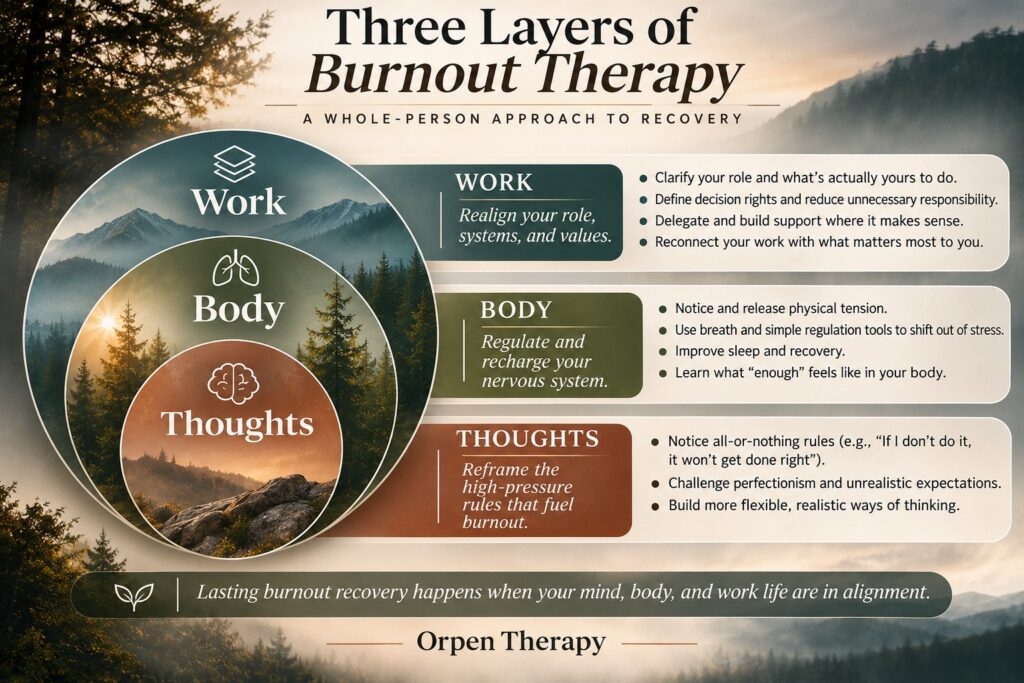
Cognitive behavioral therapy for burnout looks at the rules you run on without noticing. “If I don’t handle it, it won’t get done right.” “Saying no will cost me.” “Rest is something I earn after everything is finished.” That last one has a catch: for most leaders, everything is never finished, so rest never gets earned. Rules like these often helped build a career, and they also keep you overextended. In therapy, you test them in small, low-risk ways and see what happens. CBT also makes room for the inner critic that tends to travel with very high standards.
The research is encouraging and honest about its limits. A Cochrane review by Ruotsalainen and colleagues (2015) looked at 58 studies of healthcare workers and found that CBT-based programs reduced stress more than no intervention at one to six months, and in two studies beyond six months. The authors rated the evidence as low quality, and CBT didn’t clearly outperform other active approaches. I read that as a reason to use CBT thoughtfully, as one tool among several.
Somatic Tools
Burnout lives in the body as much as the mind: a jaw that’s always clenched, shoulders that sit up near your ears, shallow breathing through back-to-back meetings, the wired-tired feeling at 11 p.m. Somatic work helps you notice those signals earlier and settle them more easily. It can include paced breathing, grounding, and learning what “enough” feels like physically before your body has to shout it. People often report that this is the piece they didn’t expect to matter, and the one they keep using.
Picture a founder who notices, a few weeks into therapy, that her chest tightens every time one particular investor’s name lights up her phone. She’s probably felt that tightening for months. Noticing it gives her a choice she didn’t have before: a breath, a pause, a reply an hour later instead of in the next ten seconds.
EMDR, When the Past Is Part of It
Sometimes the drive to keep going has older roots. Maybe being useful was how you stayed safe or valued growing up, or a public failure early in your career still shapes how hard you push. When a particular memory keeps feeding the pressure, EMDR can help process it so it carries less charge. It isn’t part of every burnout plan, and it can make a real difference when it fits.
When Work Itself Is the Problem
Some burnout is a reasonable response to an unreasonable job. Therapy for work burnout looks at the job as well as the person in it: unclear decision rights, a co-founder relationship that’s frayed, a board that keeps moving the target, a team that brings every problem to you because you’ve always solved them. Part of the work is seeing those structures clearly enough to decide what you want to do about them.
One pattern comes up often. A leader becomes the bottleneck without ever meaning to. Early on, being involved in everything was the job, and it worked. As the company grew, the habit stayed while the capacity didn’t. Delegating can feel like losing control or letting people down, and underneath that there’s often a quieter fear of being the one who dropped the ball. So the leader keeps absorbing more. Therapy is a place to look at what makes letting go so hard, and what it would cost, and give back, to try.
Work stress therapy also pays attention to what follows you home, and sleep is usually first on that list. In a review of workplace insomnia programs, most of them CBT-based, Vega-Escaño and colleagues (2020) found improvements in sleep along with gains in productivity, presenteeism and job burnout. For many leaders, better nights are the first sign that something is shifting.
Sometimes therapy leads to a change in role, structure or company. Sometimes it leads to staying and working very differently. Both can be the right call, and you’re the one who gets to make it. If you’re wondering about timing, I’ve also written about how long recovery from burnout tends to take.
One more thing for any leader weighing this. If therapy feels like a sacrifice, it won’t last. If it feels like an investment in how you want to lead and live, it will. When it starts to feel like one more obligation on a full calendar, that’s worth saying out loud in session, because it usually means something about the work needs to change.
Questions About Burnout Therapy
How do I find a therapist who understands leadership pressure?
Many people find it helps to look for someone who works with executives, founders or business owners regularly, then use a first consultation to ask how they think about burnout and work. Pay attention to how you feel at the end of that call. Feeling understood is a better guide than any credential list.
Is what I say in therapy kept private from my company?
In general, yes. Your employer, board or investors don’t receive information about your sessions without your written permission. There are a few legal exceptions, such as a serious risk of harm, and your therapist should walk you through them at the start. If you use insurance, your insurer receives basic information needed to process claims.
Can therapy help if I can’t change my job right now?
Yes. Much of burnout therapy focuses on how you relate to the job you have: what you take on, what you let go of, how you recover between demands and what you say to the people around you. Small changes inside the same role can add up. Bigger decisions can wait until you have more energy to make them well.
If you’re a founder, executive or business owner in Seattle, on the Eastside or anywhere in Washington by video, and parts of this sound familiar, I’d be glad to talk. You can read more about how I work with executives and business owners and reach out from there.
Sean Orpen, MS, LMFT-S, CST-S, is a licensed marriage and family therapist and clinical supervisor in Seattle with more than 20 years of experience.
References
de Bloom, J., Kompier, M., Geurts, S., de Weerth, C., Taris, T., & Sonnentag, S. (2009). Do we recover from vacation? Meta-analysis of vacation effects on health and well-being. Journal of Occupational Health, 51(1), 13–25. https://doi.org/10.1539/joh.k8004
Ruotsalainen, J. H., Verbeek, J. H., Mariné, A., & Serra, C. (2015). Preventing occupational stress in healthcare workers. Cochrane Database of Systematic Reviews, 2015(4), CD002892. https://doi.org/10.1002/14651858.CD002892.pub5
Vega-Escaño, J., Porcel-Gálvez, A. M., de Diego-Cordero, R., Romero-Sánchez, J. M., Romero-Saldaña, M., & Barrientos-Trigo, S. (2020). Insomnia interventions in the workplace: A systematic review and meta-analysis. International Journal of Environmental Research and Public Health, 17(17), 6401. https://doi.org/10.3390/ijerph17176401