
Perfectionism works a lot like a scoreboard that only counts the points you dropped. You can win the game, close the round or land the promotion, and the board still lights up with the one shot you missed. Over time, that becomes the number you learn to watch.
If you’ve ever finished a strong quarter and gone straight to the list of what went wrong, you know that scoreboard. Plenty of capable, driven people live with it for years before they stop to ask whether it’s the one they want to keep.
Therapy for High Achievers, in Plain Terms
Therapy for high achievers helps people who perform well but feel driven, anxious or never quite satisfied understand how achievement became tied to their sense of worth. It works on perfectionism, the inner critic and the fear of being seen as less than capable, so you can keep your standards while carrying far less pressure.
To make that concrete, picture Avery, a composite example I’ll come back to throughout this post. Avery is a vice president at a Seattle tech company, newly promoted and the person their team trusts with the hardest launches.
From the outside, Avery looks calm and decisive. Up close, the pattern is harder to miss. Avery rewrites the team’s board slides the night before every meeting, even when the deck was already strong. They quietly take back projects they’ve already handed off, then wonder why their directors hesitate to make calls on their own. One pointed question from the CEO can replay for days. Weekends go to getting ahead, and getting ahead never quite happens.
In the moment, none of it feels like a choice. It feels like the responsible thing to do. The cost shows up later: a low hum of dread every Sunday night, a team that has started waiting for Avery’s sign-off before moving, and a constant sense that if they let go of anything, something important will slip. When the promotion came through, Avery felt a flicker of pride, followed almost immediately by the thought that the next mistake would be more visible.
If you’re an overachiever, some of Avery probably sounds familiar. Recognizing yourself in that description says something about the pressure you’ve been carrying, and it’s a pattern people can change.
When Drive Turns Into Perfectionism
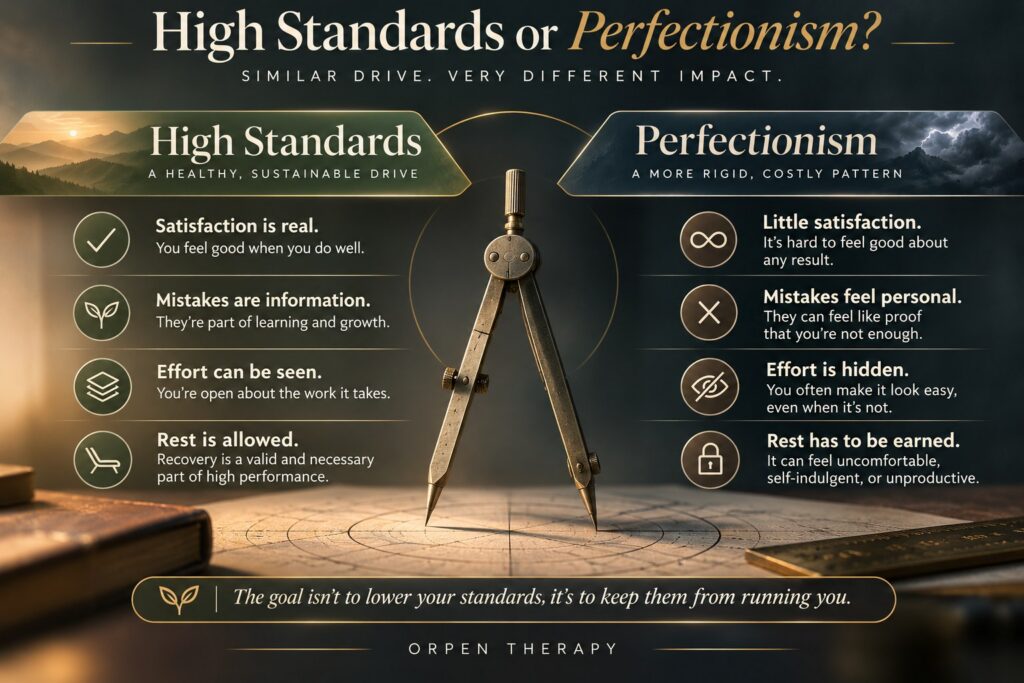
Most people assume perfectionism is simply high standards turned up a notch. There’s some truth in that, and the research draws a sharper line. In their clinical review, Hewitt and Flett (2007) describe how perfectionism differs from conscientiousness. People who are conscientious and achievement-driven feel satisfied when they do well and reward themselves for it. People with perfectionism get little satisfaction from any performance, and they treat their flaws as evidence about their worth.
Hewitt and Flett also describe three forms perfectionism can take:
- Self-oriented: requiring yourself to be perfect.
- Socially prescribed: believing other people require you to be perfect.
- Other-oriented: requiring the people around you to be perfect.
Leaders can carry any mix of the three. Avery carries the first two. Their own bar is high, and they’re convinced everyone above and below them is keeping score. Being high achieving and being perfectionistic can look identical from the outside. The difference tends to show up in what a win feels like the next morning.
Why Success Doesn’t Quiet the Inner Critic
Avery’s promotion brought about one afternoon of relief. By the next morning, the bar had moved. There was a bigger team to win over, a board that would now know their name and a fresh set of ways to fall short. Success raised the stakes, and the inner critic kept pace.
Research from Hewitt’s group helps explain why. In a longitudinal study, Nepon, Flett and Hewitt (2024) found that the need to appear perfect to others predicted later self-image goals, a focus on proving yourself and protecting how you’re seen. Those goals were in turn linked to worse mental and physical health, more loneliness and more social anxiety. The study followed university students, and the pattern will be familiar to plenty of executives.
Underneath the drive, there’s often a quieter question that rarely gets said out loud: am I still worth something if I stop? When achievement is the main answer to that question, every win has to be followed by another one. Left unchecked, this is one of the more common roads into high-functioning burnout.
The Part No One Sees
Many perfectionists work hard to hide the effort. They want the result to look easy, so the late nights, the rewrites and the worry stay out of sight. Hewitt and Flett note that this kind of perfectionistic self-presentation is tied to difficulty seeking help for psychological problems, which makes sense. Asking for help means letting someone see the seams.
Hiding has a cost. Across undergraduate, law and medical students, Chen, Saklofske, Flett and Hewitt (2024) found that loneliness helped explain the link between perfectionism and distress. People who felt pressure to appear perfect reported less social support, especially when they avoided letting others see their imperfections.
Avery’s team has no idea anything is wrong. Their partner knows, because Avery comes home with nothing left and goes quiet at dinner. That gap between the public version and the private one is where a lot of the exhaustion lives. Shame grows in silence and comparison, and it tends to shrink once it has words and a witness.
What Therapy for Perfectionism Works On
I’ll be direct about where I stand. I think good perfectionism therapy leaves your ambition intact and changes your relationship with it. You keep the standards that serve you and loosen your grip on the ones that are quietly running you down.
Hewitt and his colleagues have spent decades building a treatment around that idea. Their dynamic-relational approach, described by Mikail, Hewitt, Flett and Ge (2022), looks at the relational roots of perfectionism: the needs for acceptance and belonging that drive it, and the patterns people use to protect themselves from feeling not good enough. In their group work, people move through phases they call engagement, pattern interruption, self-redefinition and painful authenticity, and termination. In an earlier study of their short-term group approach, Hewitt and Flett report that 70 people with high levels of perfectionism showed drops in perfectionism, depression, anxiety and interpersonal problems, and those gains held six months later.
In individual therapy for overachievers, the work often starts small. For Avery, it might mean noticing the scoreboard in real time, telling one trusted colleague that a launch is stretching them thin or letting the team’s deck go to the board without a midnight rewrite and paying attention to what happens. Some of the tools from burnout work, such as CBT and body-based techniques, help here too. I describe them in my post on what burnout therapy involves.
Perfectionism also tends to follow people into the therapy room. Many people want to be good at therapy: to arrive with the right insight, say the useful thing and report steady progress every week. I’d much rather hear about the week that went sideways, the email you agonized over or the moment you snapped at someone you love. Those moments are where the pattern is easiest to see, and talking about them without polishing them first is part of the work.
There’s a line I come back to often: suffering you didn’t choose is just suffering, and discomfort you choose shows you who you are. Letting that deck go untouched is uncomfortable. It’s also a choice, and choices like that are how a different relationship with achievement gets built.
Questions People Ask About Perfectionism and Therapy
Will therapy make me less driven?
People often worry about this, and it’s a fair question. Most people I work with find they keep their ambition and lose some of the dread that came with it. Everyone’s experience is different, and nothing can be guaranteed, but losing your edge is rarely what people report.
Is being an overachiever a bad thing?
Not on its own. A problem is only a problem if it’s a problem for you or the people you’re in relationship with. Plenty of overachievers enjoy their work and their lives. It becomes worth a closer look when your achievements stop feeling like yours, when rest feels unearned or when the people around you are paying for the pressure.
Does perfectionism affect the people I lead and love?
It often does. Other-oriented perfectionism can show up as a team that’s afraid to bring you a half-finished idea, or a partner who feels graded. Hewitt and Flett link it to interpersonal problems and difficulties in close relationships. Seeing that pattern clearly is often the first step toward softening it.
Can therapy help before things reach burnout?
Yes, and that’s often the best time to start, because you have more energy to work with. If you’re noticing early warning signs, my post on catching burnout early walks through the stages and what they tend to look like.
Back to the Scoreboard
Therapy gives you a chance to look at the scoreboard you’ve been using, ask who built it and decide what you want it to count. For Avery, that might mean counting the launch that went well, the colleague they finally trusted and the evening they came home with something left for the person waiting there.
If you’re a founder, executive or business owner in Seattle, on the Eastside or anywhere in Washington by video, and this post sounds a little too familiar, I’d be glad to talk. You can learn more about my therapy for leaders and business owners and reach out when you’re ready.
About the Author
Sean Orpen, MS, LMFT-S, CST-S, is a licensed marriage and family therapist, certified sex therapist and clinical supervisor with more than 20 years of experience. Through his Seattle practice, Orpen Therapy, he works with CEOs, founders, executives, couples and individuals.
References
Chen, S., Saklofske, D. H., Flett, G. L., & Hewitt, P. L. (2024). Assessing and evaluating the perfectionism social disconnection model: Social support, loneliness, and distress among undergraduate, law, and medical students. Journal of Psychoeducational Assessment, 42(6), 743–767. https://doi.org/10.1177/07342829241244951
Hewitt, P. L., & Flett, G. L. (2007). When does conscientiousness become perfectionism? Current Psychiatry, 6(7), 49–60. https://www.mdedge.com/content/when-does-conscientiousness-become-perfectionism
Mikail, S. F., Hewitt, P. L., Flett, G. L., & Ge, S. (2022). Group dynamic-relational therapy for perfectionism. Research in Psychotherapy: Psychopathology, Process and Outcome, 25(3), 635. https://doi.org/10.4081/ripppo.2022.635
Nepon, T., Flett, G. L., & Hewitt, P. L. (2024). Perfectionism, self-image goals and compassionate goals in health and mental health: A longitudinal analysis. Journal of Psychoeducational Assessment, 42(6), 650–667. https://doi.org/10.1177/07342829241239997