
“I’m fine. It’s just a lot right now.”
I hear some version of that sentence from leaders all the time, usually months before burnout has a name. It’s said with a small shrug, and it’s usually true in the moment. It’s also how the slide begins: one reasonable explanation at a time, until “a lot right now” has lasted a year.
Preventing Burnout Starts With Noticing
Preventing burnout means catching the early stages, when you’re running hot or dipping into reserves, and building in ways to come back down before exhaustion sets in. Research points to habits that calm the body, regular movement, clear boundaries around work and real connection with other people, used consistently, including on good weeks.
When people ask me how to prevent burnout, they often expect the answer to be willpower: think more positively, manage your time better, push the stress out of your head. Mindset matters, and it has limits. You can’t think your way out of a racing heart at 11 p.m. Stress lives in the body, so the tools that help in the moment usually have to reach the body too. That’s why most of what follows is something you do, often in a minute or two, more than something you think.
The Stages of Burnout, From Overdrive to Collapse
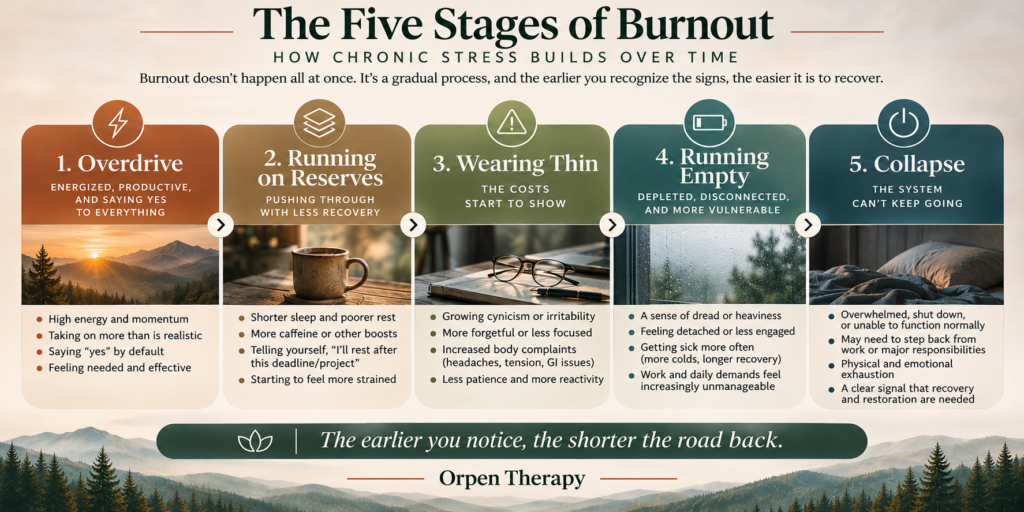
Burnout rarely arrives all at once. Researchers and clinicians have described burnout phases in different ways since the 1970s, and no single model owns the truth. Here’s the loose version I use with leaders:
- Overdrive. Energy is high and saying yes feels good. You’re taking on more because you can, and it’s working.
- Running on reserves. Sleep gets shorter, coffee gets stronger and “I’ll rest after this push” becomes a refrain.
- Wearing thin. Small things irritate you. You forget things you’d never forget. Your body starts to complain, and you pull back from people without quite deciding to.
- Running empty. Dread shows up before meetings you used to enjoy, work you cared about feels distant and you seem to get sick every time you slow down.
- Collapse. Your body or mind makes the decision for you, and keeping going is no longer possible.
Most of the leaders I see are somewhere in the middle two burnout stages. That’s also where high-functioning burnout tends to live, because output is still strong while the reserves drain. The earlier you notice where you are, the more options you have. Once someone reaches collapse, recovery tends to take longer, so the middle stages are the best place to act.
Your Nervous System Has a Say
Polyvagal theory, developed by Stephen Porges (2009), gives a useful map of what’s happening underneath those stages. In simple terms, it describes three broad states. One is a calm, connected state where you can think clearly and enjoy people. Another is a mobilized state built for fight or flight. The third is a shutdown state, when the system conserves energy by going numb, flat or foggy. Porges also describes how the face, voice and social connection help the body settle back into the calm, connected state.
Polyvagal theory is a model, and researchers still debate parts of its biology. I find its map useful anyway, because it fits what leaders tell me. Overdrive and running on reserves look a lot like living in that mobilized state for months. Running empty and collapse look a lot like shutdown. And it explains why a kind voice or a real conversation can settle your body faster than a productivity hack.
[H2] Tools That Help in the Moment
Research tells us that some of the most effective tools are small, physical and easy to repeat. None of them works for everyone, so treat this as a menu to experiment with. If one doesn’t fit, another might.
[H3] Cyclic sighing
In a month-long randomized study, Balban and colleagues (2023) compared five minutes a day of different breathing practices with mindfulness meditation. Cyclic sighing, a pattern built around long exhales, produced greater improvement in mood and a larger drop in breathing rate than meditation. The pattern is simple: breathe in through your nose, take a second short inhale on top of the first to fill your lungs, then let the air out slowly through your mouth until you’re empty. Repeat for a few minutes. Some leaders do this in the elevator or between meetings, and nobody notices.
Orienting
Orienting is a polyvagal-informed practice that many people find settling. You let your eyes move slowly around the room, letting them land on things you notice: the light on a wall, a plant, the texture of a chair. Then you notice whether your breath or shoulders shift at all.
Movement in small doses
A systematic review by Naczenski and colleagues (2017) found consistent evidence that physical activity is linked to lower exhaustion, the core of burnout, though the authors note that few of the studies were high quality. For busy leaders, this rarely means a new gym routine. It can look like a walking one-on-one, a few flights of stairs before a big meeting or ten minutes outside at lunch.
Awe walks
This is one most people haven’t heard of. In a randomized study, Sturm and colleagues (2022) asked older adults to take a 15-minute walk each week for eight weeks. One group was simply encouraged to notice things that felt vast or surprising. That group reported more joy during their walks and bigger drops in daily distress over time. In Seattle, that might mean the view from Kerry Park, a stand of old cedars in Discovery Park or the water on a gray afternoon. What seems to matter most is letting yourself feel small next to something bigger.
Building It Into the Week: Boundaries and Structure
Burnout self care tends to fail when it depends on remembering. Self care for burnout prevention works better when it’s built into structure, so it happens on the weeks you’d most likely skip it. A few structural tools leaders often find useful:
- A shutdown ritual. At the end of the workday, write down what’s still open and the very next step for each, then say a phrase you choose, like “done for today.” It gives your mind permission to stop rehearsing.
- A done list. Write down what you finished, alongside what’s left. Leaders tend to track only what’s undone, which makes every day feel like a loss.
- A worry window. Pick fifteen minutes in the late afternoon to write down worries. When one shows up at 10 p.m., you can tell it, “You’re on tomorrow’s list.”
- A decision budget. Make the biggest calls in the hours when you’re sharpest, and let lower-stakes choices wait or go to someone else.
Boundaries are the other half. I think of a boundary as a clear statement of what you’ll do, so other people know what to expect from you. For leaders, a few sentences go a long way: “I’m offline after seven. If something truly can’t wait, call me.” Or, “I can take this on if something else comes off my plate. Which one would you like me to drop?”
Connection belongs in this structure too. In an interview about their book, Emily and Amelia Nagoski describe a stress-reducing conversation: one person talks about their day while the other listens and takes their side, without trying to fix anything, and then you switch. Leaders who spend all day solving problems often find it strange at first, and then quietly essential. They also talk about engaging with something larger than yourself, whether that’s a cause, a craft or a community, as a source of meaning that work can’t always supply.
Questions About Preventing Burnout
What if I don’t have time for any of this?
Most of these tools take minutes. A few rounds of cyclic sighing fit between meetings, and a shutdown ritual takes less time than one more email. If even that feels impossible, that’s useful information about where you are on the slide.
Is burnout self care different from regular self-care?
In my view, yes. Regular self-care often means treats and breaks. When you’re trying to prevent burnout, the most helpful care tends to be structural and physical: boundaries, sleep, movement, ways to settle your body and people who know how you’re really doing.
Can a team or company help prevent burnout?
Absolutely, and leaders have more influence here than they sometimes realize. Workload, clear priorities, real time off and a culture where people can say “I’m stretched thin” without penalty all matter.
When is prevention not enough?
When you’ve tried a few of these consistently for several weeks and you’re still sliding, when sleep or mood keeps getting worse or when people close to you are worried, it’s worth getting support. I’ve written about working with a therapist on burnout if you want to know what that looks like. And if you’re ever having thoughts of not wanting to be here, please call or text 988, the Suicide and Crisis Lifeline.
If You’re Somewhere in the Middle
If you read the stages and recognized yourself in running on reserves or wearing thin, I want to say this plainly: that’s a good place to catch it. You still have energy to make changes, and small ones tend to add up faster than people expect.
I work with founders, executives and business owners in Seattle, on the Eastside and anywhere in Washington by video. If you’d like a partner in figuring out which tools fit you and where your boundaries need to move, you can learn more about my work with leaders facing burnout and reach out when you’re ready.
About the Author
Sean Orpen, MS, LMFT-S, CST-S, is a licensed marriage and family therapist, certified sex therapist and clinical supervisor with more than 20 years of experience. Through his Seattle practice, Orpen Therapy, he works with CEOs, founders, executives, couples and individuals.
References
Balban, M. Y., Neri, E., Kogon, M. M., Weed, L., Nouriani, B., Jo, B., Holl, G., Zeitzer, J. M., Spiegel, D., & Huberman, A. D. (2023). Brief structured respiration practices enhance mood and reduce physiological arousal. Cell Reports Medicine, 4(1), 100895. https://doi.org/10.1016/j.xcrm.2022.100895
Naczenski, L. M., de Vries, J. D., van Hooff, M. L. M., & Kompier, M. A. J. (2017). Systematic review of the association between physical activity and burnout. Journal of Occupational Health, 59(6), 477–494. https://doi.org/10.1539/joh.17-0050-RA
Porges, S. W. (2009). The polyvagal theory: New insights into adaptive reactions of the autonomic nervous system. Cleveland Clinic Journal of Medicine, 76(Suppl. 2), S86–S90. https://doi.org/10.3949/ccjm.76.s2.17
Sturm, V. E., Datta, S., Roy, A. R. K., Sible, I. J., Kosik, E. L., Veziris, C. R., Chow, T. E., Morris, N. A., Neuhaus, J., Kramer, J. H., Miller, B. L., Holley, S. R., & Keltner, D. (2022). Big smile, small self: Awe walks promote prosocial positive emotions in older adults. Emotion, 22(5), 1044–1058. https://doi.org/10.1037/emo0000876