
A single traumatic event is a little like one hard knot in a rope. It’s tight and it’s in the way, but you can see where it starts and where it ends, and you can work on it directly. Complex trauma is more like the drawer where every charging cable you’ve owned for ten years ended up. Pull on one, and three others tighten. Pull harder, and the whole drawer comes with it.
That’s why EMDR with complex trauma looks a little different, even though the method underneath is the same. The work still untangles things. It just starts by loosening.
What Is EMDR With Complex Trauma?
EMDR with complex trauma uses the same eight phases as standard EMDR, adapted for people whose trauma was repeated or long-lasting, often in childhood. It usually means more time building stability and coping skills, smaller pieces of memory at a time and steady attention to dissociation and overwhelm. Research supports trauma-focused therapy, including EMDR, for complex trauma histories.
If you’re newer to EMDR, my plain-language guide to what EMDR is covers the basics, and my EMDR therapy page explains how I work with it here in Seattle.
Complex trauma usually grows out of experiences that went on for a long time, often in relationships you couldn’t leave. Growing up with a parent whose mood could turn without warning. Years of being bullied, neglected or made responsible for adults. Trauma comes in degrees. A single frightening event in adulthood sits near one end. Years of fear in a home you couldn’t leave sits near the other, and most people are somewhere in between. The more often something happened, the earlier it started and the closer you were to the people involved, the more complex it tends to be. More complex trauma usually shapes more than memory. It can affect how intensely emotions hit or how quickly they shut down, how harshly you talk to yourself and how safe relationships feel. Those are the places EMDR with complex trauma pays the most attention to.
It’s far more common than most people assume. A 2019 review of studies across Europe and North America found that about 35% of North American adults report two or more adverse childhood experiences. The researchers estimated that childhood adversity accounts for roughly 30% of anxiety cases and 40% of depression cases in the region (Bellis et al., 2019). So if healing childhood trauma in adults sounds like a niche topic, it isn’t. It’s a big part of why people walk into therapy at all.
To make this concrete, I’ll follow one person through the work. Morgan is a composite example, an illustration built from patterns that show up often, and not a real client. Morgan is in their late thirties, good at their job and the friend everyone calls in a crisis. Morgan grew up in a house where the mood could change in a second, and learned early to read a room before saying anything. Nothing about Morgan’s childhood would make the news. There were just years of it.
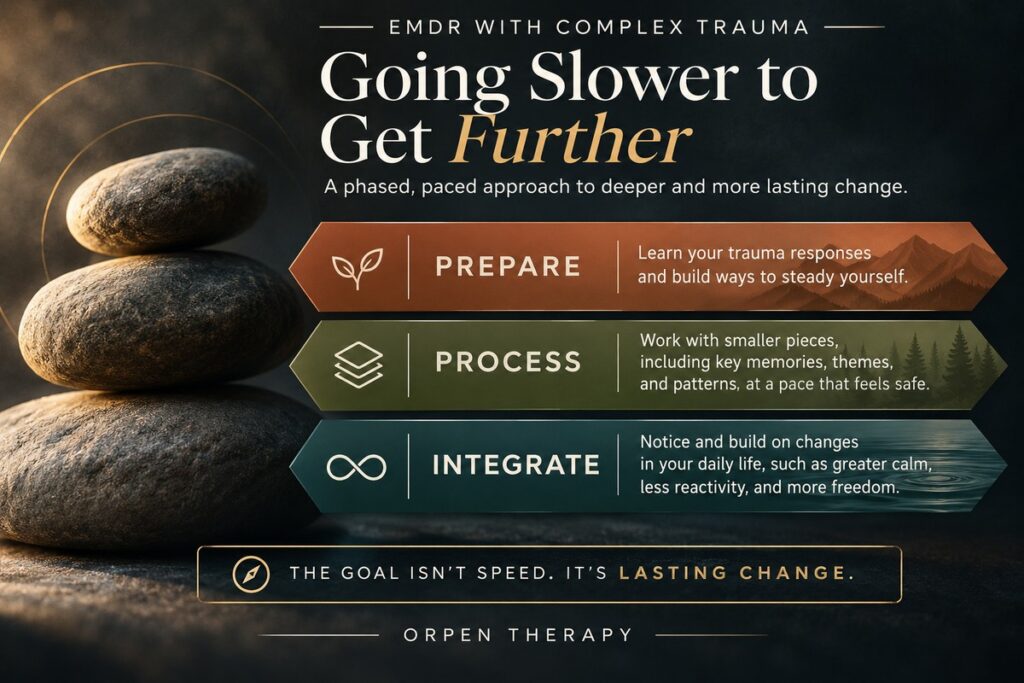
Going Slower to Get Further
When people hear “go slower,” some picture months of talking before the real EMDR starts. That’s not what I mean, and the research doesn’t point there either.
A large 2020 review pulled together 104 trials of adults with complex trauma histories, including survivors of childhood abuse, veterans and refugees. Trauma-focused therapies were the most effective treatments for PTSD and depression. Phase-based approaches, which build skills before and alongside processing, helped most with emotional ups and downs and with relationship problems (Melton et al., 2020).
Here’s my position. Going slower means both of those things working together: a real preparation phase, then processing in smaller pieces, with steady attention to how you’re doing along the way. Preparation is phase two of EMDR’s eight phases, and I walk through all of them in my post on the 8 phases of EMDR. With complex trauma, that phase usually gets more room.
A big part of preparation is learning your own trauma response types. Most people know fight and flight. Freeze and fawn are just as common, and they’re harder to spot because they can look like calm or kindness.
- Fight: irritability, arguing, needing to stay in control
- Flight: staying busy, overworking, leaving before you can be left
- Freeze: going blank, numb or foggy, losing chunks of time
- Fawn: smoothing things over, saying yes on autopilot, tracking everyone else’s mood
Morgan turns out to be mostly fawn, with a side of flight. During preparation, Morgan starts noticing the moment their shoulders creep up in a work meeting, and practices a few ways of coming back into the room: feeling their feet on the floor, slowing their breath, calling up an image of a place that feels steady. This part is quiet work. It’s also the groundwork that lets the later work stay steady.
When the Memories Start to Move
Processing is the part EMDR is known for, and it’s often what people mean when they ask how to process trauma. You hold a piece of a memory in mind while the therapist guides bilateral stimulation, such as eye movements or alternating taps, and your brain starts linking that old material to what you know now.
With complex trauma, there’s rarely one memory to target. There might be hundreds of moments that taught the same lesson. So the work tends to focus on clusters and themes: an early memory, the worst one, the most recent one, or a belief like “I’m only safe if everyone around me is happy.” Working on a few representative memories often loosens the whole cluster.
One trial I find especially encouraging followed adult survivors of childhood abuse who did skills training first and then EMDR. PTSD symptoms dropped substantially, and the gains held at a one-year follow-up. What caught my attention was the timing. Dissociation and emotion regulation didn’t shift much during the skills phase on its own. They improved once trauma processing started (Wigard et al., 2024). Preparation gets you ready. Processing is where a lot of the change happens.
Picture Morgan a few months in, working on a memory of a kitchen, a cabinet door slamming and a kid standing very still by the counter. At first the image is sharp and Morgan’s chest is tight. Over a few sets, it gets smaller and farther away. At some point Morgan says something like, “That kid was doing the best they could.” The memory is still there. It just doesn’t grip the same way. In the weeks that follow, Morgan still notices their shoulders rise in meetings. More often now, they say what they think anyway.
EMDR for PTSD has the deepest research base of anything EMDR is used for, and the research on complex trauma is younger but pointing in a hopeful direction. People typically report some stirred-up days along the way, and everyone’s path is different, so there’s no guarantee of how any one session will feel. I cover what’s common and when to pause in my post on EMDR side effects.
Questions About EMDR for More Complex Trauma
How is EMDR different when the trauma is more complex?
The core is the same: the same eight phases and the same bilateral stimulation. What usually changes is the pacing. There’s often more time in preparation, more attention to dissociation, work on clusters of memories and themes, and more sessions overall. A good EMDR therapist adjusts as you go, based on how you’re responding.
Do I need clear memories of my childhood to do EMDR?
No. Many people with complex trauma have gaps, or memories that feel more like a mood or a body sensation than a story. EMDR can start with what you notice now, like a reaction in a meeting or a tightness in your chest, and work from there. Your memories don’t need to be complete or proven, and a careful therapist won’t go digging for memories you don’t have.
What if I dissociate or shut down during a session?
That’s common, and it’s part of why preparation matters so much with complex trauma. Your therapist watches for signs that you’re drifting, slows down, and helps you come back with grounding skills you’ve already practiced. It helps to tell your therapist what shutting down looks like for you, so you can both catch it early. If you’re wondering whether now is the right time to start, my side effects post also talks about readiness.
A Note Before You Go
If parts of Morgan’s story felt familiar, I want to say something plainly: the ways you adapted made sense. Fawning, freezing and staying busy were smart responses to a hard situation, and they probably got you through it. They’re also allowed to retire.
You don’t have to untangle the whole drawer at once. If you’re in Seattle or anywhere in Washington, I’d be glad to talk with you about whether EMDR fits where you are right now, at a pace that respects how long you’ve been carrying this. You can learn more about EMDR therapy in Seattle, in person or virtually.
About the Author
Sean Orpen, MS, LMFT-S, CST-S, is a licensed marriage and family therapist, certified sex therapist and EMDRIA-certified EMDR therapist in Seattle with more than 20 years of experience. He offers EMDR in person and virtually across Washington.
References
Bellis, M. A., Hughes, K., Ford, K., Ramos Rodriguez, G., Sethi, D., & Passmore, J. (2019). Life course health consequences and associated annual costs of adverse childhood experiences across Europe and North America: A systematic review and meta-analysis. The Lancet Public Health, 4(10), e517–e528. https://doi.org/10.1016/S2468-2667(19)30145-8
Melton, H., Meader, N., Dale, H., Wright, K., Jones-Diette, J., Temple, M., Shah, I., Lovell, K., McMillan, D., Churchill, R., Barbui, C., Gilbody, S., & Coventry, P. (2020). Interventions for adults with a history of complex traumatic events: The INCiTE mixed-methods systematic review. Health Technology Assessment, 24(43), 1–312. https://doi.org/10.3310/hta24430
Wigard, I., Meyerbröker, K., Ehring, T., Topper, M., Arntz, A., & Emmelkamp, P. (2024). Skills training followed by either EMDR or narrative therapy for posttraumatic stress disorder in adult survivors of childhood abuse: A randomized controlled trial. European Journal of Psychotraumatology, 15(1), Article 2332104. https://doi.org/10.1080/20008066.2024.2332104