
In a Dutch trial of 140 adults with PTSD, the people who received EMDR averaged about six and a half weekly sessions, each 90 minutes long, and their symptoms dropped faster than those of people in a comparison trauma therapy (Nijdam et al., 2012). By the end, both groups had improved about equally. The early speed is what catches people’s attention, especially anyone who assumed trauma work had to take years.
Numbers like that make more sense once you know what happens inside the room. The standard EMDR protocol gives every course of treatment the same basic shape, built around the 8 phases of EMDR, whether someone comes in for one hard memory or a long history of them. If eight phases sounds like a lot, you’re definitely not the only one who feels that way. I think knowing the map ahead of time makes the work easier, because uncertainty is its own kind of stress. If you’re new to EMDR altogether, my plain-language overview of EMDR is a good place to start, and my EMDR therapy page covers how I work in Seattle and online.
The 8 Phases of EMDR at a Glance
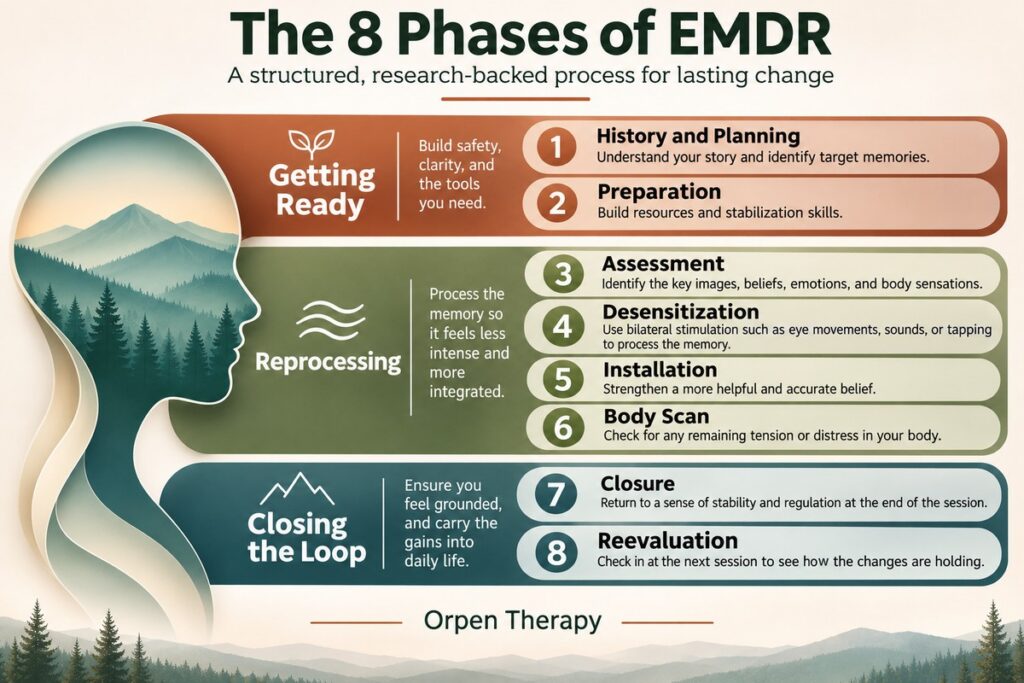
The 8 phases of EMDR are history taking, preparation, assessment, desensitization, installation, body scan, closure and reevaluation. The first two build trust and coping skills, the middle four do the reprocessing, and the last two make sure each session ends steady and the next one starts from an accurate picture of what has changed.
Here’s the full sequence in one place:
1. History taking: what brings you in, what you want to change, and which memories seem connected to it.
2. Preparation: learning how EMDR works and practicing ways to settle yourself.
3. Assessment: choosing one memory and naming the image, belief and body feeling attached to it.
4. Desensitization: short rounds of bilateral stimulation while the memory loses its charge.
5. Installation: strengthening a more accurate belief about yourself.
6. Body scan: checking for any leftover tension and clearing it.
7. Closure: bringing you back to steady before the session ends.
8. Reevaluation: starting the next session by checking what held and what shifted.
The stages of EMDR can stretch across several sessions or share one. The first two might take a few meetings, while phases three through seven often happen in a single session and then repeat for the next memory. A clinical review in Innovations in Clinical Neuroscience lays out the same eight defined steps and notes that the back-and-forth stimulation can come from eye movements, knee taps, headphones or handheld tappers.
Getting Ready: Phases 1 and 2
Picture planning a long hike in the Cascades. Before you set foot on the trail, you check the route, look at the weather and pack the right layers.
The first two phases are that planning. In history taking, your therapist gets curious about what’s bothering you now and what might sit underneath it. You decide how much detail to share. Often the work starts with something specific in the present, like the knot in your stomach before a certain kind of conversation, and traces back to the earlier moments that taught your body to brace that way. I find specificity helps here. “I’m anxious all the time” is hard to work with. “My chest tightens when someone sounds disappointed in me” gives us somewhere to start.
Preparation is where you build your footing. Your therapist explains what processing will feel like, and you practice ways to steady yourself when feelings rise. One common tool is a calm place exercise: you picture somewhere you feel settled and notice what that’s like in your body. You’ll also try the bilateral stimulation on neutral material, so the eye movements, taps or tones feel familiar before they’re ever paired with something hard.
Some people get impatient in this phase, and I understand why. You came in to feel better, and practicing breathing can feel like a detour. Here’s the paradox: slowing down at the start is often what lets the later work move quickly. I’d think of preparation as an investment. Time that feels like an investment tends to pay off. Time that feels like a sacrifice tends to get rushed.
The Heart of the Work: Phases 3 to 6
So what happens in an EMDR therapy session once processing begins? Here’s a made-up example to show the rhythm.
Imagine someone whose stomach still drops whenever a car brakes hard behind them, years after a minor fender bender. In the assessment phase, their therapist asks them to pick the worst image from that day, maybe the moment they saw the other car in the mirror. Then they name the belief that comes with it (“I’m not safe”), the belief they’d rather hold (“I’m safe now”), the emotion, and where they feel it in their body. They rate how disturbing the memory feels from 0 to 10.
Desensitization comes next. The therapist starts a set of bilateral stimulation that might last 30 seconds or so, then pauses and asks, “What are you noticing?” The answer might be an image, a thought, a sensation or nothing much at all. Usually the therapist says, “Go with that,” and starts another set. The person doesn’t have to steer. Their brain moves from one piece to the next, sometimes in directions that seem unrelated at first, and the number slowly comes down.
Once the memory feels much less charged, installation pairs it with the belief they chose, and the therapist checks how true it feels now. Then comes the body scan: holding the memory and the new belief together while noticing the body from head to toe. If any tension is still there, a few more sets usually clear it.
Through all of it, the person is awake, talking and in charge. Most people describe it as tiring in the way a good workout is tiring: effort you chose, with something to show for it.
Closing the Loop: Phases 7 and 8
Closure happens at the end of every session, whether or not a memory is fully processed. Your therapist makes sure you leave steady. That might mean returning to your calm place, using one of the skills from preparation, and talking briefly about the next few days. Processing can keep going quietly after you leave, so you may be asked to jot down anything that comes up.
Reevaluation opens the next session. Your therapist checks the memory you worked on last time and asks what you noticed during the week. If the number stayed low, you move to the next target. If something new surfaced, it becomes part of the plan. I like this phase because it keeps the work honest. The plan is a guess, and reevaluation lets you update it with real information.
I’ll cover the after-effects some people notice between sessions in a separate post on EMDR side effects.
How Long Does EMDR Take?
The honest answer is that it depends, and I’d be wary of anyone who gives you a number before getting to know you.
Most EMDR sessions run 60 to 90 minutes. Longer sessions give processing room to settle before closure, and the research points the same way: a meta-analysis of 26 randomized controlled trials found that sessions longer than 60 minutes were linked to bigger drops in anxiety and depression.
As for how many sessions of EMDR are needed, a single upsetting event can sometimes be processed in a handful of sessions, which is roughly what the Dutch trial found. Many people notice meaningful change within six to twelve sessions. Childhood trauma, years of repeated stress or several unrelated events usually take longer, mostly because preparation takes longer and there’s more to work with.
A few things tend to shape the timeline:
- How many distinct memories or themes are part of the picture
- How much support and stability you have in daily life
- Whether you meet weekly or more often
- How much preparation you need before processing feels manageable
I’d encourage you to choose the path and let the pace be what it is. The best measure is change where it counts: the drive that feels ordinary again, the conversation you stop dreading. Those tell you more than any session count.
Questions People Ask Before Starting
Can I stop partway through processing?
Yes, at any time. Before processing starts, you and your therapist agree on a stop signal, often a raised hand. Using it doesn’t undo your progress. Your therapist helps you settle, and you decide together whether to keep going that day or pick it up next time.
What do I do between sessions?
Mostly, live your life. Some therapists ask you to keep a short log of dreams, memories or reactions that come up, and to use your calming skills if something feels stirred up. There’s no homework where you replay the memory on your own.
What if nothing seems to happen?
That’s common in the first few sets. Sometimes the brain needs a few rounds to warm up, and sometimes the target needs adjusting. A good therapist will slow down, check the setup and change course if needed.
If you’ve been carrying something that still feels too close, I’d be glad to talk with you about whether EMDR fits. You can learn how I work and schedule a consultation on my EMDR therapy page. I see clients in Seattle and online across Washington.
About the Author
Sean Orpen, MS, LMFT-S, CST-S, is a licensed marriage and family therapist, clinical supervisor and EMDRIA-certified EMDR therapist in Seattle with more than 20 years of experience.
References
Chen, Y.-R., Hung, K.-W., Tsai, J.-C., Chu, H., Chung, M.-H., Chen, S.-R., Liao, Y.-M., Ou, K.-L., Chang, Y.-C., & Chou, K.-R. (2014). Efficacy of eye-movement desensitization and reprocessing for patients with posttraumatic stress disorder: A meta-analysis of randomized controlled trials. PLoS ONE, 9(8), e103676. https://doi.org/10.1371/journal.pone.0103676
Gainer, D., Alam, S., Alam, H., & Redding, H. (2020). A flash of hope: Eye movement desensitization and reprocessing (EMDR) therapy. Innovations in Clinical Neuroscience, 17(7–9), 12–20. https://pmc.ncbi.nlm.nih.gov/articles/PMC7839656
Nijdam, M. J., Gersons, B. P. R., Reitsma, J. B., de Jongh, A., & Olff, M. (2012). Brief eclectic psychotherapy v. eye movement desensitisation and reprocessing therapy for post-traumatic stress disorder: Randomised controlled trial. The British Journal of Psychiatry, 200(3), 224–231. https://doi.org/10.1192/bjp.bp.111.099234