
It’s a Tuesday evening, a few hours after your third EMDR session. You made it home and ate something, and now you’re standing at the counter waiting for the kettle, feeling oddly heavy, like you spent the whole day moving furniture. A memory you haven’t thought about in years drifts in while you’re rinsing a mug. Later, your dreams are vivid enough that you wake up once and lie there for a minute, sorting out where you are.
If you’ve had nights like that, you’re in good company. They’re some of the most common EMDR side effects, and they’re also some of the least talked about before people start. I want you to hear about them ahead of time, so they don’t catch you off guard at 11 p.m.
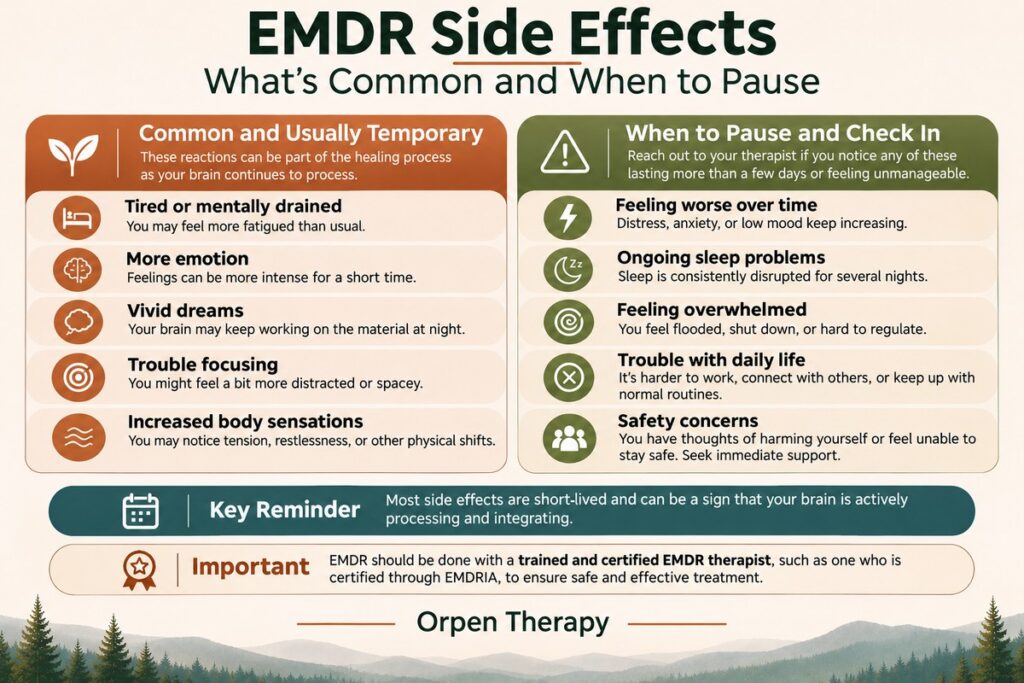
EMDR side effects are usually mild and short-lived. The most common are tiredness, vivid dreams, a stirred-up mood and old memories surfacing in the day or two after a session, sometimes called an EMDR hangover. They tend to ease on their own as your brain keeps working through what came up in session.
Below are four beliefs about EMDR I hear often, and each one holds a piece of the truth. If you’re newer to EMDR, start with my plain-language guide to what EMDR is. My EMDR therapy page explains how I work with it here in Seattle.
Myth: EMDR Is Risky for Most People
Searching for the dangers of EMDR therapy can turn up some alarming stories, and I understand why people feel nervous. You’re being asked to deliberately bring up something painful.
Kevin van Schie and Suzanne van Veen reviewed 51 randomized trials of EMDR for PTSD and checked how each one handled side effects (van Schie & van Veen, 2026). Only nine mentioned adverse effects at all. Where participants did report them, they were typically mild and temporary. They also found little support for the worry that EMDR blurs memories or creates false ones.
I appreciate that paper because it holds EMDR to a high standard. Most trials never tracked side effects carefully, so the field has less safety data than it should. Two things are true at once: what we know points to EMDR being safe for most people, and the research on harms is thinner than the research on benefits.
In practice, a good EMDR therapist asks how you’ve been between sessions, every time, and you get to answer honestly, even when the answer is “worse.”
Can EMDR Make Things Worse?
This question sits behind a lot of hesitation, and the belief underneath it usually sounds like this: if I feel worse after a session, something went wrong.
Feeling more stirred up for a few days is common in trauma-focused therapy, and on its own it tells you very little about whether therapy is helping. Memories that have been sitting still start to move, and movement can feel uncomfortable before it feels like relief. Think about cleaning out a garage you’ve avoided for years. After the first afternoon, the place looks worse than when you started, with boxes everywhere. That mess is part of the work.
Here’s what an EMDR hangover often looks like:
- Feeling tired, foggy or flat for the rest of the day
- Dreams that are more vivid than usual
- Memories, images or body sensations popping up at random moments
- Emotions closer to the surface, including irritability or tears
- Noticing new connections between your past and your present
People typically report that this settles within a day or two. Everyone responds differently, though, and no one can guarantee how a particular session will land for you. People often say ordinary things help: a lighter evening, food and water, a little movement, and the calming skills they practiced during preparation. Some find it useful to jot down what surfaces and bring it to their next session. Your own therapist can help you work out what fits you. The closing steps of every session are built for this, and I walk through them in my post on the 8 phases of EMDR.
So, can EMDR make things worse? Sometimes, briefly, in the ways listed above. It becomes a real concern when the stirring doesn’t settle. Talk to your therapist, and consider pausing processing, if:
- Distress keeps building in the days after a session
- You’re losing time, feeling unreal or far away from yourself more than usual
- Urges to drink, use or hurt yourself come back
- You can’t get through work or take care of the people who rely on you
Pausing is a normal part of EMDR. Your therapist can shift back to preparation and coping skills, slow the pace, or work with smaller pieces of a memory. If you ever feel unsafe, you can call or text 988, the Suicide and Crisis Lifeline, any time of day.
Why Is EMDR So Controversial?
If you’ve done any reading, you’ve probably run into the skepticism. Why is EMDR so controversial? I see three honest reasons.
The first is its origin story. EMDR grew out of an observation about eye movements and distressing thoughts, and early enthusiasm ran ahead of the evidence. Critics still debate how much the eye movements themselves add.
The second is study quality. A 2025 review by Emma Simpson and colleagues gathered the randomized trials of EMDR for adult PTSD published since 2018 (Simpson et al., 2025). Most were small, and all but one carried a moderate or high risk of bias. That’s a fair criticism.
The third is how EMDR looks from the outside. A therapist moving their fingers back and forth can read like a gimmick, especially when it gets marketed as a miracle.
Here’s my position. The same review found EMDR worked better than a waitlist or usual care, and about as well as trauma-focused cognitive behavioral therapy, one of the most established trauma treatments. EMDR also tended to take less of people’s time. I’m comfortable recommending a treatment with that track record, and honest that the science is still maturing.
Myth: You Have to Have Your Life Together First
A lot of people assume they’re too much of a mess for EMDR: too anxious, too many hard years, too many diagnoses. When they ask who is not a good candidate for EMDR therapy, they’re often quietly asking whether it’s them.
Usually it isn’t. In a Dutch trial of 121 adults with PTSD from repeated childhood abuse, Noortje van Vliet and colleagues looked at whether borderline personality disorder, self-injury, suicidal thoughts or dissociation predicted a worse response to EMDR (van Vliet et al., 2024). None of them held up as a reliable predictor over time. The authors concluded that these characteristics shouldn’t, on their own, be a reason to withhold trauma treatment. The strongest predictor of a slower response was how severe someone’s PTSD was at the start, which mostly means some people need more sessions.
Readiness still matters. That same trial excluded people in an acute suicidal crisis, people facing ongoing abuse and people with active alcohol or drug dependence, and those are the situations where I’d slow down too. In my view, EMDR may not be the right next step yet if:
- You’re in crisis and need stabilization and safety first
- You’re still in danger, such as living with someone who is hurting you
- Substance use is active and unmanaged
- Your life has no room right now for a tired evening or a rough couple of days
None of these is a permanent label. They’re about timing. Most of them change, and EMDR can wait for you. And if you’re unsure whether now is the right time, that’s a good thing to talk through in a consultation for EMDR therapy.
More Questions About EMDR Side Effects
How long does an EMDR hangover last?
People typically report that the tiredness and stirred-up feelings ease within a day or two, though everyone is different and there’s no guarantee of how long it will last for you. If they’re still building after a week, or getting in the way of daily life, tell your therapist, so the next session can slow down or return to coping skills for a while.
Is it okay to go back to work right after a session?
Many people do, once they know how their body responds. Some find a little buffer helps at first, like a walk before the next meeting. Virtual sessions skip the commute and also the transition time, which is worth talking through with your therapist.
Can I do EMDR while taking psychiatric medication?
Yes, many people do. Medication can help keep symptoms in a range where processing feels manageable. Let your EMDR therapist know what you’re taking, and talk with your prescriber before changing anything.
Should my partner or family know I’m doing EMDR?
That’s your call. It can help to tell one or two people you trust, whether that’s a partner, a close friend or a roommate, so they understand why you might be tired or quiet after sessions. You don’t owe anyone the details of what you’re working on. A line like “I had a heavy therapy day, so I might go to bed early” can be enough.
Back to That Tuesday Night
Go back to that evening at the counter: the heavy tiredness, the memory drifting in, the dream that woke you. From the inside, it can feel like something is wrong. From a little further back, it looks like a mind that finally has room to work on something it’s been carrying. Most nights like that pass by morning, and the next time that memory shows up, it often lands a little lighter.
If side effects are what’s holding you back, bring those questions to a consultation. They deserve real answers. You can read more about EMDR therapy in Seattle, including how I offer it in person and virtually across Washington.
I’m Sean Orpen, MS, LMFT-S, CST-S, a licensed marriage and family therapist, certified sex therapist and EMDRIA-certified EMDR therapist in Seattle.
References
Simpson, E., Carroll, C., Sutton, A., Forsyth, J., Rayner, A., Ren, S., Franklin, M., & Wood, E. (2025). Clinical and cost-effectiveness of eye movement desensitization and reprocessing for treatment and prevention of post-traumatic stress disorder in adults: A systematic review and meta-analysis. British Journal of Psychology, 116(4), 1128–1149. https://doi.org/10.1111/bjop.70005
van Schie, K., & van Veen, S. C. (2026). Adverse effects of eye movement desensitization and reprocessing therapy: A neglected but urgent area of inquiry. Current Opinion in Psychology, 67, Article 102155. https://doi.org/10.1016/j.copsyc.2025.102155
van Vliet, N. I., Huntjens, R. J. C., van Dijk, M. K., Huisman, M., Bachrach, N., Meewisse, M.-L., van Haren, S., & de Jongh, A. (2024). Predictors and moderators of treatment outcomes in phase-based treatment and trauma-focused treatments in patients with childhood abuse-related post-traumatic stress disorder. European Journal of Psychotraumatology, 15(1), Article 2300589. https://doi.org/10.1080/20008066.2023.2300589