
“I don’t think I have trauma. I just can’t turn my brain off.”
I hear some version of that from people who are curious about EMDR but not sure it’s meant for them. They’ve read that EMDR is a trauma therapy, and what they live with feels more ordinary than that: a 2 a.m. inventory of everything that could go wrong, a tight chest before a meeting, or a thought that keeps looping until they check the stove one more time.
Those are fair questions, so this post is built around them, one at a time.
Does EMDR Help With Anxiety?
EMDR for anxiety can help when worry, panic or fear is tied to earlier experiences that still feel charged. It works with the memories behind the anxiety, the situations that set it off now and the future scenarios you dread. Research is strongest for panic disorder and phobias, and promising but thinner for generalized worry, OCD and sleep.
The clearest evidence comes from panic. In a Dutch trial, 84 adults with panic disorder were randomly assigned to 13 weekly sessions of either EMDR or cognitive behavioral therapy, one of the best-studied treatments for panic. EMDR worked as well as CBT for panic symptoms and for quality of life (Horst et al., 2017).
The wider picture is more mixed. A large 2020 meta-analysis found promising results for phobias and test anxiety, but the studies were few and many carried a high risk of bias. The authors concluded there wasn’t yet enough evidence to recommend EMDR beyond PTSD with confidence (Cuijpers et al., 2020).
So, does EMDR help with anxiety? For many people, yes. I also want you to know the research on anxiety is younger than the research on trauma, and I think a good therapist should be upfront about that. You can read how I use EMDR on my EMDR therapy page.
Why Would a Trauma Therapy Work on Worry?
Anxiety looks forward. Memory looks back. It’s reasonable to wonder how a memory-based therapy helps with a future-focused problem.
Here’s the link. Your brain predicts what’s coming by drawing on what’s already happened, and some of those earlier experiences get stored with their full emotional charge still attached. When that happens, they keep shaping predictions long after the situation has changed. Think of a smoke alarm that went off during a real fire years ago and now goes off every time someone makes toast. The alarm still works. It’s going off for toast because of what it learned during the fire.
Those charged memories don’t have to be dramatic. They can be the moment you froze in front of the class in fourth grade, a parent who worried out loud about everything, or the first panic attack itself. Panic memories often look a lot like trauma memories, and panic disorder often starts after a distressing life event. That overlap is part of why researchers tested EMDR for panic in the first place (Horst et al., 2017).
When the charge comes off those memories, many people find the alarm quiets down too.
What Does EMDR for Anxiety Look Like in Session?
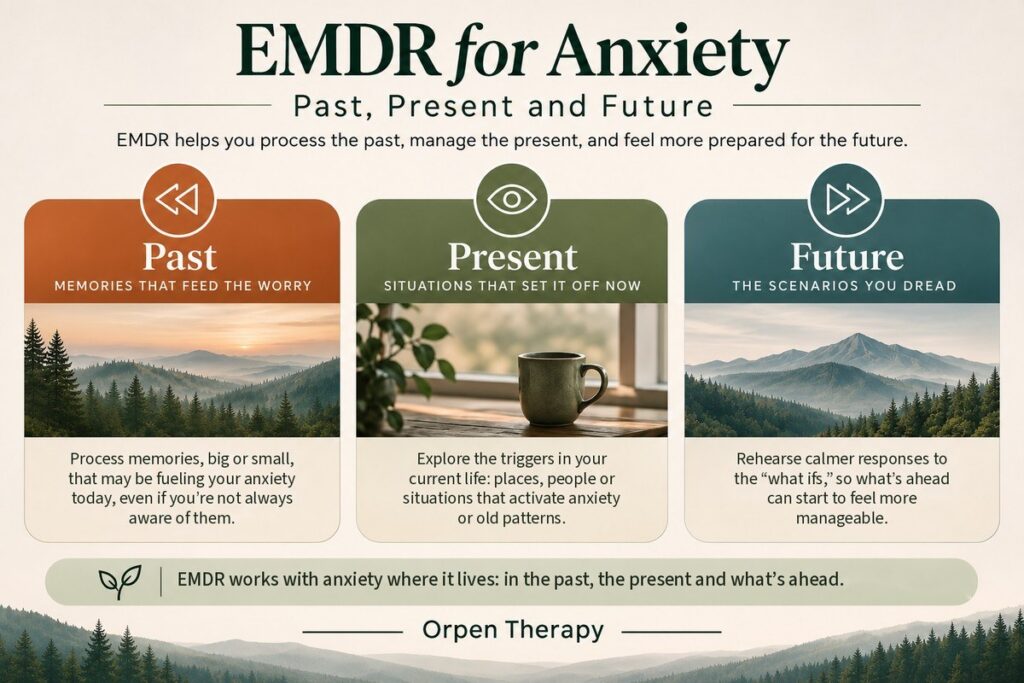
EMDR follows the same eight phases whatever it’s being used for, and I describe each one in my post on the 8 phases of EMDR. For anxiety, the processing usually works on three time frames.
- Past: the memories that seem to feed the worry, such as the first panic attack in a grocery store or an early experience of being humiliated
- Present: the situations that set it off now, like a crowded checkout line or an email from your manager with no subject line
- Future: the scenarios you dread, imagined with the calmer response you’d like to have
You don’t need to work through your whole life story. Many people focus on a handful of memories and triggers. People typically report that the charge on a memory drops over a few sets, though everyone responds differently and there’s no guarantee of how quickly that will happen for you. It’s also common to feel a bit stirred up for a day or two afterward, which I cover in my post on EMDR side effects.
Can EMDR Help With OCD?
EMDR for OCD is an area where I want to be especially careful. Exposure and response prevention, a form of CBT, has the strongest track record for OCD, and I wouldn’t offer EMDR as a replacement for it.
A 2021 review of 90 studies on EMDR for conditions other than PTSD found positive results across many areas, including OCD, other anxiety disorders, performance anxiety and sleep problems. The authors were also clear that more rigorous research is needed before drawing firm conclusions (Scelles & Bulnes, 2021).
Where EMDR can fit is alongside other OCD treatment, especially when obsessions are tied to distressing memories or vivid intrusive images. For example, someone whose fear of contamination started after a frightening illness in the family might work on that memory with EMDR while continuing exposure work. The two approaches can support each other.
Is Bilateral Stimulation for Anxiety Something You Can Use Between Sessions?
Bilateral stimulation is the side-to-side part of EMDR: eye movements, alternating taps or tones. I explain how it works in my plain-language guide to EMDR.
Some EMDR therapists teach a gentle version of bilateral stimulation for anxiety during the preparation phase. One common form is the “butterfly hug,” where you cross your arms over your chest and slowly tap your shoulders, left and right, while you bring a calming image to mind. It’s meant for settling. Working through memories happens in session, with your therapist.
Many people say it helps them come down a notch when anxiety spikes. Others don’t notice much. Like any coping skill, it fits some people better than others, and your own therapist is the best person to help you figure out whether it belongs in your toolkit.
Can EMDR Help With Sleep and Depression Too?
Anxiety rarely travels alone. It tends to bring poor sleep and low mood along with it, and each one makes the others harder.
EMDR for sleep hasn’t been studied as a stand-alone treatment as much as EMDR for anxiety or PTSD, but sleep problems are among the areas where reviews have found positive results (Scelles & Bulnes, 2021). People typically report sleeping better as the charge comes off what was keeping them up, although that varies a lot from person to person.
Depression has a bit more research behind it. A 2021 meta-analysis of EMDR for depression found a large effect on depressive symptoms, and results comparable to other active treatments. The authors noted the studies were few and small, so the findings are encouraging but early (Carletto et al., 2021). In practice, EMDR therapy for anxiety and depression often happens at the same time, because the same memories can feed both. If depression is the main thing you’re carrying, my individual therapy page describes other ways I work with it.
Anything Else People Ask About EMDR for Anxiety?
Does EMDR work for social anxiety?
It can. Social anxiety often traces back to specific moments of embarrassment, rejection or being singled out, which gives EMDR something concrete to work with. Performance anxiety is among the areas where research has found positive results, though the studies are still small.
Can EMDR help with a specific phobia, like flying or needles?
Phobias are among the better-supported uses of EMDR outside of trauma, with the same caution about small studies. The work often starts with the first frightening experience, then moves to present-day triggers and a rehearsal of the next flight or appointment.
Can EMDR help with health anxiety?
Health anxiety hasn’t been studied much on its own. For some people, it connects to a frightening medical experience or watching someone they love get sick, and those memories can be worked on with EMDR. It’s always worth checking in with your doctor about physical symptoms, too.
What if my anxiety doesn’t seem to have a starting point?
That’s common. Your therapist can start from how the anxiety feels in your body today and notice what memories come up, or focus on present triggers and future situations. You don’t need to find a dramatic origin story. Some anxiety has strong biological roots, and in those cases EMDR may be one part of a broader plan.
Can EMDR be combined with other therapy I’m already doing?
Often, yes. Many people do EMDR with one therapist while continuing other work, or add EMDR sessions to an existing treatment. It helps when everyone involved knows what you’re working on, so the pieces fit together.
Here’s a question to sit with. If your anxiety could talk, what would it say it’s trying to protect you from? The answer often points to a memory, and memories are where EMDR does its best work. If you’d like to explore that with someone, I offer EMDR therapy in Seattle and virtually across Washington.
I’m Sean Orpen, MS, LMFT-S, CST-S, a licensed marriage and family therapist, certified sex therapist and EMDRIA-certified EMDR therapist in Seattle.
References
Carletto, S., Malandrone, F., Berchialla, P., Oliva, F., Colombi, N., Hase, M., Hofmann, A., & Ostacoli, L. (2021). Eye movement desensitization and reprocessing for depression: A systematic review and meta-analysis. European Journal of Psychotraumatology, 12(1), Article 1894736. https://doi.org/10.1080/20008198.2021.1894736
Cuijpers, P., van Veen, S. C., Sijbrandij, M., Yoder, W., & Cristea, I. A. (2020). Eye movement desensitization and reprocessing for mental health problems: A systematic review and meta-analysis. Cognitive Behaviour Therapy, 49(3), 165–180. https://doi.org/10.1080/16506073.2019.1703801
Horst, F., Den Oudsten, B., Zijlstra, W., de Jongh, A., Lobbestael, J., & De Vries, J. (2017). Cognitive behavioral therapy vs. eye movement desensitization and reprocessing for treating panic disorder: A randomized controlled trial. Frontiers in Psychology, 8, Article 1409. https://doi.org/10.3389/fpsyg.2017.01409
Scelles, C., & Bulnes, L. C. (2021). EMDR as treatment option for conditions other than PTSD: A systematic review. Frontiers in Psychology, 12, Article 644369. https://doi.org/10.3389/fpsyg.2021.644369