
EMDR has one of the clunkiest names in therapy, and I think that name keeps a lot of people away from something that could help them. Eye movement desensitization and reprocessing sounds like a procedure you’d sign a waiver for. The experience itself is much more ordinary. You sit with a therapist, bring a hard memory to mind for short stretches, and follow a simple back-and-forth rhythm while your brain does some sorting it couldn’t finish the first time.
If you typed “what is EMDR” into a search bar after a friend, a doctor or a podcast mentioned it, you’re in good company. This is the plain-language version: where it came from, what seems to happen in the brain, who it tends to help, and the questions people ask before they start. If you’re in the Seattle area and already know you want to explore it, my EMDR therapy page covers how I work with it.
What Is EMDR?
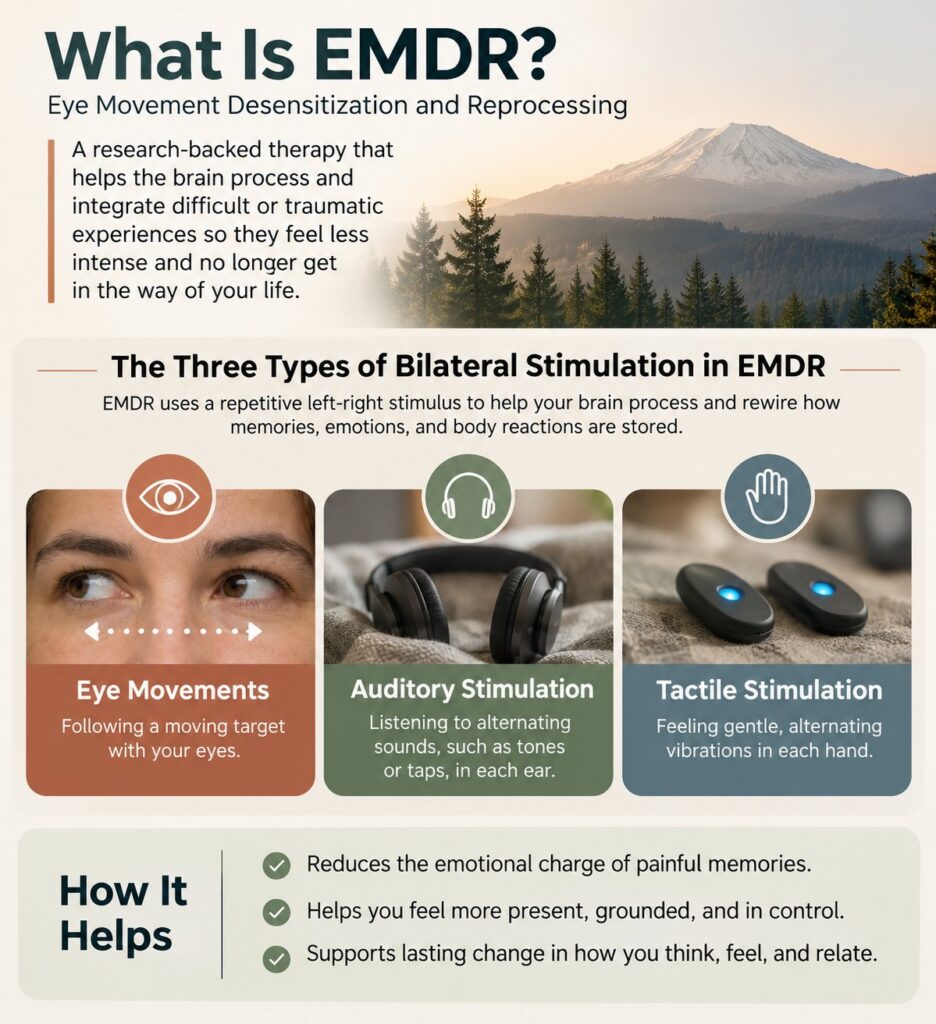
EMDR, short for eye movement desensitization and reprocessing, is a structured therapy that helps the brain reprocess distressing memories so they lose their emotional charge. While you briefly hold a memory in mind, the therapist guides bilateral stimulation, such as side-to-side eye movements or alternating taps. You still remember the event, and it no longer feels like it’s happening now.
Most people expect therapy for a painful memory to mean telling the story again and again until it hurts less. EMDR takes a different route. You don’t have to narrate every detail, and there’s no homework where you write the event out or replay it on your own between sessions. Francine Shapiro, the psychologist who developed EMDR, pointed to exactly this in a review of 24 randomized controlled trials: the method can bring relief without a detailed retelling of what happened.
Here’s the everyday version of the idea behind it. Think about a stack of mail you never opened. It doesn’t disappear because you stopped looking at it. It sits on the counter, and every time you walk past, something in you tightens a little. Some memories get stored that way: unopened, unfiled, still carrying the full weight of the moment they happened. A tone of voice, a smell or a certain kind of silence brushes past the pile, and your body reacts as if the event is still in progress.
EMDR is a way of finally opening that mail with someone beside you. The memory gets looked at in small, manageable pieces, connected to what you know now, and put somewhere it belongs. You still remember it. It just stops running the room.
Where the Name Comes From
People often ask what does EMDR stand for, and the answer explains a lot about the method, including why the name is a little misleading.
Eye movement desensitization and reprocessing has three parts:
- Eye movement refers to the original technique. Shapiro developed the approach in the late 1980s, using guided side-to-side eye movements while a person held a distressing memory in mind.
- Desensitization is the part most people notice first. Over the course of processing, the emotional charge of a memory comes down. Something that used to make your chest tighten starts to feel more like information.
- Reprocessing is, in my view, the heart of it. The memory gets linked up with the rest of what you know: that you survived, that it wasn’t your fault, that you’re older now and have more choices than you did then.
The reason I call the name misleading is that “eye movement” sounds like the whole point. Over the years, clinicians found that other forms of back-and-forth stimulation can do similar work, so many people now do EMDR with tapping or tones instead. The eye movements were where the method started. The reprocessing is what people tend to remember afterward.
Bilateral Stimulation and the Brain
Bilateral means two-sided. The bilateral stimulation EMDR uses is simply a rhythm that alternates between left and right. In a session, that might look like following a therapist’s hand or a moving light with your eyes, holding small buzzers that pulse in each palm, or listening to tones that switch between your ears through headphones. Online EMDR sessions use on-screen tools that do the same thing.
So how does EMDR work in the brain? The honest answer is that researchers are still mapping it, and I’d rather tell you that than oversell it. The explanation with the most support right now involves working memory, the mental workspace you use to hold something in mind for a few moments. That workspace has limited room. When you hold a painful memory there and track a moving light at the same time, the two tasks compete for space, and the memory tends to come back a little less vivid and a little less intense.
You can get a small taste of this at home. Picture a mildly annoying moment from last week, something with a bit of sting to it. Now keep picturing it while you count backward from one hundred by sevens. For most people, the image gets blurry and the feeling softens. Nothing about the event changed. Your attention just got divided, and the memory couldn’t hold onto all of its usual intensity.
A 2018 systematic review of 87 studies found reasonable support for this working memory explanation, along with physical changes in the body after successful EMDR, such as shifts in heart rate and arousal. The same reviewers were clear that the research on mechanisms is still early, and that larger, tighter studies are needed. I appreciate that candor. You can know a treatment helps people well before anyone can fully explain why.
Who Tends to Benefit From EMDR?
EMDR is best known as a treatment for PTSD, and that reputation is earned. A meta-analysis of 26 randomized controlled trials found that EMDR significantly reduced symptoms of PTSD in the people studied, along with their depression and anxiety. When a memory stops firing as loudly, the low mood and constant alertness built around it often ease too.
You don’t need a dramatic story to be a good candidate, though. Plenty of what keeps people stuck comes from experiences they’d never call trauma: a childhood where feelings weren’t welcome, a medical scare, a humiliating moment at school, a relationship that slowly taught you to brace for criticism. These experiences can leave the same unopened mail on the counter.
Imagine someone who freezes every time a manager says “Do you have a minute?” They know they’re good at their job, but their body hasn’t gotten the message. In an illustration like this, EMDR might trace the freeze back to older moments of being called into a room and blamed, and help the brain file them as finished.
People often find their way to EMDR for things like:
- A trauma history, recent or long past
- Anxiety, panic or a sense of always being on guard
- Shame or a harsh inner critic that won’t quiet down
- Performance anxiety, at work or in the bedroom
- Patterns they understand in their head but can’t seem to shift
I’ll go deeper on trauma and anxiety in separate posts. For now, here’s my position: fit matters more than labels. Sometimes EMDR is the right tool by itself. Sometimes it works best alongside regular talk-based individual therapy, where there’s room to make sense of what comes up between processing sessions. A good EMDR therapist will tell you honestly which they think fits you.
A Few More Things People Ask About EMDR
Is EMDR hypnosis?
No. People ask this a lot, and it makes sense given how unusual the method sounds. In hypnosis, a person is guided into a deeply relaxed, suggestible state. In EMDR, you stay fully awake, aware of the room and in charge of the process. You can stop at any point, and you’ll remember everything that happened in the session.
Do I have to describe what happened in detail?
You don’t. Your therapist needs a general sense of what you’re working on, but you can keep the specifics private if that feels better. Many people find this one of the most appealing parts of EMDR, especially if talking through the event has felt overwhelming in the past.
Can EMDR help if I don’t have a major trauma?
Yes. EMDR is often used for smaller experiences that still left a mark, like an old embarrassment that shapes how you show up at work, or a pattern of shutting down in conflict. If a memory still carries a charge when you brush past it, it can be worth working with.
Is EMDR right for everyone?
Not at every moment. If your life is in active crisis, or you don’t yet have reliable ways to calm yourself down when distress spikes, a good therapist will spend time on stabilization first. That preparation is part of EMDR. Processing works best on solid ground, and a careful therapist helps you build it first.
A Question to Sit With
Before you decide anything about EMDR, it might help to sit with one question: which memory, when something brushes past it, still lands like it’s happening now?
You don’t have to do anything with the answer today. Noticing it tells you where some of your energy is still going, and gives you something concrete to bring to a first conversation.
If you’d like to talk it through, I offer EMDR in person in Seattle, convenient to the Eastside, and online for people anywhere in Washington. You can learn more and reach out through my EMDR therapy page.
I’m Sean Orpen, MS, LMFT-S, CST-S, a licensed marriage and family therapist and clinical supervisor in Seattle with more than 20 years of experience helping people work through what keeps them stuck.
References
Chen, Y.-R., Hung, K.-W., Tsai, J.-C., Chu, H., Chung, M.-H., Chen, S.-R., Liao, Y.-M., Ou, K.-L., Chang, Y.-C., & Chou, K.-R. (2014). Efficacy of eye-movement desensitization and reprocessing for patients with posttraumatic stress disorder: A meta-analysis of randomized controlled trials. PLoS ONE, 9(8), e103676. https://doi.org/10.1371/journal.pone.0103676
Landin-Romero, R., Moreno-Alcazar, A., Pagani, M., & Amann, B. L. (2018). How does eye movement desensitization and reprocessing therapy work? A systematic review on suggested mechanisms of action. Frontiers in Psychology, 9, 1395. https://doi.org/10.3389/fpsyg.2018.01395
Shapiro, F. (2014). The role of eye movement desensitization and reprocessing (EMDR) therapy in medicine: Addressing the psychological and physical symptoms stemming from adverse life experiences. The Permanente Journal, 18(1), 71–77. https://doi.org/10.7812/TPP/13-098