
One version of the story goes like this: someone cheats because the relationship was broken, the sex had dried up, or the love had run out. The other version is harder to hear. Someone cheats on a partner they love, in a relationship they’d describe as good, and can’t fully explain it, even to themselves. Both stories are real. The second is far more common than most people expect, and it sits behind a question I hear often in my work as a sex therapist in Seattle: why do people cheat on people they love.
If you’re asking it, you’re definitely not the only one. Maybe you were hurt, and “it just happened” feels like no explanation at all. Maybe you’re the one who strayed and still can’t make sense of it. Esther Perel’s The State of Affairs offers a lens I find more useful than most: an affair is often less about the partner at home and more about the self the person was looking for (Perel, 2017).
I want to be clear about one thing before going further. Understanding why an affair happened is not the same as excusing it. The hurt is real, the betrayal is real, and the responsibility belongs to the person who made the choice. Understanding is what makes the next choice possible, whether that’s repair or a clean ending.
Why Do People Cheat on People They Love?
Most of us assume affairs are a symptom: find the problem in the relationship and you’ve found the cause. Sometimes that’s true. Research complicates the picture, though. In a study of people actively seeking affairs, low relationship quality was not a major driver for most participants. Sexual dissatisfaction was the most strongly endorsed motive, and people who sought affairs for autonomy, a wish for more independence and freedom, reported better relationship quality, not worse (Selterman et al., 2023).
That last finding is worth sitting with. It suggests some people stray not because they want out, but because something in them wants room. Perel’s version of this is that people who stray are often turning away less from their partner than from the person they themselves have become. In her words, “We’re seeking not another partner, but another self” (Perel, 2010).
Think about the version of you that shows up on a trip with old friends: looser, funnier, more spontaneous. Most of us have a self like that, one that doesn’t get much airtime between school pickups, deadlines, and the dishwasher. Many affairs start as a way to visit that self. The trouble is how the visit happens.
The Affair as a Search for a Lost Self
Here’s the paradox at the center of all this: many affairs are a bid for growth made in the most damaging way possible.
Ellyn Bader and Peter Pearson’s Developmental Model of couples therapy gives us language for it. Couples tend to begin in a stage of strong togetherness, where similarity feels like safety and difference feels like a threat. Healthy growth means moving toward differentiation: each partner defining themselves from the inside, voicing their own thoughts, wants, and limits, and tolerating the differences that surface, all while staying connected (Bader & Pearson, 1988).
When that growth stalls, people often feel a quiet suffocation they can’t name. Imagine a couple ten years in. One partner has slowly shelved the parts of themselves that create friction: the adventurous part, the sexually curious part, the part that wants something the other doesn’t. Nobody asked them to. It just felt easier. Then someone outside the relationship meets the shelved version and responds with delight. The affair feels like oxygen. What it often holds is a self that never got permission to exist at home.
Perel describes many affairs as a quest for aliveness and erotic vitality, not simply for sex (Perel, 2010). That’s a big reason I approach this work through a sex therapy lens. Desire tends to need some separateness to breathe. When two people merge so completely that there’s no one left to want, the erotic charge often goes looking for somewhere else to live. If that spark has gone quiet in your own relationship, rediscovering playfulness in intimacy is a gentler place to start.
When the Question Is “Why Did I Cheat?”
If you’re the one who strayed, you may feel stuck between defending yourself and drowning in shame. Shame shuts down curiosity, and defensiveness shuts down your partner. Asking “why did I cheat” from a place of curiosity is more useful than asking it as a verdict. Perel suggests questions like these: What did the affair give you? How did that person illuminate other parts of you? Did you think about your partner while it was happening? At what point did you realize you wanted to stay (Perel, 2010)?
Some people find themselves asking why do I want to cheat on someone I love before anything has happened. That question deserves the same curiosity. The pull is information. It points toward something you’re missing, in yourself or in the relationship, and naming it out loud is almost always a better move than acting on it in secret. Individual therapy is often the right place to sort out what belongs to you before bringing it into the room with your partner.
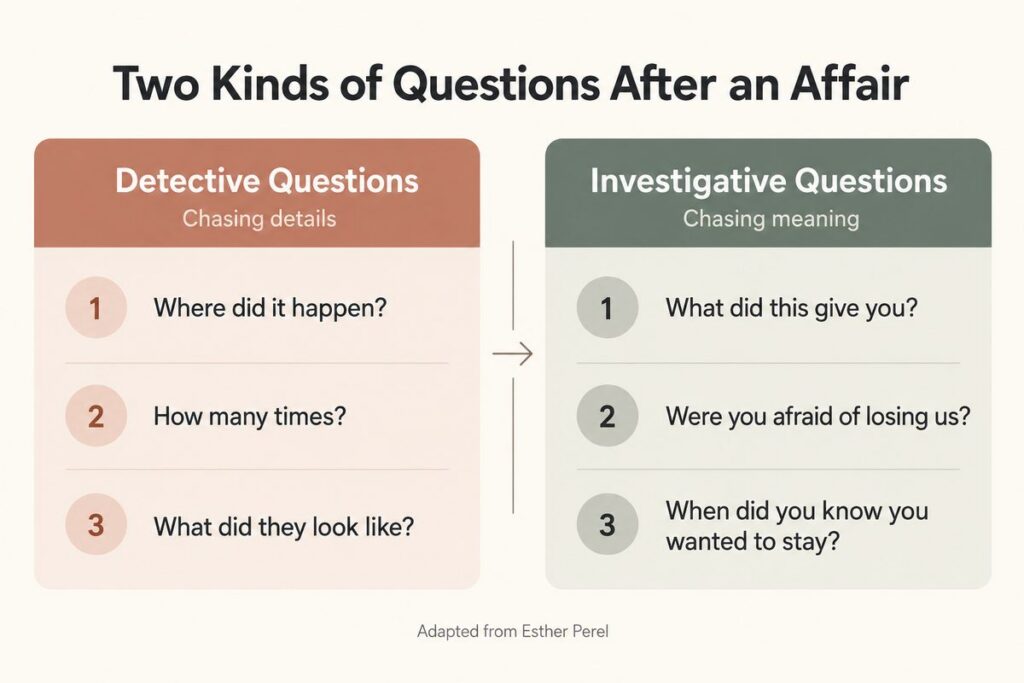
Detective Questions vs. Investigative Questions
For the partner who was hurt, the need to know can be overwhelming. Perel distinguishes between two stances (Perel, 2010). Detective questions chase details: where, how many times, what did they look like. They tend to feed comparison and obsession. Investigative questions chase meaning: What did this give you that you couldn’t find with me? Were you afraid of losing us? When did you know you wanted to stay?
Safety information matters, of course: health, finances, whether the affair has truly ended. Beyond that, the forensic search rarely delivers the calm it promises. Perel goes further, writing that genuine trust “rests on our ability to tolerate what we don’t know about the other” (Perel, 2010).
That’s differentiation in action. A fused relationship needs total access to feel safe. A differentiated one can hold the discomfort of two separate inner worlds. For the hurt partner’s side of this, the post on how to heal from being cheated on goes deeper.
Can a Relationship Work After Cheating?
It can, though “work” means very different things to different couples. When Perel followed up with couples years after an affair, she found three broad patterns (Perel, 2010).
Some couples stay stuck in the past. The affair becomes the story of the relationship, replayed in every argument, with one partner permanently the wrongdoer and the other permanently the injured party. In developmental terms, they’re still fused, just angrily so.
Some couples survive. They move past the affair and restore something close to what they had before, often because they deeply value commitment and continuity. The relationship holds, but it doesn’t change much.
And some couples become explorers. They use the crisis to build something more honest, more curious, and more alive. Perel suggests that many of us will have two or three relationships in a lifetime, and some of us will have them all with the same person (Perel, 2010).
None of these is a moral failing. Only the third asks each partner to grow, and that growth is differentiation.
What Reconciliation After Infidelity Asks of Both Partners
If the affair was a search for a self that couldn’t exist at home, real reconciliation after infidelity asks for the reverse: bringing that self into the relationship, in the open.
For the partner who strayed, that means taking full responsibility for the betrayal while getting specific about what they were reaching for, and being willing to show it. For the hurt partner, it means eventually turning from monitoring toward curiosity, on their own timeline and no one else’s. For both, it means relearning how to tolerate difference without reading it as danger.
This holds whatever shape your relationship takes. Monogamous or open, married or not, same-sex or different-sex, a broken agreement carries real weight, and the path through it looks remarkably similar.
It’s hard work to do alone. Couples therapy gives you a place to have these conversations with someone steadying the room, so neither of you has to hold it alone, and the post on couples therapy after cheating walks through what the process involves.
Frequently Asked Questions
Does an affair always mean something was wrong in the relationship?
Not always. Some affairs grow out of real relational problems. Others have more to do with one person’s relationship to themselves, which is part of why “what was wrong with us?” can be the wrong first question.
Is it possible to cheat and still love your partner?
Yes, and that’s often what makes it so disorienting. An affair frequently meets a need that has more to do with the self than the partner. That doesn’t soften the harm, but “you never loved me” is rarely the most accurate reading of what happened.
Is wanting to cheat a sign I should leave?
Not necessarily. The pull usually points to something missing: aliveness, freedom, a part of yourself that’s gone quiet. Naming it with your partner, or first with a therapist, gives you real information. If that need still can’t find room after an honest attempt, that’s information too.
If any of this feels close to home, you don’t have to sort it out alone. If you’re in Seattle or on the Eastside, working with a sex therapist can help you understand what the affair was reaching for and decide, with clearer eyes, what comes next. I’d be glad to help.
About the Author
Sean Orpen, MS, LMFT-S, CST-S, is a licensed marriage and family therapist and certified sex therapist based in Seattle, working with individuals and couples across Seattle and the Eastside on infidelity, desire, and repair.
References
Perel, E. (2010, July/August). After the storm: The affair in retrospect. Psychotherapy Networker.
Perel, E. (2017). The state of affairs: Rethinking infidelity. Harper.