
Ethical non-monogamy works a lot like the word “restaurant.” Tell a friend you’re going to a restaurant tonight and they know you’ll be eating somewhere other than home, and that’s about all they know. It could be a taco truck or a twelve-course tasting menu. It could be a booth for two or a long table of friends passing plates. The word names a category. The menu, the kitchen and the company are where the details live.
When someone in my Seattle sex therapy practice tells me they’re in an ENM relationship, I’m in the same spot as that friend. I know the general shape. I don’t yet know whether they mean an open marriage, a network of partners who all know each other, or something still taking form. This guide walks through the main structures and the language that goes with them, so the menu is easier to read.
What Does ENM Mean?
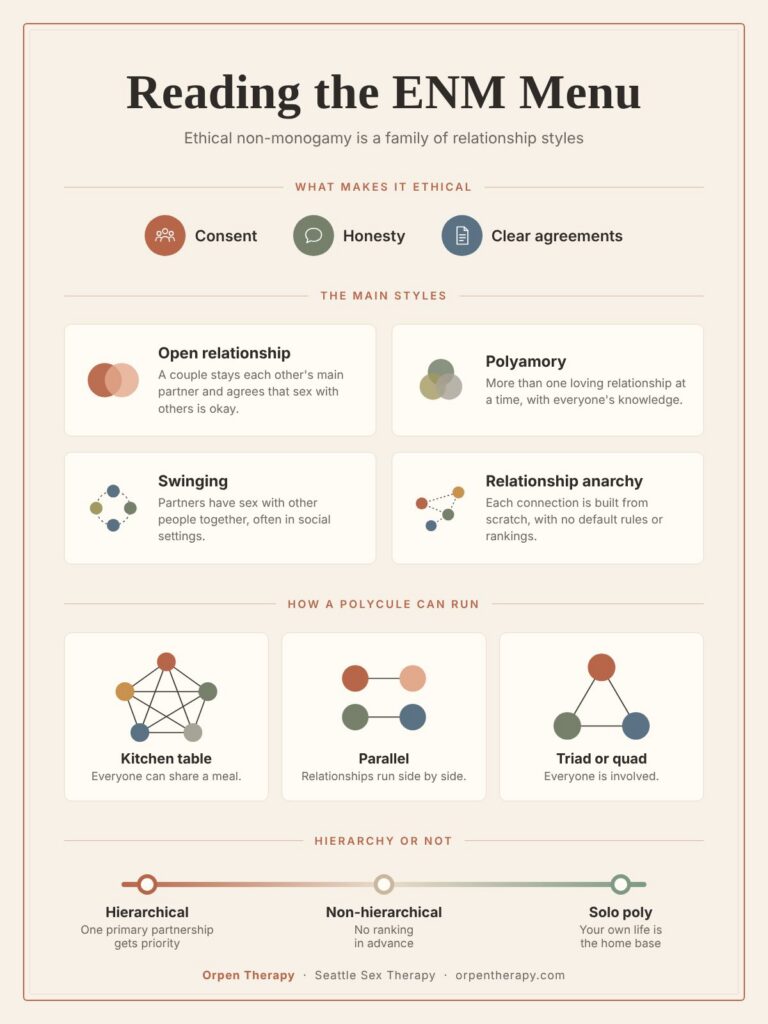
An ENM relationship, short for ethical non-monogamy, is any relationship in which partners openly agree that romantic or sexual connection with other people is allowed. Polyamory, open relationships, swinging and relationship anarchy are all forms of ENM. What makes it ethical is informed consent, honesty and agreements everyone involved understands.
Researchers usually call this consensual non-monogamy, or CNM. In The Ethical Slut, Janet Hardy and Dossie Easton ground ethics in honesty, consent and genuine care for everyone involved, and I think that’s the right place to start.
People sometimes hear “ethical non-monogamy” and picture something chaotic. In my experience, ENM partners tend to talk about their relationship more often, and in more detail, than most monogamous couples I meet. You can’t share a calendar with three people without getting specific.
How Is Polyamory Different From an Open Relationship?
This is the question I hear most. The polyamory vs open relationship distinction mostly comes down to where emotional connection is expected to go.
An open relationship usually means a couple stays each other’s main romantic partner while agreeing that sex with other people is okay. An open marriage is the same arrangement between spouses.
Polyamory means having, or being open to, more than one loving relationship at a time, with everyone’s knowledge. The emphasis is on relationships: dating, falling for someone, sometimes building a life together.
Swinging, a third branch, usually means a couple having sex with other people together, often in social settings.
In real life these blur. Plenty of open relationships grow feelings nobody planned for. Labels are a good way to start the conversation, and then the details take over. Tristan Taormino’s Opening Up, built on interviews with more than a hundred people, is still one of the clearest maps of this territory.
Where Do Polycules Come In?
A polycule is the network formed by people connected through polyamorous relationships. Picture a diagram: you, your partners, their partners, and sometimes their partners too. The word blends “polyamory” and “molecule,” and the image fits.
How a polycule runs day to day varies a lot. A few common styles:
- Kitchen table poly: everyone in the network is comfortable enough to share a meal or a holiday, including people who aren’t dating each other. Metamours (your partner’s other partners) often become friends.
- Parallel poly: relationships run side by side with little overlap. Metamours know about each other and don’t need to be close.
- Triads and quads: three or four people who are all involved with one another, sometimes as a closed group.
None of these is the advanced version. Kitchen table poly gets a lot of attention online, and it’s lovely when it grows naturally, but pushing metamours into closeness tends to backfire. Every flavor is an amazing flavor, as long as everyone at the table chose it.
Does ENM Need a Hierarchy?
Some people organize non-monogamy around a primary partnership. In hierarchical polyamory, one relationship (often a nesting partner you live with or share finances with) gets priority in time, decisions or both. This can feel stable, especially for a couple opening up after years together.
Non-hierarchical polyamory avoids ranking partners in advance and lets each relationship find its own level. Someone who is solo polyamorous takes this further. They may have several meaningful relationships and no plans to merge households or name a primary partner. Their own life is the home base.
Relationship anarchy questions the categories altogether, building each connection from scratch with no default script.
Each of these can be a healthy way to live. What I care about is that the hierarchy, or the lack of one, is said out loud. A lot of the pain I see in hierarchical setups comes from priorities that exist and never get named, so a newer partner learns the rules only by running into them. Naming them is part of healthy boundaries in a relationship.
Who Chooses ENM, and Is It Healthy?
More people than you might guess. In two national samples of single adults in the U.S., Haupert and colleagues found that more than one in five had been in a consensually non-monogamous relationship at some point. That share held steady across age, income, religion and politics.
Interest runs broader still. In a national YouGov survey that Justin Lehmiller wrote about, 48 percent of men and 31 percent of women said their ideal relationship would include some form of non-monogamy. And when Lehmiller surveyed more than 4,000 Americans about their sexual fantasies for Tell Me What You Want, being in a non-monogamous relationship emerged as one of the seven most common themes.
If you’ve wondered about this, you’re definitely not the only one, and wondering is allowed to stay wondering.
On health, a review by Rubel and Bogaert looked at research on swinging, open relationships and polyamory and found that people in consensually non-monogamous relationships report psychological well-being and relationship quality similar to people in monogamous ones. The structure doesn’t predict how a relationship goes. The people and their skills do.
I’d also gently retire the word “normal” from this conversation. It carries a lot of shame. A more useful question is whether a relationship brings something good to the people in it, and whether everyone involved chose it.
Other Questions About ENM
Is ENM just cheating with permission?
Cheating involves deception: someone breaks an agreement their partner believes is still in place. ENM begins with everyone knowing and agreeing. Breaking an agreement inside an open relationship still hurts, which is why the agreements deserve so much care.
Can a married couple be ENM?
Yes. An ENM marriage can take any of the forms in this post, from an open marriage to polyamory with a spouse as a nesting partner. What tends to matter is that both spouses are choosing it freely and keep revisiting what they’ve agreed to as life changes.
Can a monogamous person date someone who’s polyamorous?
It happens more often than people expect, and it can work. These mono/poly relationships ask for very clear conversations about what each person needs, which often means practicing how to be assertive about your own limits. They also ask for honesty if one partner is quietly hoping the other will change.
Will a therapist judge my relationship structure?
A good one won’t. Training in non-monogamy varies a lot between therapists, so it’s fair to ask directly before you start: “How do you work with people in ENM relationships?” As an AASECT-certified sex therapist, I see relationship structure as one part of your life to understand, alongside everything else you bring in.
How Do You Know If ENM Fits You?
Fit starts with why. People open up for many reasons: more sexual variety, loving more than one person without hiding it, or realizing monogamy never quite fit. Opening a relationship to fix a disconnection between partners puts a lot of weight on new people who never agreed to carry it. If the honest answer is that things have gone quiet between you, rediscovering playfulness together might be the better first step.
A few questions worth answering out loud with your partner:
- What am I hoping this adds to my life?
- What am I afraid it could cost?
- What would I need to feel secure if my partner were on a date tonight?
- Are we both choosing this, or is one of us agreeing to keep the peace?
That last one matters most. Opening up tends to hold when it feels like an investment in something you both value. If you notice one of you is leaning in and the other is bracing, that’s important information, and it’s worth slowing down. Some of what comes up will be about attachment, especially if one of you tends toward anxious attachment and the other needs more room. The issues that tend to surface once a relationship opens (jealousy, compersion, new relationship energy, broken agreements) are the subject of my next post.
Back to the restaurant. You don’t need to know every cuisine in the city to have a good meal. You need to know what you’re hungry for, what you’re willing to try, and who you want at the table with you. The labels in this post are the menu. The conversations you have with the people you love are the meal.
If you’d like help with those conversations, you can read more about how I work on my sex therapy page. If you’re a couple still deciding whether to open up at all, couples therapy is a good place to take that question slowly. I’m Sean Orpen, MS, LMFT-S, CST-S, and I see individuals, couples and multi-partner relationships from across Seattle and the Eastside.
References
Hardy, J. W., & Easton, D. (2017). The ethical slut: A practical guide to polyamory, open relationships, and other freedoms in sex and love (3rd ed.). Ten Speed Press. https://www.penguinrandomhouse.com/books/553912/the-ethical-slut-third-edition-by-janet-w-hardy-and-dossie-easton/
Haupert, M. L., Gesselman, A. N., Moors, A. C., Fisher, H. E., & Garcia, J. R. (2017). Prevalence of experiences with consensual nonmonogamous relationships: Findings from two national samples of single Americans. Journal of Sex & Marital Therapy, 43(5), 424–440. https://doi.org/10.1080/0092623X.2016.1178675
Lehmiller, J. J. (2016, November 4). Would your ideal relationship be monogamous or open? 1,000 Americans weigh in. Sex and Psychology. https://www.sexandpsychology.com/blog/2016/11/4/monogamous-and-open-relationships/
Lehmiller, J. J. (2018). Tell me what you want: The science of sexual desire and how it can help you improve your sex life. Balance. https://www.sexandpsychology.com/books/
Rubel, A. N., & Bogaert, A. F. (2015). Consensual nonmonogamy: Psychological well-being and relationship quality correlates. Journal of Sex Research, 52(9), 961–982. https://doi.org/10.1080/00224499.2014.942722 Taormino, T. (2008). Opening up: A guide to creating and sustaining open relationships. Cleis Press. https://www.simonandschuster.net/books/Opening-Up/Tristan-Taormino/9781573444972