
Most couples who enter therapy after infidelity are not sure they want to stay together. They are sure they cannot keep doing what they have been doing since the discovery — the circular conversations that return to the same three points, the oscillation between closeness and withdrawal, the exhaustion of trying to navigate something this large without a map. What they are looking for, in the first session at least, is usually not a verdict on the relationship but a different kind of container for the conversation. Somewhere that does not require them to perform recovery before it has actually happened.
This piece covers what couples therapy after cheating actually involves — not the promise of a fixed outcome, but the structure of the work itself. What happens in the room, what the process is designed to accomplish, and what both partners can realistically expect.
What Couples Therapy After Cheating Is Not
It is not conflict mediation. The goal is not to reach a compromise on what happened or to negotiate an agreement about the infidelity. There is no compromise available there, and attempting to treat it as a negotiation tends to produce a shallow resolution that does not hold.
It is not a loyalty test. The therapist is not evaluating whether the offending partner is remorseful enough or whether the injured partner is sufficiently forgiving. Both people’s experience is taken seriously as a starting point, and neither is asked to perform an emotional state they have not yet reached.
It is not a guarantee of any particular outcome. Couples therapy after infidelity creates the conditions for meaningful work. It does not determine whether the relationship survives. Some couples who enter therapy recover the relationship fully. Some discover in the process that the relationship has run its course and use the therapy to separate with more clarity and less damage. Both can be legitimate outcomes.
What the Therapy Actually Does
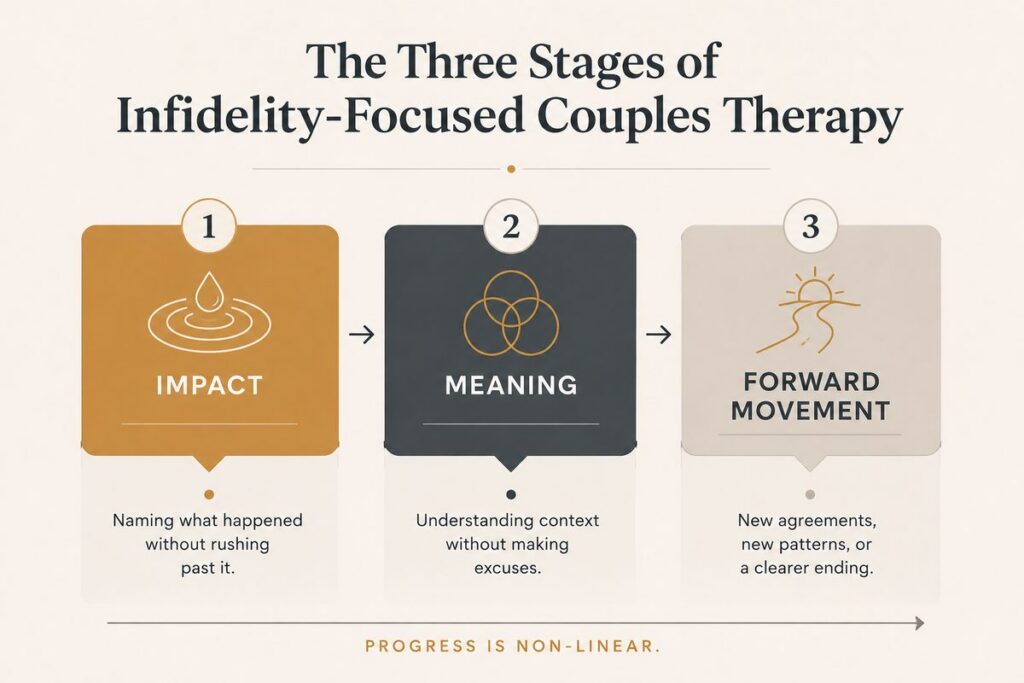
The most clinically supported framework for couples work after infidelity is the approach developed by Snyder, Baucom, and Gordon, which treats infidelity as a relationship trauma and structures the work accordingly. Their research, summarized in Getting Past the Affair, identifies three stages that effective infidelity-focused therapy moves through, in order.
The first stage is impact. Before any rebuilding work is possible, the full impact of the infidelity needs to be named and held without being rushed past. This means creating enough safety for the injured partner to articulate what the discovery did — not as accusation, but as description. It also means helping the offending partner stay present with that description without defending against it, which is often the harder clinical task. The goal of this stage is not resolution but clarity: a shared, accurate understanding of what is actually being dealt with.
The second stage is meaning. Once the immediate crisis has stabilized enough for reflection, the therapy turns to the question of context: not excuse, but understanding. What was happening in the relationship before the infidelity? What did the affair mean to the person who had it? What needs or longings were at play that had not been addressed directly in the relationship? This stage is often misunderstood as blaming the injured partner for the infidelity. It is not. It is an attempt to understand the full picture, which is necessary for making an informed decision about the future. Infidelity that is understood is more workable than infidelity that remains opaque.
The third stage is forward movement. This is where healing after infidelity shifts from processing the past to building something different. If the couple is choosing to stay together, this involves explicit agreements about transparency and accountability, new patterns of emotional connection designed to address what was missing, and the gradual rebuilding of trust through behavioral consistency rather than promises. If the couple is separating, this stage involves navigating the ending with enough care that both people can actually move forward.
Does Marriage Counseling Work After Infidelity?
This question is asked in the early days, when the injury is acute and the outcome feels entirely uncertain. The research is more encouraging than most people expect.
A meta-analysis published in the Journal of Marital and Family Therapy found that couples who received structured treatment for infidelity showed significant improvements in both individual and relationship functioning, with many reporting that the relationship was meaningfully better than it had been before the infidelity was disclosed. This is not universal, and it does not mean that recovery is easy or guaranteed. But it does mean that the premise of the question — that therapy cannot help in this situation — is not supported by the evidence.
The factors that most reliably predict good outcomes are: the willingness of the offending partner to remain engaged with the impact rather than pushing for premature forgiveness, the injured partner’s ability to eventually move toward some degree of processing rather than becoming fixed in the injury, and the presence of adequate therapeutic support for both.
The couples for whom therapy is least effective are usually those where one partner is already resolved to leave and using the therapy as a form of confirmation rather than genuine inquiry, or where the offending partner is unable to remain present with the impact long enough to do real work. A skilled therapist can identify these patterns early and help the couple understand what they are actually working with.
What Both Partners Can Expect in the Process
For the injured partner, the early stages of therapy are often more depleting than settling. Articulating the impact in structured sessions requires accessing material that the nervous system has been managing through avoidance or flooding. Many people describe feeling worse before feeling better, not because the therapy is failing but because the work requires going toward the pain rather than around it. The depletion is typically followed by a gradually increasing sense of having somewhere to put the experience — a container that holds it without requiring the injured partner to manage it entirely alone.
For the offending partner, the therapeutic task is different and often underestimated. Remaining present with a partner’s pain without defending, minimizing, or rushing toward resolution requires a significant capacity for emotional tolerance that many people discover they do not currently have. Individual therapy alongside the couples work is often valuable for this reason — building the internal resources needed to show up in the joint sessions in the way the work requires.
Sean Orpen, MS, LMFT-S, CST-S, works with couples in Seattle and the Eastside navigating infidelity — in the acute phase and in the longer work that follows. For the individual experience of the betrayed partner, the post on how to heal from being cheated on covers that territory in more depth.
Frequently Asked Questions About Couples Therapy After Cheating
When should we start couples therapy after infidelity?
As soon as both partners are willing to be in the room together, which is not always immediately after discovery. Some couples need a period of individual stabilization first. Others find that starting couples therapy quickly is what provides enough structure to prevent the relationship from collapsing entirely in the acute phase. There is no universal right timing, but earlier is generally better than waiting until both people have fully resolved what they feel, which is unlikely to happen without support.
Should we each have individual therapy as well?
Usually yes, at some point in the process. The couples work is focused on the relational dynamic; individual therapy creates a separate space for each person’s internal experience. For the injured partner, individual therapy provides a place to process the betrayal without the complexity of the partner’s presence. For the offending partner, it provides the support needed to do the work in couples sessions well.
What if the injured partner isn’t ready to forgive?
Forgiveness is not a precondition for therapy, and a skilled therapist will not push for it prematurely. The research on infidelity recovery is clear that forgiveness, when it comes, tends to emerge from the process of the work rather than precede it. Asking an injured partner to forgive before the impact has been fully acknowledged and the offending partner’s empathic responsiveness has been demonstrated tends to produce a performed forgiveness that does not hold.
How do we know if the therapy is working?
Early markers of productive work include: the circular conversations beginning to change character, both partners feeling more clearly heard in session, the intrusive symptoms in the injured partner beginning to decrease in intensity, and a growing sense in both partners that the relationship’s future feels at least somewhat open rather than predetermined. The absence of dramatic breakthroughs is not a sign of failure; the most meaningful shifts in this work tend to be gradual.
Is it possible to build something better after infidelity?
For some couples, yes. The couples who report this most consistently are usually those for whom the infidelity was symptomatic of something that had been unaddressed in the relationship for a long time — and who used the crisis as an occasion for honesty and depth that the relationship had not previously had. This is not a rationalization for infidelity; it is a description of what becomes possible when two people choose to do the work. Therapy for trust issues addresses the longer-arc work of rebuilding that foundation.
References
Sean Orpen, MS, LMFT-S, CST-S, works with couples in Seattle and the Eastside navigating infidelity and the work of deciding what comes next. Reaching out is a reasonable first step.