
I think high-functioning burnout is the hardest kind of burnout to catch, because from the outside it looks a lot like success. The quarter closes on time. The board meeting goes well. People still bring you the hard calls, and you still make them. Nothing on your calendar suggests anything is wrong.
Underneath, something has shifted. Maybe Sunday evenings feel heavier than they used to. Maybe a team you genuinely like has started to feel like a list of problems to manage. If that sounds familiar, you’re far from the only one.
What Is High-Functioning Burnout?
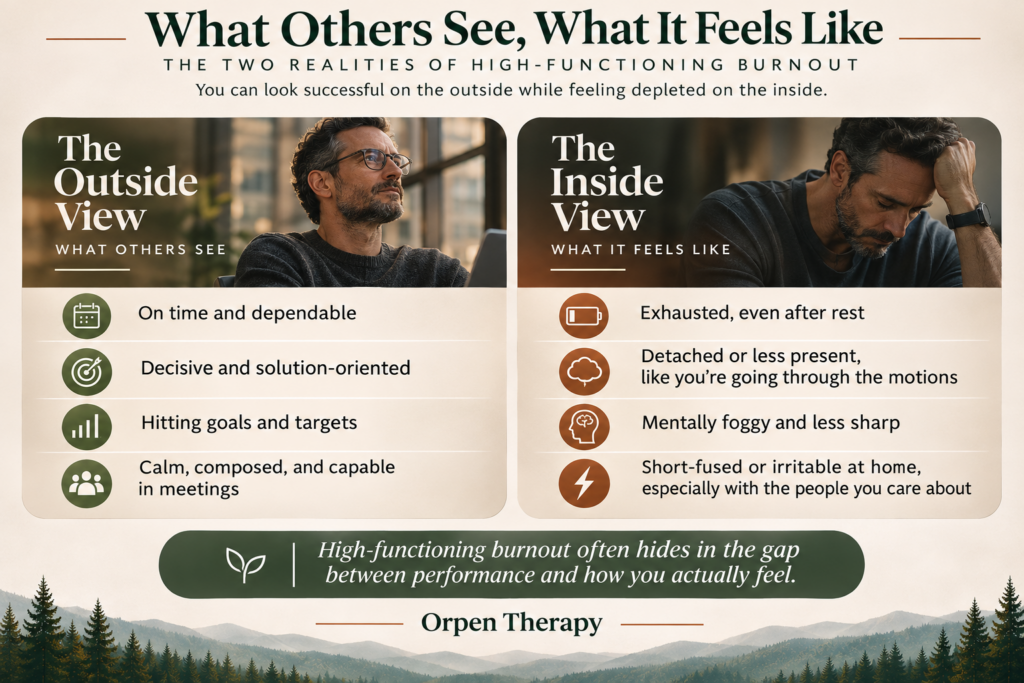
High-functioning burnout is burnout that hides behind strong performance. You keep meeting deadlines and leading well while running on exhaustion, growing detached from work you used to care about and losing a sharpness you can’t quite explain. Because results stay high, the people experiencing it, and those around them, often miss the signs until they become severe.
The word burnout gets used loosely, so it helps to know what researchers mean by it. In their review of decades of work on the subject, Maslach and Leiter (2016) describe burnout syndrome as a response to chronic stress on the job with three parts: overwhelming exhaustion, a cynical or detached feeling toward the work, and a sense of being less effective than you used to be.
With high-functioning burnout, the first two are usually well underway while the third stays out of sight. Your effectiveness may be slipping, but you’re covering the gap with longer hours, more coffee and sheer will. Other people see the results. You’re the only one who knows what they’re costing.
Why the Work Keeps Getting Done
When most people picture burnout, they picture someone who can’t get out of bed, starts missing deadlines and eventually walks away. That version is real. With leaders, I more often see something quieter: the output holds steady while the person producing it slowly runs down.
There’s a reason for that. If you’ve built a career on pushing through, pushing through is the first tool you reach for, and it works. You stay late, you skip the workout, you answer the email at 11 p.m., and the problem in front of you gets solved. Here’s the paradox: the skill that got you where you are is the same skill that keeps you from noticing what it’s costing you.
Research backs up the idea that showing up can hide a lot. Salvagioni and colleagues (2017) reviewed 36 prospective studies on the effects of job burnout and found it predicted presenteeism, meaning people kept working while they weren’t well, along with insomnia, depressive symptoms and a range of physical health problems. Being present at work, in other words, is one of the places burnout hides.
Some leaders are more prone to this than others. If your sense of worth has become closely tied to how well you perform, or if perfectionism has been part of how you operate for a long time, the internal pressure to keep results high is enormous. Slowing down can feel like failure, even when it’s the most reasonable choice available.
The Signs Leaders Explain Away
Most early signs of burnout come with a built-in explanation. It’s a busy season. The launch is almost done. Things will settle after the reorg. Each explanation makes sense on its own, which is exactly why the pattern is easy to miss.
Here are some of the signs I hear leaders talk themselves out of:
- Rest stops restoring you. You take a long weekend, and Monday morning feels the same as Friday afternoon.
- Your patience runs out at home first. You’re steady with your team and short with your partner, your kids or your friends.
- Decisions take more passes. Calls you used to make in a minute now get a second look, then a third.
- Things that used to matter feel flat. Wins don’t land the way they once did, and small problems feel personal.
- Sleep changes. It gets lighter or shorter, or work follows you into your dreams.
- Your body starts to complain. Headaches, stomach trouble, or getting sick the moment you finally slow down.
None of these on its own means you’re burned out. When several show up together and stick around for months, they’re worth taking seriously. They also tend to build in a fairly predictable order, which I walk through in a separate post on the stages of burnout.
What Does a Burnout Feel Like From the Inside?
“What does a burnout feel like?” is one of the most common questions people type into a search bar, and it makes sense. The experience is hard to name while you’re inside it.
When Schaufeli, Desart and De Witte (2020) built the Burnout Assessment Tool, they started by interviewing practitioners about how burnout shows up in real life. Four core features emerged: exhaustion, mental distance from work, and trouble regulating both your thinking and your emotions.
In everyday terms, that can look like reading the same email three times and still not taking it in. It can look like irritation that arrives faster and bigger than the moment calls for, or a wave of emotion in the car that seems to come from nowhere. Mental distance often sounds like “I just don’t care the way I used to,” and that sentence tends to scare the people who say it, because caring has always been their thing.
If any of this fits, it’s a reflection of how much you’ve been carrying, and for how long. That’s worth taking seriously, and it’s also something people come back from.
Executive Burnout and Everyday Stress
Every leader deals with stress: a hard negotiation, a tense board meeting, a product that ships late. Stress usually has an end point, and when the pressure lifts, you recover. Executive burnout is what happens when the pressure never lifts long enough for recovery to happen, or when the usual ways you recover stop working.
A few things make burnout at the top its own animal. Your decisions affect other people’s jobs and livelihoods, so the weight follows you home. There’s rarely an off-season. And leadership burnout carries a specific kind of loneliness: the higher you go, the fewer people there are you can be honest with about how you’re doing. Many leaders describe being the person everyone else leans on, and not being able to remember the last time they leaned on anyone.
Left alone long enough, burnout rarely stays in your head. Severe burnout symptoms start to look like illness: sleep that falls apart, depressive symptoms, and physical problems that keep coming back. The same review by Salvagioni and colleagues linked burnout over time to type 2 diabetes, coronary heart disease and musculoskeletal pain. If you’re having thoughts of harming yourself or of not wanting to be here, please call or text 988, the Suicide and Crisis Lifeline, right away.
You don’t have to wait until things get that far to talk with someone. Many leaders find it useful to get an outside perspective while they’re still functioning well, because there’s more room to make changes on their own terms. If you’re curious what that looks like, I’ve written about how a therapist helps with burnout, from the first session onward.
Questions Leaders Ask About Burnout
Can you have burnout and still love your work?
Yes, and it’s common. Many people who burn out care deeply about what they do, and that care is often what kept them going long after their reserves ran low. Maslach and Leiter point to a mismatch between a person’s values and the demands of the job as one driver of burnout, so loving the mission and burning out can be true at the same time.
Is high-functioning burnout the same as depression?
They overlap, and researchers are still sorting out exactly how. Maslach and Leiter describe burnout as tied to the work context, while depression tends to color every area of life. The two can show up together, and a therapist can help you sort out what’s going on and what kind of support fits.
Why do the people closest to me notice before I do?
Home is usually where your reserves run out first. You spend the best of your patience and focus at work, and what’s left for a partner, friends or family gets thinner. The people closest to you also know your baseline better than anyone, so they notice the shift sooner. If someone who loves you has said you seem different lately, that observation is worth some curiosity.
Does burnout only happen to people who work too many hours?
Workload is one piece. Maslach and Leiter describe six areas of work life that shape burnout: workload, control, reward, community, fairness and values. A leader with a reasonable schedule can still burn out when they have little real control, feel unrecognized, or keep making calls that cut against what they believe.
A Note From Me
If you recognized yourself in this post, I’m glad you kept reading. Noticing is where change starts, and it usually comes before anyone else is ready to say it out loud.
I work with founders, executives and business owners in Seattle and on the Eastside, and virtually anywhere in Washington. Many of the people I see are still performing well when they first come in, and that’s a good time to start. You don’t need a crisis to deserve support, and you don’t need to have it all figured out before we talk. You can learn more about my therapy for executives and reach out when the timing feels right. Fit matters most, so if I’m not the right person for you, I’ll help you find someone who is.
About the Author
Sean Orpen, MS, LMFT-S, CST-S, is a licensed marriage and family therapist, certified sex therapist and clinical supervisor with more than 20 years of experience. Through his Seattle practice, Orpen Therapy, he works with CEOs, executives, entrepreneurs, couples and individuals.
References
Maslach, C., & Leiter, M. P. (2016). Understanding the burnout experience: Recent research and its implications for psychiatry. World Psychiatry, 15(2), 103–111. https://doi.org/10.1002/wps.20311
Salvagioni, D. A. J., Melanda, F. N., Mesas, A. E., González, A. D., Gabani, F. L., & Andrade, S. M. (2017). Physical, psychological and occupational consequences of job burnout: A systematic review of prospective studies. PLoS ONE, 12(10), e0185781. https://doi.org/10.1371/journal.pone.0185781
Schaufeli, W. B., Desart, S., & De Witte, H. (2020). Burnout Assessment Tool (BAT): Development, validity, and reliability. International Journal of Environmental Research and Public Health, 17(24), 9495. https://doi.org/10.3390/ijerph17249495