
It’s three weeks into the leave you finally took. Your inbox is handed off, the calendar is empty and you’ve slept more in the last twenty days than in the previous six months. You sit down with a coffee on a Tuesday morning, the house quiet, and you still feel flattened.
That moment usually comes with a question, said out loud or not: how long is this going to take? If you’re asking it, you’re in good company. It’s one of the first things nearly every leader I work with wants to know.
How Long Does Burnout Last?
Burnout recovery time depends on how deep the burnout went and how much changes around it. Milder burnout often begins to ease over several weeks to a few months once something real shifts. More severe burnout can take a year or longer, and some people notice lingering fatigue or lower stress tolerance for years.
I know that range is wider than most people want. Executives are used to timelines, and “it depends” can sound like a dodge. So when someone asks me, “How long does it take to recover from burnout?” I break the answer into three parts. Burnout recovery time tends to track how long you ran on empty before you noticed, how much of the original pressure is still in place and whether your body is getting a real chance to settle. The more of those you can change, the shorter the road usually is.
Why Doesn’t Rest Alone Fix It?
Most people assume burnout ends when the pressure does. Take the leave, finish the launch, survive the quarter, and you’ll bounce back. There’s some truth in that, and it misses an important piece.
Emily and Amelia Nagoski make a distinction in their book, Burnout (2019), that I find useful with leaders. A stressor is the thing that’s happening: the board, the layoffs, the investor who won’t stop emailing. Stress is what happens in your body in response. You can deal with the stressor and still have the stress sitting in your body, unfinished. The Nagoskis call the way out “completing the stress cycle,” giving your body a clear signal that the danger has passed.
They use an everyday example I like. Picture a long drive home in heavy traffic, your grip tightening on the wheel for an hour. You finally pull into the driveway. The stressor is over, and your body is still braced for the next near miss.
They describe physical activity as the most efficient way to do that, along with slow breathing, a good laugh, a long hug, a real cry, creative work and warm time with people you like. They’re also clear that no single method works for everyone, so if hugging or running isn’t your thing, something else will be. None of these is a cure on its own. Together, they help explain why a quiet week on the couch can leave you just as wound up as when you started.
The Nagoskis also argue that people recover from burnout with each other, through help and kindness from the people around them. They talk about how much our culture admires the lone figure who needs no one, and how much that ideal costs us. For leaders who are used to being the one everyone else relies on, accepting care can be the hardest part of the whole process.
Mental distance from work matters too. In a meta-analysis of 86 publications covering more than 38,000 employees, Wendsche and Lohmann-Haislah (2017) found that people who could psychologically detach from work in their off-hours reported less exhaustion and better sleep. They also found that heavy investment in work and doing work-related things during time off made detaching harder. If you’re on leave but still checking Slack before breakfast, your body may be resting while your mind never left the office.
How Long Can Burnout Last When It’s Severe?
Here I want to be honest, because I think false reassurance does more harm than a clear picture. When burnout gets severe enough that someone needs significant time away from work, recovery can stretch out.
Swedish researchers have followed people treated for stress-related exhaustion for years. In one study, Glise, Wiegner and Jonsdottir (2020) found that seven years after people first sought care, almost half still reported fatigue, 73 percent reported lower tolerance for stress, and about a third were still clinically judged to have exhaustion. In another, Eskilsson and colleagues (2024) checked in with people ten years after a rehabilitation program. Their symptoms had stayed about where they were one year after the program, 73 percent of those working had changed workplaces, and nearly a third had cut back their hours.
Those numbers come from people with the most severe cases, so they describe one end of the range. They also show that the deeper burnout goes, the longer the road tends to be, and that many people recover partly by changing how and where they work. To me, that’s an argument for taking burnout seriously earlier, while the road back is still short.
Is There a Pattern to Getting Better?
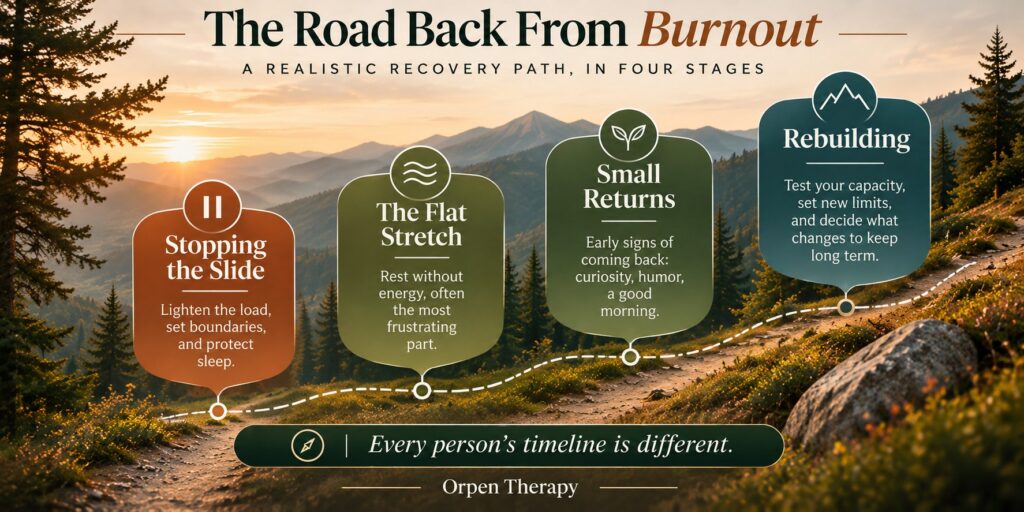
People often search for how to get over burnout as if it were a single hurdle. In practice, it looks more like a season. Recovery rarely moves in a straight line, and these aren’t official stages. They’re a loose pattern I see often, and naming them tends to make the slow parts easier to sit through:
- Stopping the slide. You lighten the load where you can, protect sleep and stop treating exhaustion as a character flaw.
- The flat stretch. You’re resting, and the energy hasn’t come back yet. For many people, this is the most frustrating part, and the part where they’re most tempted to rush back.
- Small returns. Curiosity, humor and a good morning start showing up. They come and go at first.
- Rebuilding. You test your capacity in measured ways, try new limits and decide what has to change for this not to happen again.
This is the map for coming back from burnout. The way it develops in the first place follows a different pattern, which I cover in a separate post on how burnout builds in stages.
What Speeds Recovery, and What Stalls It?
There’s no single answer to how to recover from burnout. Every recovery is different, and nothing here comes with a guarantee. Still, a few things tend to show up again and again.
What often helps is real change in the conditions that caused the burnout, sleep that’s protected, regular ways to complete the stress cycle, time with people who aren’t asking anything of you and some kind of support for the parts you can’t sort out alone. Many leaders find it useful to have a place to think out loud about all of this, and I describe what happens in burnout therapy in more detail elsewhere.
What tends to stall recovery is quieter. Going back to the same load too soon. Measuring progress against your best year instead of last month. And bringing perfectionistic standards to recovery itself, so that resting becomes one more thing you can do wrong. A leader who’s been brilliant at pushing through tries to push through recovery, and it backfires. Picture a founder who comes back from six weeks off feeling noticeably better, takes on the full calendar the very first Monday and is back where they started by spring. The time off helped. The return didn’t leave room for that progress to hold. Recovery responds to a different kind of effort: steady, patient and a little boring.
A related trap is turning recovery into a to-do list. Thirty minutes of yoga, a smoothie, eight hours of sleep, check, check, check. The Nagoskis describe well-being as something you do, a back-and-forth between effort and rest, time with people and time alone. Moving through those cycles with some attention to how your body feels tends to help more than finishing the list. Many leaders have spent years overriding their body’s signals, working through hunger, tension and exhaustion until the signal gets too loud to ignore. Noticing what’s happening inside your body has a name, interoception, and the encouraging part is that it’s a skill people can learn with practice.
Still Have Questions About Getting Over Burnout?
How will I know I’m getting better?
Usually in small ways before big ones. People often notice that mornings feel less heavy, that they laugh more easily, that they can read a long email without rereading it or that they look forward to something again. Those early signs tend to come and go before they settle in.
Is it normal to feel worse right after I slow down?
Many people report exactly that. When the pace drops, the tiredness you’ve been outrunning has room to show up, along with feelings you didn’t have time for. It can be unsettling, and for many people it passes as the body catches up. If it doesn’t ease, or you feel hopeless, that’s a reason to reach out for support. If you’re ever having thoughts of not wanting to be here, please call or text 988, the Suicide and Crisis Lifeline.
Can burnout come back after I recover?
It can, especially if you return to the same conditions with the same habits. The research on lower stress tolerance suggests that some people stay more sensitive to pressure for a while. Knowing that is useful. It tells you what you’ll want to protect going forward.
Here’s a question to sit with: what would you need to stop carrying for your recovery to have room to happen?
If you’re a founder, executive or business owner in Seattle, on the Eastside or anywhere in Washington by video, and you’d like help finding the answer, you can read more about how I work with leaders in therapy and reach out when you’re ready.
Sean Orpen, MS, LMFT-S, CST-S, is a licensed marriage and family therapist and clinical supervisor in Seattle with more than 20 years of experience.
References
Eskilsson, T., Olsson, D., Ekbäck, A.-M., & Järvholm, L. S. (2024). Symptoms, work situation and work functioning 10 years after rehabilitation of stress-induced exhaustion disorder. BMC Psychiatry, 24, 525. https://doi.org/10.1186/s12888-024-05975-x
Glise, K., Wiegner, L., & Jonsdottir, I. H. (2020). Long-term follow-up of residual symptoms in patients treated for stress-related exhaustion. BMC Psychology, 8, 26. https://doi.org/10.1186/s40359-020-0395-8
Nagoski, E., & Nagoski, A. (2019). Burnout: The secret to unlocking the stress cycle. Ballantine Books. https://emily-nagoski.squarespace.com
Wendsche, J., & Lohmann-Haislah, A. (2017). A meta-analysis on antecedents and outcomes of detachment from work. Frontiers in Psychology, 7, 2072. https://doi.org/10.3389/fpsyg.2016.02072