
Picture the couple who’s been married forty years and still likes each other. Not just loves, in the dutiful, obligated way people sometimes mean it. Actually likes. You’ve probably met a pair like this: they finish each other’s sentences without it feeling like a bit, they still seem a little pleased when the other one walks into the room. You’ve probably also wondered what they know that you don’t.
The honest answer is less romantic than people expect, and more useful. A loving marriage isn’t built on compatibility, shared hobbies, or having picked exactly the right person. Decades of relationship research point somewhere much more ordinary: lasting marriages run on a small number of repeatable habits, and almost none of them have to do with how much two people have in common.
That’s a relief, in a way, once it actually sinks in. It means the couples who make it aren’t operating on some rarer form of luck or chemistry that the rest of us missed out on. They’re not smarter about picking partners, and they didn’t stumble into a version of compatibility that skipped them past the hard parts. What they’ve mostly done, whether they’d describe it this way or not, is keep practicing a short list of ordinary behaviors long after the relationship stopped being new.
What Is a Good Marriage, According to the Research
If you’re asking what is a good marriage in any way that holds up over decades, the research keeps landing in the same place. The Gottman Institute’s long-running studies of couples have found that the strongest predictor of whether a marriage lasts isn’t communication skill or conflict resolution technique. It’s whether two people, underneath the daily friction of running a shared life, still genuinely like each other. Researchers call this fondness and admiration, and couples who maintain it have a markedly higher likelihood of staying together long-term.
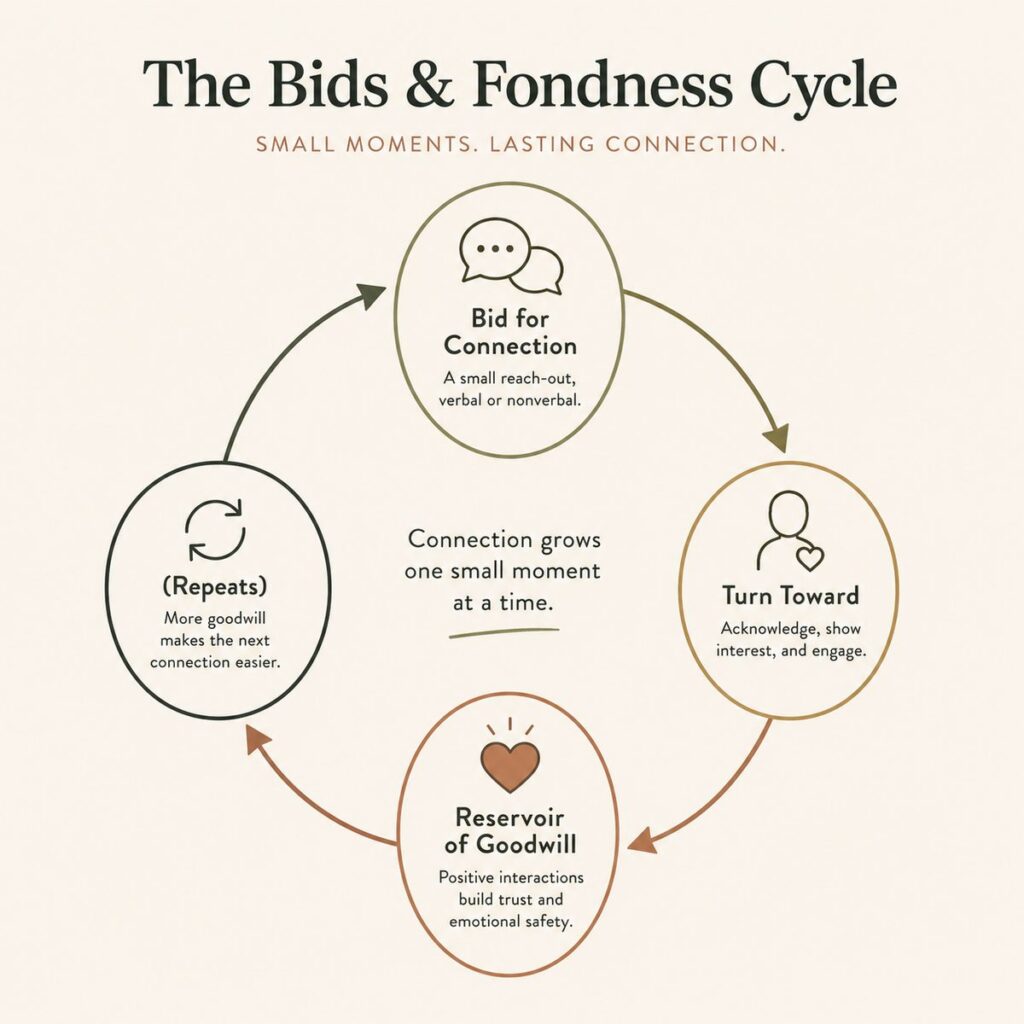
This matters more than it sounds like it should, because fondness functions like a buffer. In a marriage where it’s present, an ambiguous comment gets read charitably: a partner assumes good intent rather than insult. In a marriage where it’s eroded, the same comment gets read as confirmation of everything already suspected. The exact same sentence lands two completely different ways depending on what reservoir of goodwill it’s landing in. If you’ve ever watched two couples respond almost oppositely to what looks like an identical remark, this is usually why.
For couples working through how to improve communication in a marriage, this is often the piece that gets missed. Better scripts for arguing don’t help much if the underlying goodwill has already drained out. Rebuilding that reservoir tends to matter more than rebuilding the vocabulary.
The Small Moments That Build the Reservoir
That reservoir doesn’t get filled by grand gestures. It gets filled by something researchers call bids for connection: the small, often unremarkable attempts one partner makes to get the other’s attention, interest, or affection. A comment about something on the drive home. A hand reaching for another hand without announcement. A question asked simply because the asker is curious.
A 10-year longitudinal study of more than 2,000 married adults found something that puts real weight behind this idea. Feeling cared for, understood, and appreciated by a partner, what researchers call perceived partner responsiveness, predicted meaningful gains in long-term wellbeing a full decade later, even after accounting for personality traits and the quality of a person’s other relationships. In plain terms: the felt sense that your partner actually notices you isn’t a nice bonus on top of a good marriage. It’s doing real, measurable work over the long haul.
What separates couples who stay married from couples who don’t isn’t whether these small bids happen. They happen constantly in every relationship, regardless of who’s in it or how long they’ve been together. What separates them is whether the bid gets noticed and met, or missed and let go. You can watch this play out at a dinner table in real time: one partner mentions something small, and the other either looks up or doesn’t.
Couples in Seattle and the Eastside describe this dynamic in strikingly similar terms regardless of how long they’ve been married or what kind of week they’ve had. A long commute, back-to-back meetings, kids who need shuttling to three different activities. None of that is unusual, and none of it is really the problem. The problem shows up later, in the ten minutes before bed when there’s finally room for a bid and it goes unanswered because everyone is simply too depleted to notice it happened.
The Most Important Things in a Marriage Aren’t the Big Ones
If you had to name the most important things in a marriage, most people reach for the large, dramatic categories first: shared values, financial compatibility, whether you want kids. Those things matter, but they’re rarely what separates a marriage that lasts from one that doesn’t. What tends to matter more is something almost embarrassingly small: whether the day-to-day noticing keeps happening once the initial infatuation wears off.
This is also where happy marriage characteristics start to look less like a personality type and more like a practice. Couples who report the highest satisfaction aren’t necessarily the ones who never disagree or who happen to share every interest. They’re the ones who kept the habit of turning toward each other going, even once life got loud with work, kids, and everything else competing for attention. It’s a less flattering explanation than ‘we’re just compatible,’ but it’s also a far more workable one, since a habit can be rebuilt in a way that compatibility, once it’s gone, cannot.
Why ‘A Loving Marriage’ Reframes the Whole Question
This is good news in a specific way: it means a loving marriage isn’t a fixed trait two people either have or don’t. It’s closer to a skill, something built through repetition, and therefore something that can be rebuilt if it’s been neglected. A couple who has drifted into missing each other’s bids hasn’t necessarily lost the underlying fondness. More often, life simply got loud enough that noticing stopped happening automatically.
This reframe tends to change how couples talk about the problem once they understand it. Instead of asking whether they’re still in love, which can feel like an impossibly large and frightening question, they can ask something much smaller and more answerable: when did we stop noticing each other, and what would it take to start again. That’s a question with an actual path forward, which is more than can usually be said for the bigger one.
The research on this is reassuringly concrete. A study examining Gottman-based couple therapy found that couples receiving structured sessions showed measurable improvement in both marital adjustment and intimacy, and that these gains held up at follow-up rather than fading once therapy ended. In other words, this isn’t a skill people either have from the start or permanently lack. It’s teachable, and the improvement tends to stick.
That’s where marriage counseling tends to be most useful: not as a crisis intervention, but as a way of re-teaching two people how to notice each other again, on purpose, until it stops requiring effort. For couples rebuilding after a specific breach of trust, marriage counseling after an affair often starts from this same place, since the daily habit of noticing each other is usually what has to be rebuilt first, well before the larger conversation about trust can hold any weight.
Frequently Asked Questions
Does a healthy marriage mean we never fight?
No. Conflict is present in essentially every long marriage. What distinguishes lasting marriages is the ratio of positive to negative moments surrounding that conflict, not the absence of disagreement.
What if we used to have this and lost it?
That’s an extremely common reason couples come to marriage counseling. The underlying connection is usually still recoverable. What’s typically missing is the daily practice of noticing each other, which tends to erode quietly under stress, work, and parenting rather than disappearing all at once. If the erosion has shown up more as ongoing conflict than distance, signs your marriage is in trouble is worth a look alongside this.
Is this the same for every kind of marriage?
Yes. This research holds regardless of gender, orientation, or how a couple’s relationship is structured. The mechanism is about attention and responsiveness between two people, not about the specific configuration of the relationship.
How long does it take to rebuild this kind of connection?
It varies, but most couples notice a shift within a few months of consistent practice. It’s less about one breakthrough conversation and more about accumulating small moments of being noticed, the same way the original connection was built.
Building This Together
For couples who want to rebuild this kind of connection with structured support, marriage counseling offers a way to practice these habits deliberately rather than waiting for them to return on their own.
Sean Orpen, MS, LMFT-S, CST-S, works with couples in Seattle and the Eastside who want to understand not just what’s gone wrong, but what actually makes a marriage work over time.
References
Gottman Institute. (2026). Fondness, admiration, and intimacy. https://www.gottman.com/blog/fondness-admiration-and-intimacy/
Selcuk, E., Gunaydin, G., Ong, A. D., & Almeida, D. M. (2016). Does partner responsiveness predict hedonic and eudaimonic well-being? A 10-year longitudinal study. Journal of Marriage and Family, 78(2), 311–325. https://pmc.ncbi.nlm.nih.gov/articles/PMC5458635/
Davoodvandi, M., Navabi Nejad, S., & Farzad, V. (2018). Examining the effectiveness of Gottman couple therapy on improving marital adjustment and couples’ intimacy. Iranian Journal of Psychiatry, 13(2), 135–141. https://pmc.ncbi.nlm.nih.gov/articles/PMC6037577/