
Ask a couple why they came in, and communication in marriage is usually the first thing named, though what that actually means often stays fuzzy. It rarely means they’ve run out of things to say. More often, it means the words go out, get heard, and still don’t land. Ask what they mean by it, and the answer gets fuzzy fast. It rarely means they’ve run out of things to say. More often, it means the words go out, get heard, and still don’t land. Couples working through marriage counseling in Seattle and the Eastside describe this same thing over and over: two people who are still talking, still polite, still up to date on each other’s days, and somehow further apart than either of them can explain.
What makes this hard to pin down is that both partners can usually point to proof they’re talking just fine. Logistics get handled. Plans get made. Nobody is refusing to talk on purpose. And yet there’s a flatness to it: a sense that conversation has turned into a task to finish rather than a place where two people actually meet. That gap, between talking and truly connecting, is usually where the real work begins. It rarely looks the way either partner expects going in.
It’s part of why marriage counseling so often starts with communication rather than any single unresolved issue. The real issue is usually how two people are talking to each other, not what they’re talking about.
Why “We Need to Talk More” Usually Doesn’t Work
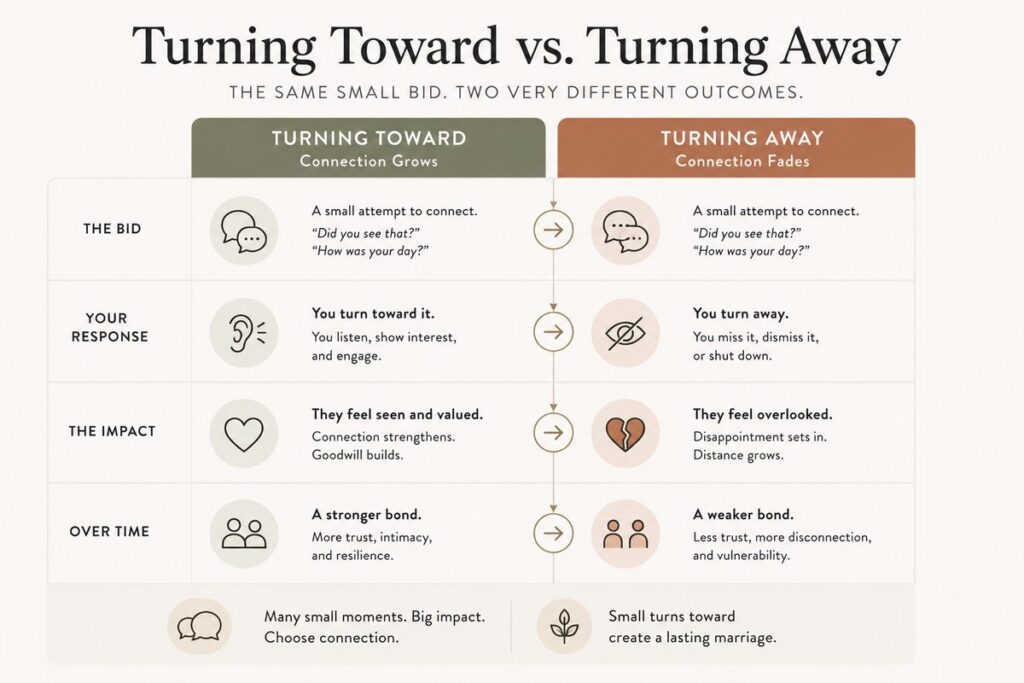
When communication in marriage starts to break down, the instinct is often to schedule more talking: a weekly check-in, a set effort to share feelings. Sometimes that helps. More often it falls short, because the real breakdown usually isn’t happening in the big, planned talks. It’s happening in the hundreds of small, unplanned moments in an ordinary day: a comment about the news, a sigh after a hard meeting, a passing question that’s really an invitation to connect, dressed up as something smaller.
Researchers call these moments bids for connection. Studies of newlywed couples found that the pattern predicting whether a marriage stayed stable over time had less to do with the depth of any one talk, and more to do with how often those small, ordinary bids got noticed and answered, even briefly (Driver & Gottman, 2004). That still holds true in practice: the couples who feel closest are rarely the ones who talk the most. They’re the ones who catch each other’s small offerings without much effort.
What Breaks Down First
Before communication collapses into open conflict, it usually narrows first. Partners stop offering the small, low-stakes comments. Not because they’ve run out of things to say. Because enough of those comments went unanswered that offering them started to feel pointless. It’s a quiet kind of fraying, and nobody announces it. The amount of talking can even stay about the same while the real connection behind it thins out.
When conflict finally surfaces, it tends to land harder than the situation calls for, because it’s often carrying the weight of everything that went unsaid in the smaller moments leading up to it. This is one of the more confusing parts of a marriage at this stage: the fight looks like it’s about the dishes, or the calendar, or something said at dinner, when it’s really about a much longer buildup that neither partner has named out loud. Both people can walk away from an argument like that feeling like the other one is overreacting. Both are technically right about the small thing. Both are missing the bigger one underneath it.
Marriage counseling tends to be most useful right here, before the pattern hardens into something both partners assume is just how the relationship works now. What often surprises couples: how quickly things shift once the real mechanism gets named out loud in the room. Missed bids pile into distance. Distance turns into conflict. Once that’s said plainly, it stops feeling like a flaw in either partner and starts looking like a pattern that can be interrupted.
Learning How to Communicate With Your Partner Again
Relearning how to communicate with your partner rarely starts with a big talk. It starts smaller than that. Couples who practice noticing and acknowledging each other’s small bids (a glance toward something interesting, a comment that’s really a request for attention) tend to see communication improve faster than couples who schedule formal talks about communication itself. Being responsive matters more than being present. Research on couples’ daily interactions found that support only helped wellbeing and relationship quality when it was actually responsive to what the other person needed in the moment, not just offered generically (Maisel & Gable, 2009).
In practice, this looks plain. Undramatic, even. It might mean putting a phone down for the fifteen seconds it takes to actually hear what a spouse just said, instead of nodding while still scrolling. It might mean asking one honest follow-up question instead of jumping straight to advice. Communication skills for couples aren’t complicated tricks. They’re closer to a habit of attention, practiced often enough that it stops taking conscious effort. For couples working with a marriage counselor in Seattle or on the Eastside, this is usually the first thing that gets rebuilt. Everything else tends to follow from it.
Putting It Back Together
The fix for a marriage that’s gone quiet like this usually isn’t more talking. It’s more responsiveness, in the moments that are already happening. There’s also a specific pattern worth swapping out, and it’s one of the better-documented signs of where a marriage is headed: raising an issue with a sentence that names the behavior and the feeling (“I felt dismissed when that got cut off”) rather than one that names the partner’s character (“you never listen”). Long-term research following newlywed couples through their first five years of marriage found that negative communication patterns, including this kind of character-based blame, predicted later marital distress and divorce more reliably than how much a couple talked overall (Markman et al., 2010).
This is really at the heart of how to improve communication in marriage. It has less to do with adding more words and more to do with what the words are doing. The first version of a complaint tends to open a conversation. The second tends to trigger a defense instead, which is often how couples end up in the same argument on repeat without ever quite settling what started it.
Neither version of that sentence is dishonest, which is part of what makes the shift hard to make on instinct alone. “You never listen” often does describe how something felt in the moment. But it lands as an attack on someone’s character, not a description of one moment. Most people respond to an attack on who they are by defending themselves rather than getting curious about what actually happened. The behavior-and-feeling version gives a partner something to respond to instead of something to defend against. It’s a small language shift. The effect on the rest of the talk is not small at all.
Frequently Asked Questions
Why does my partner say I never listen when I feel like I do?
Listening and responding to bids for connection are related but separate skills. It’s possible to take in what’s said while still missing the smaller, unspoken request underneath it for acknowledgment.
How is this different in long-term marriages versus newer relationships?
The pattern works the same way no matter how long a couple has been together, but the amount of built-up missed bids tends to be higher in longer marriages, which is part of why it can feel harder to reverse. It isn’t actually harder, just more layered.
What if one partner communicates more than the other by nature?
That’s a difference in style, not necessarily a sign of a problem. What matters more than how much either partner talks is whether both partners feel noticed within whatever amount of talking is actually happening.
What are some practical communication skills for couples to start with?
Noticing and responding to small bids, swapping character-based complaints for behavior-and-feeling statements, and setting aside distraction-free time, even briefly, tend to matter more than any single scripted technique.
Can communication be repaired without couples counseling?
Some couples make real progress on their own once they understand the bids-for-connection idea. Others find it easier with a third person in the room, especially if the pattern of missed bids has gone on long enough to feel automatic.
Rebuilding the Connection
Marriage counseling offers a structured way to practice this kind of responsiveness with guidance, especially for couples who’ve tried talking more on their own without much change. And for a broader look at what keeps a marriage strong over the long run, What Makes a Healthy, Lasting Marriage covers more of the research this repair work is built on.
Sean Orpen, MS, LMFT-S, CST-S, works with couples throughout Seattle and the Eastside on exactly this kind of repair. Not the big, dramatic conversation. The small, ordinary moments of being noticed, one exchange at a time.
References
Driver, J. L., & Gottman, J. M. (2004). Daily marital interactions and positive affect during marital conflict among newlywed couples. Family Process, 43(3), 301–314. https://doi.org/10.1111/j.1545-5300.2004.00024.x
Markman, H. J., Rhoades, G. K., Stanley, S. M., Ragan, E. P., & Whitton, S. W. (2010). The premarital communication roots of marital distress and divorce: The first five years of marriage. Journal of Family Psychology, 24(3), 289–298. https://pmc.ncbi.nlm.nih.gov/articles/PMC4298140/
Maisel, N. C., & Gable, S. L. (2009). The paradox of received social support: The importance of responsiveness. Psychological Science, 20(8), 928–932. https://doi.org/10.1111/j.1467-9280.2009.02388.x