
Same fight. Different day. Different starting point, too: the dishes, the calendar, something said in the car. But somewhere around minute two, both people recognize the shape of it. This is that fight again. Couple fighting about the same thing on repeat, almost word for word, is one of the more common reasons people finally reach out for marriage counseling, and almost everyone who describes it says some version of the same thing: it’s never really about the topic. By the time a disagreement has become a recurring fight, the actual subject usually stops mattering. What’s repeating isn’t the topic. It’s a pattern.
There’s a specific kind of tiredness that comes from this version of conflict, different from the tiredness of a single hard conversation. It’s the sense of having had this exact argument enough times to guess, almost word for word, how the other person will respond. That predictability is itself a clue. A fight that has turned into a script is rarely still about whatever it looks like on the surface.
What’s Actually Repeating
One partner feels unheard, often about something specific enough to name at the time but small enough that it seemed to pass. That feeling doesn’t actually go away. It comes back under a new label: money this week, scheduling next week, because the real problem was never actually addressed, just argued past. Constant fighting in marriage rarely means a couple disagrees more than average. It usually means one real issue keeps getting reopened under a series of smaller, easier-to-name disguises.
This is different from a marriage where the fighting has started to turn into something colder. Signs Your Marriage Is in Trouble covers that difference in more depth, but the short version is that frequency alone isn’t the worrying part. Plenty of lasting marriages have the same disagreement for years without it threatening the relationship itself. What matters more is whether the fights stay fights, hot and engaged, or whether they start turning into contempt or silence instead. A couple that argues often but keeps arguing, rather than going quiet or avoiding the topic altogether, is often in a very different position than one where the fighting has stopped and nothing has taken its place.
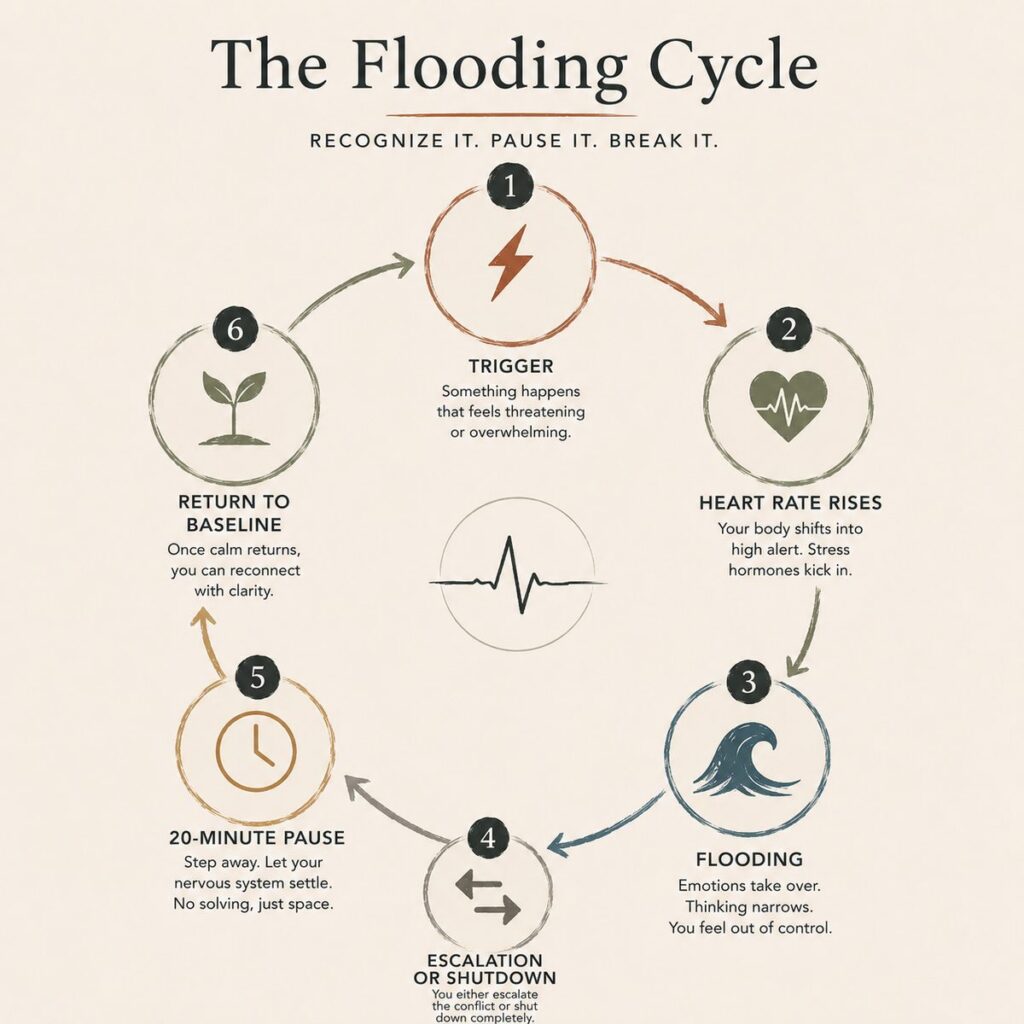
There’s also a physical piece that explains why these fights tend to escalate faster than the situation calls for. Once a conflict starts, the body can shift into a state researchers call flooding: a racing heart, a rush of stress hormones, a genuine fight-or-flight response. Research tracking couples over several years found that this kind of physical arousal during conflict, not just what was said, predicted which marriages were headed toward divorce (Gottman & Levenson, 1992). In that state, the parts of the brain responsible for empathy and creative problem-solving become much less available. Whoever is flooded isn’t choosing to stop listening well. Their body has made that choice for them.
Why the Same Approach Keeps Failing
This is why talking it through in the heat of the moment so often backfires. Two people who are both flooded aren’t capable of the kind of conversation that actually solves real problems. They’re capable of escalating it, or shutting down entirely, neither of which fixes the underlying pattern. Research on couples’ conflict discussions found that when at least one partner was highly flooded, the pair was clearly less able to solve the problem in front of them, no matter how reasonable either person’s individual point actually was (Malik et al., 2020). Couple arguing while flooded tends to produce more material for the next fight, not less: new grievances, new evidence for whatever story either partner is already telling about the other.
It’s worth saying plainly: this isn’t a character problem. Plenty of thoughtful, caring people become genuinely unreasonable once flooded, not because they’ve stopped caring about the relationship but because the part of the brain that handles nuance and compromise has temporarily shut down. Trying to reason someone out of that state with more logic usually doesn’t work, because logic isn’t running the show right now. This is often the hardest part for partners to accept about each other in the moment: the person across the table isn’t being deliberately difficult. Their body has simply made a decision their thinking mind hasn’t caught up to yet.
What Actually Helps Reduce Fights in a Relationship
Learning how to reduce fights in a relationship rarely starts with getting better at arguing. It starts with noticing flooding early enough to stop it before the conversation turns into something neither partner can take back easily. Recovering from flooding takes real time. The body typically needs about twenty minutes of genuine calm before it can return to baseline, and that calm has to mean actually stepping away from the conflict rather than replaying the argument in your head during the break, which keeps the body activated the whole time.
This matters because the same negative patterns that show up inside one flooded argument tend to be the ones that predict how a marriage is doing overall. Research following newlywed couples through their first five years found that negative communication patterns, more than the sheer amount of conflict, predicted which marriages ended in distress or divorce (Markman et al., 2010). In other words, the fight itself isn’t the risk factor. How it gets handled once it starts is.
This is part of why couples often bring this exact pattern into marriage counseling rather than trying to push through it alone. Noticing flooding in real time and stopping it before it escalates is a skill you can learn, but it’s genuinely hard to build without an outside perspective, especially in a marriage where both partners tend to flood at roughly the same moments.
Breaking the Cycle
Stopping this pattern usually starts with naming it as a pattern rather than replaying the latest version of it. That’s often harder than it sounds in the moment, since naming a pattern takes enough distance from the current argument to see it as one of many rather than the one that finally matters. A short, agreed-upon pause: “I’m feeling too flooded to keep going, can we take twenty minutes and come back to this,” does more to stop the fight from repeating than any amount of pushing through it in the moment. Marriage counseling is often where couples first practice this kind of pause together, since it’s harder to build the habit alone when both people are already worked up.
Once both partners have actually calmed down, productive conversations become possible in a way they simply aren’t while either person is still flooded. Partly because the nervous system is back online, and partly because it becomes possible to name the underlying issue directly instead of through whatever topic happened to trigger it this time. For the communication patterns underneath most recurring conflict, How to Improve Communication in Your Marriage looks at what tends to help once both people are actually able to hear each other again.
Frequently Asked Questions
Is it normal for a marriage to have the same fight repeatedly?
It’s common, but it’s also a clear sign that a real issue hasn’t actually been resolved. The repetition itself is useful information. It points to what’s really going on underneath the surface topic.
How do I know if I’m flooded during an argument?
Common signs include a racing heart, feeling unable to follow what your partner is saying, and a strong urge to either escalate or shut down entirely. If a conversation suddenly feels impossible to continue calmly, that’s usually flooding.
Does taking a break mean avoiding the issue?
No. A genuine break with a clear plan to return to the conversation is different from avoidance. The break exists to make the eventual conversation more useful, not to skip it.
What if my partner won’t take a break and wants to keep going?
This is a common sticking point, and it’s often worth addressing directly outside of conflict: agreeing in advance, when both partners are calm, on what a pause will look like the next time things escalate.
Can a recurring fight ever just resolve on its own without addressing the underlying issue?
Sometimes the surface trigger fades on its own, but the real issue usually doesn’t. It tends to come back later under a different label, which is part of why the same fight can feel like it keeps returning even when neither partner can immediately name what’s actually driving it.
Interrupting the Pattern Together
Marriage counseling offers structured support for couples caught in this kind of cycle, especially when the same fight keeps coming back despite real effort to resolve it. The work usually isn’t about learning to disagree less. It’s about learning to spot the pattern early enough to stop it, and to have the real conversation the recurring fight has been standing in for all along.
Sean Orpen, MS, LMFT-S, CST-S, works with couples in Seattle and the Eastside, of any gender configuration or relationship structure, on interrupting recurring conflict before it becomes the defining feature of the marriage.
References
Gottman, J. M., & Levenson, R. W. (1992). Marital processes predictive of later dissolution: Behavior, physiology, and health. Journal of Personality and Social Psychology, 63(2), 221–233. https://doi.org/10.1037/0022-3514.63.2.221
Malik, J., Heyman, R. E., & Smith Slep, A. M. (2020). Emotional flooding in response to negative affect in couple conflicts: Individual differences and correlates. Journal of Family Psychology, 34(2), 145–154. https://pmc.ncbi.nlm.nih.gov/articles/PMC7007326/
Markman, H. J., Rhoades, G. K., Stanley, S. M., Ragan, E. P., & Whitton, S. W. (2010). The premarital communication roots of marital distress and divorce: The first five years of marriage. Journal of Family Psychology, 24(3), 289–298. https://pmc.ncbi.nlm.nih.gov/articles/PMC4298140/