
You want to know if it’s over. That’s the real question sitting underneath every logistics question you actually ask in a first session: how many sessions, how long this takes, what the success rate looks like. It’s a fair question to carry into a room where you’re searching for counseling for cheating and hoping someone can just tell you whether what you had is still possible. An honest answer is that the marriage that existed before the affair generally isn’t what gets rebuilt. Something else does.
That answer tends to land as disappointing at first, even though it isn’t meant to be. Most people arrive hoping for a path back to exactly what they had, minus the betrayal. What actually tends to happen instead is closer to building a new structure on the same foundation: same two people, same history, same reasons the relationship mattered in the first place, but a different set of agreements, a different level of transparency, and a different understanding of what each partner needs to feel safe.
Why “Getting Back to Normal” Isn’t the Goal
This can be a hard thing to hear in the early weeks, when the instinct is often to want things to return to how they were before the discovery. But the marriage as it existed before usually had a structural vulnerability somewhere. Not always obvious, not always the fault of either partner specifically, but present. Rebuilding toward that same structure tends to recreate the same risk. What tends to work better, and what most affair-focused models of couples therapy are actually built around, is treating the crisis as the start of building something with different architecture, rather than a return trip to the old one.
That structural vulnerability can look like almost anything: a long pattern of one partner’s needs going unspoken, a slow drift into parallel lives that neither person quite named, a way of handling conflict that left real issues unresolved for years. It rarely announces itself clearly before the affair. It’s usually only visible in hindsight, once both partners are willing to look at the relationship as it actually was rather than as they remembered it.
Marital counseling for infidelity, done well, isn’t really in the business of restoration. It’s closer to renovation after a structural failure: you don’t just patch the wall where it cracked. You look at why it cracked there and not somewhere else, and you build that section differently the second time. This is part of what makes marriage counseling after an affair different from general couples work in its early phase: the renovation can’t really start until the structure has stopped actively failing.
Searching for the Right Kind of Help
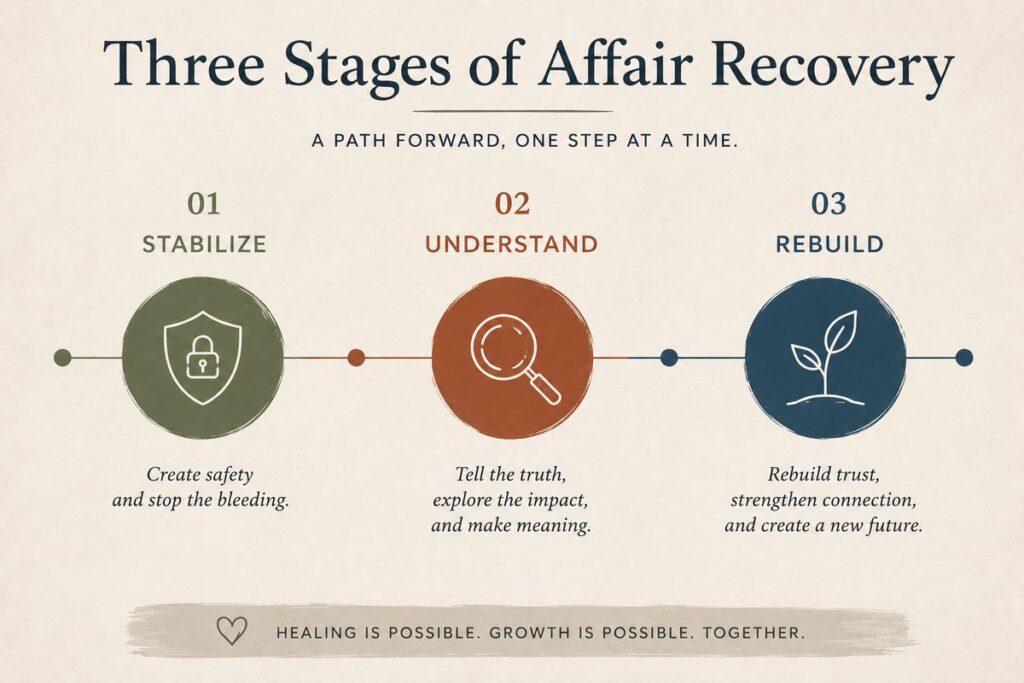
A lot of people who land here are searching specifically for marriage counseling for cheating husband situations, and just as many are searching from the other direction: a wife who had the affair, a partner in a same-sex marriage, or someone who isn’t yet sure which version of the story they’re even in. Couples therapy cheating brings into the room looks different depending on who’s telling it and what exactly happened, but the clinical process itself doesn’t change much based on which partner had the affair or what gender either of them is. The mechanics stay largely the same regardless of the specific configuration: stabilize first, understand second, rebuild third.
That order matters more than it might seem. Couples who try to skip straight to understanding, having the big conversation about why, before either partner has actually stabilized tend to find that conversation goes badly and often has to happen again later, once there’s enough calm in the room for it to actually land. It’s a common instinct, especially for the partner who had the affair, to want to explain everything immediately, as though a full accounting will fix things faster. In practice it usually just adds more material to an already flooded system.
What the Early Work Actually Involves
The first stage after disclosure is rarely about understanding why the affair happened. It’s about stabilizing two people who are, in a fairly literal sense, in crisis. That means managing acute distress, establishing clear boundaries (which usually includes full separation from the other party involved), and helping both partners regulate well enough to be in the same room without every conversation becoming a flashpoint. A three-stage model developed specifically for affair recovery describes this initial phase, dealing with the immediate impact, as the necessary foundation before any of the deeper work can actually hold (Gordon et al., 2004).
This stage is often the hardest to sit inside, partly because it doesn’t feel productive in the way people expect therapy to feel. There’s no insight yet, no breakthrough, often not even much conversation about the affair itself. What’s happening instead is closer to first aid: making sure both people can function, sleep, get through a workday, and be in the same room without the entire relationship reopening every time. Rushing past this stage to get to the “real” work tends to backfire, because the deeper conversations don’t hold when either partner is still in acute crisis. Some of what breaks down in this stage overlaps with ordinary communication strain rather than the affair specifically, and How to Improve Communication in Your Marriage addresses that broader pattern for couples where it’s relevant.
Only after that stabilization does the work shift toward understanding what happened and rebuilding trust deliberately, rather than hoping it returns on its own. That rebuilding tends to rest on consistency over time: reliability, transparency, and emotional presence demonstrated repeatedly, rather than on any single conversation or apology, however sincere. A recent systematic review of the research on trust repair in couples identified proactive transparency and consistent accountability, not any single gesture, as the factors most associated with trust actually returning (Giacobbi & Lalot, 2025).
What Determines Whether a Marriage Survives This
Recent research following couples through affair recovery has found something worth naming directly: the partners who stayed and rebuilt successfully consistently described having a couples therapist who helped set boundaries and rebuild a frame of safety, rather than one who tried to assign blame or rush the process (Mitchell et al., 2026). The decision to stay also tended to involve clear-eyed reasons beyond simple inertia: genuine remaining commitment, a believable account from the partner who had the affair, and a realistic sense of what rebuilding would actually require.
That last piece matters more than it might seem. Couples who stay because they’ve honestly weighed what rebuilding will take, and decided it’s worth attempting, tend to fare differently than couples who stay by default, simply because leaving feels harder or scarier than staying. The work in therapy often includes helping both partners get honest about which of these is actually happening, since a decision made mostly out of fear of the alternative rarely holds up under the weight of the rebuilding process.
Not every marriage survives infidelity, and that outcome doesn’t reflect a failure of the process. Even when a couple ultimately separates, working through it in marriage counseling tends to produce a clearer, less corrosive ending than trying to work through the same decision without support.
Frequently Asked Questions
How long does recovery from an affair usually take?
There’s real variation, but most couples need meaningful time, often well beyond what feels comfortable, before trust feels stable again. Some couples notice real improvement within months. Full recovery is typically a longer arc.
Does it matter what kind of affair it was?
The specifics matter for understanding what happened, but the recovery process itself is broadly similar whether the affair was emotional, physical, or both. The core work of rebuilding safety and trust applies either way.
Can the relationship that had an affair end up stronger than before?
It’s possible, though it’s a difficult thing to promise and an even harder thing to hear in the early weeks. What’s more accurate is that couples who do the work often build something more honest than what existed before, even if it doesn’t feel that way at first.
What if we’re not sure we want to stay together?
That uncertainty is common and doesn’t need to be resolved before starting. Counseling can help create the clarity needed to make that decision well, whichever direction it goes.
Does marriage counseling for a cheating husband work differently than for a cheating wife?
Not in any clinically meaningful way. The stabilize-understand-rebuild sequence and the research behind it apply regardless of which partner had the affair, the gender of either partner, or the relationship’s configuration.
Starting the Process
Marriage counseling provides the structured space this kind of recovery usually requires: somewhere both partners can be heard without the conversation collapsing into the crisis itself. That structure matters most in the early weeks, when neither partner can reliably manage it alone.
If uncertainty about staying together extends beyond this one event, Marriage Counseling During Separation: Is It Too Late? can help clarify what’s actually being decided.
Sean Orpen, MS, LMFT-S, CST-S, works with couples in Seattle and the Eastside navigating the aftermath of infidelity, with particular attention to building something honest rather than simply restoring what existed before. That distinction, between restoration and honest rebuilding, tends to matter more over time than it seems in the first difficult sessions.
References
Gordon, K. C., Baucom, D. H., & Snyder, D. K. (2004). An integrative intervention for promoting recovery from extramarital affairs. Journal of Marital and Family Therapy, 30(2), 213–231. https://doi.org/10.1111/j.1752-0606.2004.tb01235.x
Giacobbi, M., & Lalot, F. (2025). Unpacking trust repair in couples: A systematic literature review. Journal of Family Therapy, 47(1), e12483. https://doi.org/10.1111/1467-6427.12483
Mitchell, E. A., Brown, K. S., Spencer, J., & Harris, K. (2026). Staying together after infidelity: An exploration of the decision-making process of recovery from the perspective of the injured partner. Journal of Marital and Family Therapy, 52, 1–12. https://doi.org/10.1111/jmft.70110