
Erectile dysfunction is usually defined as a problem with erections, but in my office it rarely introduces itself that way. Men come in describing something else first. They’re tired, a bit less interested in sex, distracted. They’ll name a whole collection of concerns before saying the harder sentence out loud: that getting and keeping an erection has become difficult. It comes out eventually, and that sideways approach tells us a lot about where the problem lives.
Very often, it lives in sexual anxiety. Not always, and not before the medical side has been checked, but far more often than the pill-first conversation about ED suggests. As a sex therapist in Seattle, I see this constantly, and it’s more workable than most men expect.
What Erectile Dysfunction Actually Looks Like
ED usually shows up as difficulty getting an erection, difficulty keeping one, or erections that are softer than they used to be. Any of those, repeated, creates real distress.
A few questions help us sort out what’s happening. Has it always been this way, or is it new? For some men it goes back as far as they can remember. For others it’s tied to a new relationship or a new phase of life. Does it happen everywhere, or only in specific situations? And how firm do erections get? The answer can tell us a lot.
Physicians use the same distinctions. A sudden start, erections that come and go depending on the situation, and normal erections during sleep all point toward psychogenic ED, which means the mind is carrying more of the load than the body (Yafi et al., 2016).
When Your Body Becomes a Tool
Once men can talk freely, what surfaces is shame. Many of us were raised to have a performance-oriented relationship with our bodies. The body becomes a tool, something that has to perform consistently for us to feel validated. When the mind-body connection wavers unexpectedly, men feel confused, less of a man, and unable to be the partner they want to be.
The distress that comes from culture and identity is usually bigger than the erection concern itself, and it isn’t limited to straight men. The European Society of Sexual Medicine notes that men who have sex with men report ED at higher rates, with minority stress and competition around rigid erections playing a role (Dewitte et al., 2021).
Start With Your Doctor
Before anything else, I encourage a full medical workup with your general practitioner, including bloodwork, testosterone, and estrogen. As men move through their 30s, 40s, and 50s, testosterone drops, and concerns like high blood pressure can affect erections directly.
This matters beyond sex. Erectile problems often show up before heart problems do, which makes ED an early warning sign for cardiovascular disease, particularly in men under 55 (Yafi et al., 2016). Medications matter too. SSRIs and some blood pressure medications are commonly linked to difficulty getting or keeping an erection. If a medication is part of the picture, working with your prescriber is essential to optimizing your sexuality. Please don’t stop or change one on your own.
How Sexual Anxiety Makes ED Come True
Erections depend heavily on our emotional state. Chronic stress, relationship conflict, the fear of losing your job when it feels like everyone in Seattle tech is getting laid off: any of these makes it hard to stay in your body. If stress is running the show, this piece on stress management for life, work, and parenting is a good place to start.
Esther Perel describes sex not as something you do but as a place you go (Perel, 2013). Stress and fear are barriers to getting there. It helps to separate two things. Arousal is your body’s ability to interpret and receive stimulation. Desire is the beliefs, thoughts, and feelings that come with that sensation. Sexual anxiety gets in the way of both.
Then there’s anticipatory anxiety. When sex is a possibility, it’s easy to project into the future and picture the failure before it happens. That projection pulls you out of your body, drains desire, and the problem comes true. You end up actualizing your anxiety. It’s one of the first patterns we work on together.
Noticing Instead of Evaluating
A big part of the work is learning to notice what’s happening in your body rather than evaluate it. Noticing requires curiosity and description. Evaluating applies a value judgment.
Men struggling with erections are usually grading the erection, and their own worth along with it. That shame kills desire. Research describes the same pattern: men with erectile difficulties shift attention toward signs of failure and monitor their bodies closely, often called spectatoring, which pulls them away from erotic cues and inhibits arousal (Dewitte et al., 2021).
The minute you evaluate yourself, you exit the experience. Your job isn’t to perform. Your job is to experience the pleasure you’re consenting to.
Sex Doesn’t End When an Erection Does
The next anchor is staying in contact: remaining physically, emotionally, and attentively engaged with your partner no matter what your body is doing. It’s not uncommon to lose an erection three, four, even five times during one sexual experience, and sex therapists Michael Metz and Barry McCarthy describe it as natural for erections to wax and wane during extended sexual play (Metz & McCarthy, 2004). Stay present, and you’ll still be there when arousal returns.
Sex doesn’t end because an erection disappears. It ends when we choose to abandon the experience, and our partner, to avoid the anxiety or shame that shows up when the body is doing something confusing.
Getting Comfortable With a Soft Penis
It’s remarkably uncommon for men to share their penis with a partner when it isn’t erect. How often have you let a partner play with your penis when it was completely soft? And if you’re the partner, how often have you asked to, not to create an erection or an orgasm, but simply to enjoy it for what it is?
When you can eroticize your penis for what it is, a way to give and receive pleasure, connection, play, and fun, the pressure to perform tends to fall away. And ironically, that makes erections easier to come by. I encourage people to get comfortable with soft penises. If play has gone quiet more generally, rediscovering playfulness in intimacy is worth a read.
How to Overcome Sexual Performance Anxiety: Interrupt the Loop
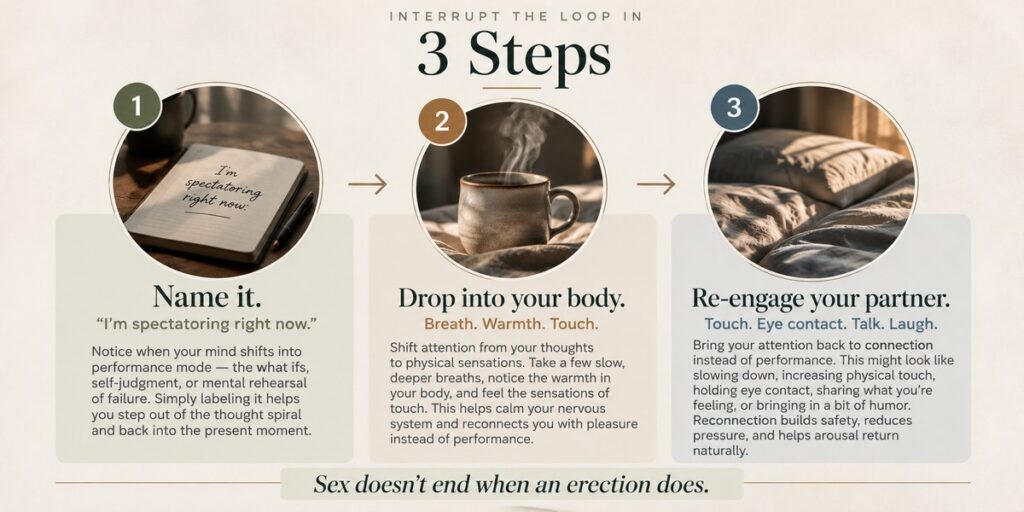
One of my favorite tools is a loop interruption. When a problem shows up, we get stuck in looping thoughts. Interrupting the loop lets you step outside it, adjust, and re-engage.
- Name it. When you notice you’re thinking about performance, say it to yourself: “I’m spectatoring right now.”
- Drop into your body. Feel your breath, the warmth in your body, your partner’s touch, the sheets. Sensation keeps you in the present instead of the future, where anxiety lives and desire disappears.
- Re-engage your partner. Change how you’re touching them or how they’re touching you. Make eye contact, talk, laugh, switch who’s giving and who’s receiving. Stay connected until your body is ready to join you.
This is how insight becomes interruptible behavior that gets you out of the loop and back into your agency.
If this sounds like cognitive behavioral therapy for sexual performance anxiety, that’s because it borrows from the same idea: catch the thought, step outside it, and choose a different next move. Current guidance on ED treatment includes these techniques alongside mindfulness approaches that redirect attention toward sensation (Dewitte et al., 2021). You can’t think your way into an erection. The goal is to stay present long enough for arousal to find its way back.
Teach Your Partner How Your Body Works
It also helps to bring some intentionality into this. With a new partner it’s harder, because it takes vulnerability, but it’s worth it with long-term partners too. Before you’re intimate with someone, how do you teach them about your body and what helps you get into it? And how often do you ask them the same questions?
Teaching a partner how your body responds removes secrecy, and secrecy increases pressure. It turns your partner into an ally instead of a judge. In practice, that might sound like: “Sometimes it takes three or four times together before my body feels comfortable enough for erections to be reliable.” Or: “Sometimes I get in my head, and I might lose my erection for a bit or want to slow down. Is that okay?” It’s the same muscle you’d use when introducing your partner to kink.
For most of us, the goal of sex is to give and receive pleasure. Erections and orgasms are secondary benefits, not the way we measure ourselves or anyone else.
Frequently Asked Questions
How do you know if you have ED or just a bad night?
An off night now and then is completely normal. It’s worth attention when difficulty becomes a consistent pattern over several months and causes real distress. A checkup is a good first step either way.
Can sexual anxiety cause ED even if my body is healthy?
Yes. When anxiety is the main driver, it’s called psychogenic ED, and it’s especially common in younger men. It tends to be situational: fine alone, harder with a partner.
What does sexual therapy for erectile dysfunction involve?
Assessment, coordination with your doctor, and practical work on anxiety, attention, and communication, often with your partner involved. Combining psychological and medical treatment tends to work better than either alone (Dewitte et al., 2021). If you’re in Seattle or on the Eastside, sex therapy is a good place to start.
If any of this sounds familiar, please know you’re not broken. Working with a sex therapist can help you get out of your head and back into the experience with the people you care about. I’d be more than happy to help you find your way there.
About the Author
Sean Orpen, MS, LMFT-S, CST-S, is a licensed marriage and family therapist and certified sex therapist based in Seattle, working with individuals and couples across Seattle and the Eastside on sexual anxiety and erectile concerns.