
Most people picture a marriage ending with one loud, unmistakable moment: an affair discovered, a fight that finally goes too far, someone packing a bag. What actually happens is usually much quieter. A tone shifts and stays shifted. A question stops getting asked. Two people share a house, a calendar, sometimes a bed, and somewhere along the way stop actually reaching each other. By the time anyone says “trouble” out loud, the trouble itself is often years old.
That gap between the dramatic version and the real version matters, because it means the signs your marriage is in trouble rarely announce themselves. They accumulate. And they tend to be consistent enough that a therapist can usually name the pattern within the first session, even when the couple sitting across from them still isn’t sure what’s actually wrong.
This is part of what makes the early stages so disorienting to live inside. Nobody wakes up one day and decides the marriage is failing. It’s more that a hundred small adjustments get made along the way, each one reasonable on its own: letting a comment slide because bringing it up feels like more trouble than it’s worth, going quiet during an argument because the last three didn’t go anywhere, assuming a partner’s mood rather than asking about it. None of those choices feel like warning signs in the moment. Looked at together, months or years later, they usually are.
What the Signs of a Failing Marriage Actually Look Like
Decades of marital research, most notably the Gottman Institute’s long-running studies of couples, point to four specific behaviors that show up again and again in relationships heading toward serious trouble: criticism, contempt, defensiveness, and stonewalling. None of these are about whether a couple fights. Conflict itself isn’t the warning sign. What matters is how the conflict gets handled once it starts.
Criticism that targets character instead of behavior is one of the clearest signs of a failing marriage. There’s a real difference between “I was frustrated the bills sat unpaid” and “you never think about anyone but yourself.” The first names a moment. The second names a person, and it tends to provoke defensiveness rather than change.
Contempt is the sharper, more corrosive version: sarcasm, eye-rolling, the quiet conviction that one partner has become superior to the other. Of the patterns researchers track, contempt is the single strongest predictor that a marriage is heading toward divorce.
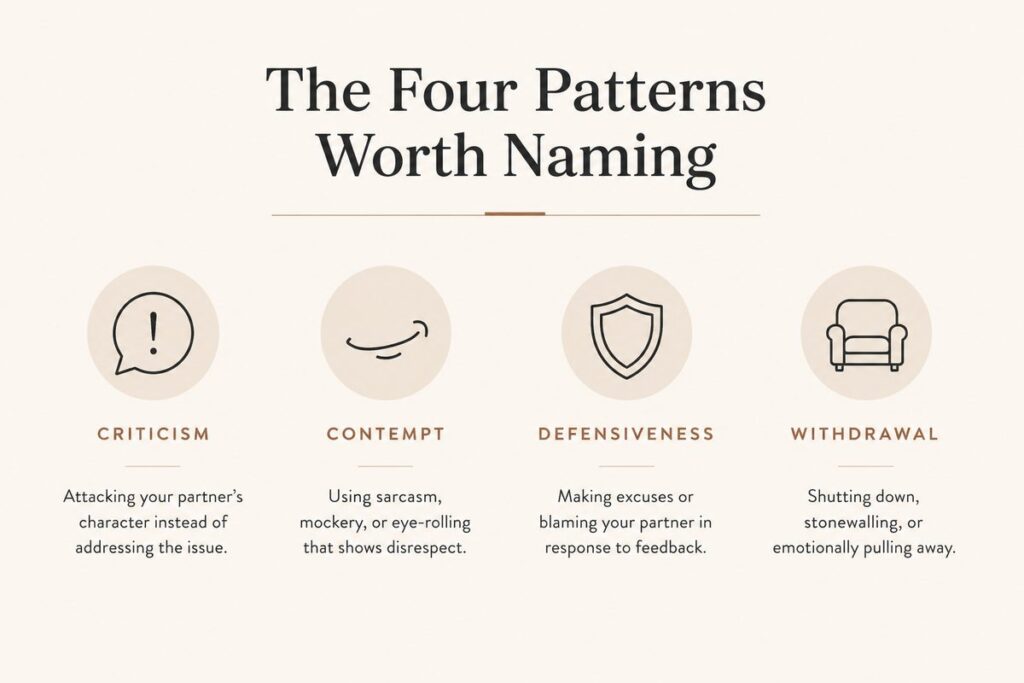
What makes these patterns worth naming specifically, rather than just describing a couple as “not getting along,” is that they tend to arrive in a fairly predictable order. Criticism, left unaddressed, tends to invite contempt. Contempt tends to provoke defensiveness in response. And once defensiveness has failed to resolve anything a few times over, one or both partners usually stop trying and start withdrawing instead. Recognizing which stage a marriage is actually in changes what kind of help makes sense, since the fix for early criticism looks different from the fix for a couple who has already gone quiet with each other.
Why the Signs of a Dying Marriage Get Missed for So Long
Defensiveness and withdrawal tend to follow close behind. One partner stops absorbing feedback and starts deflecting it. The other, worn down by repeated exchanges that go nowhere, eventually stops bringing things up at all. That withdrawal, sometimes called stonewalling, can look like peace from the outside. It rarely is.
Part of why this particular sign of a dying marriage gets missed is physiological, not just emotional. Research on emotional flooding has found that partners who become overwhelmed during conflict, flooded with more than they can process in the moment, are measurably worse at solving problems together and more likely to disengage entirely rather than stay in the conversation. The nervous system, not just the relationship, is checking out. For couples working through this in marriage counseling, learning to recognize flooding before it takes over is often the first practical skill, well before any conversation about the underlying issue itself.
The Symptoms of a Failing Marriage That Predict the Most
It’s tempting to treat all four patterns as equally serious, but they’re not. A 16-year study tracking 373 couples found that destructive and withdrawal behaviors present in the very first year of marriage predicted significantly higher divorce rates over the following decade and a half, even when those behaviors later softened. In other words, some of the earliest symptoms of a failing marriage are also the ones with the longest reach. That’s part of why couples working through how to stop the cycle of fighting in a marriage often find that the specific topic they keep fighting about matters less than how early the pattern took hold.
The same research found something couples in Seattle and the Eastside often don’t expect: withdrawal patterns aren’t fixed. They can decrease over time, particularly once a couple has language for what’s happening and a structured way to interrupt it, which is a large part of what makes these signs worth naming rather than quietly enduring.
What These Signs Are Actually Telling You
It’s tempting to treat these patterns as a verdict on the relationship itself. They’re not. They’re information about how two people are currently relating under stress, and that’s a different thing entirely. A couple who has slid into contempt and withdrawal isn’t necessarily incompatible. More often, they’ve simply run out of tools for managing the distance that built up between them, without anyone ever teaching them another way to navigate it.
This is part of why couples so often misread their own situation. The person living inside a struggling marriage is rarely positioned to evaluate it clearly. Exhaustion, hurt, and the accumulation of unresolved moments tend to narrow the field of vision down to whatever happened most recently, which makes it hard to see the shape of the larger pattern. This holds regardless of how a couple’s relationship is structured or who is in it.
It also explains why so many couples wait far longer than they mean to before reaching out for help. When the pattern is this gradual, there’s rarely a single incident that feels serious enough to justify calling it a crisis. What tends to finally prompt the call isn’t one dramatic fight, it’s the slow accumulation of a hundred smaller ones, or the quiet realization that the last real conversation happened longer ago than either partner wants to admit.
If the communication itself has become the sharpest part of the problem rather than a symptom of something underneath, rebuilding how a couple actually talks to each other is often where the real work starts.
When Noticing Becomes a Decision Point
Recognizing these signs doesn’t obligate anyone to a particular outcome. It’s simply the point where a couple gets to choose, with clearer eyes, what happens next: bringing in outside support, having a more honest conversation than the ones that have been happening, or taking real time to figure out what each partner actually wants. What tends not to help is waiting for the pattern to resolve on its own, since these dynamics are largely self-reinforcing once they take hold.
Marriage counseling at this stage isn’t about assigning blame for how things got here. It’s about interrupting a cycle that has become automatic for both partners, and about rebuilding the small, repeated moments of noticing each other that got lost somewhere along the way. That work looks different for every couple. For some, it means working through a specific betrayal before anything else can move forward; for others, it’s simply learning to catch the four patterns before they escalate.
Frequently Asked Questions
Is fighting a sign my marriage is in trouble?
Not on its own. Couples who stay together long-term still disagree. What differs is whether the disagreements involve contempt and withdrawal, or whether both partners stay engaged and recover afterward.
Can a marriage recover after these signs appear?
Often, yes, particularly when both partners are willing to look honestly at the pattern rather than at who is more at fault. Recognizing the signs early generally makes the work easier than waiting.
How do I bring this up with my spouse without starting a fight?
Naming a specific moment and how it affected you tends to land better than a general accusation. “I noticed we’ve stopped really talking after dinner, and I miss that” opens a conversation. “We never talk anymore” tends to close one.
When should a couple consider professional support?
If these patterns have been present for months rather than weeks, or if attempts to talk it through keep ending the same way, an outside perspective from a marriage counselor in Seattle can interrupt the cycle in a way that two tired people often cannot do alone.
Working Through It Together
Recognizing the signs is the easier part. The harder part is knowing what to do once you’ve named them, which is where marriage counseling becomes useful: not as a last resort, but as a structured way to interrupt a pattern before it hardens further.
Sean Orpen, MS, LMFT-S, CST-S, works with couples and individuals in Seattle and the Eastside navigating exactly this kind of distress: the work of figuring out what a pattern is actually telling you, and what to do once you know.
References
Gottman Institute. (2026). The Four Horsemen: Recognizing criticism, contempt, defensiveness, and stonewalling. https://www.gottman.com/blog/the-four-horsemen-recognizing-criticism-contempt-defensiveness-and-stonewalling/
Birditt, K. S., Brown, E., Orbuch, T. L., & McIlvane, J. M. (2010). Marital conflict behaviors and implications for divorce over 16 years. Journal of Marriage and Family, 72(5), 1188–1204. https://pmc.ncbi.nlm.nih.gov/articles/PMC3777640
Malik, J., Heyman, R. E., & Slep, A. M. S. (2020). Emotional flooding in response to negative affect in couple conflicts: Individual differences and correlates. Journal of Family Psychology, 34(2), 145–154. https://pmc.ncbi.nlm.nih.gov/articles/PMC7007326/